
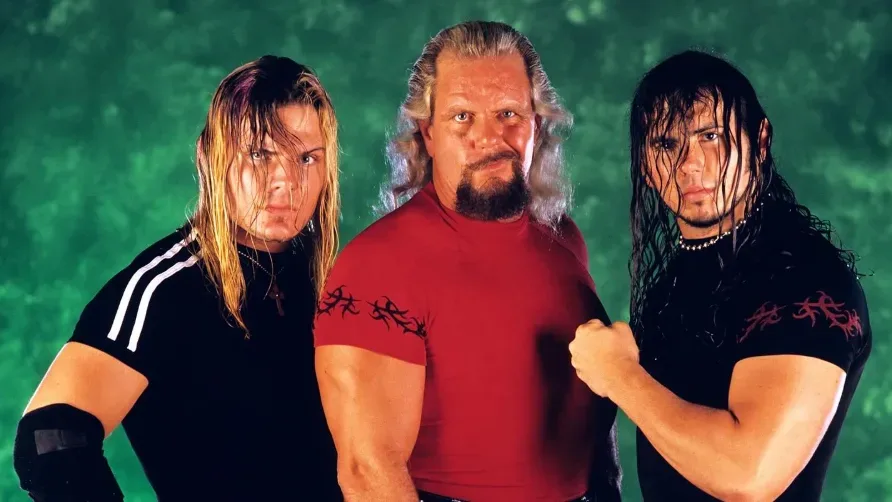
Michael P.S. Hayes has reflected on one of the earliest WWE chapters in the careers of Matt and Jeff Hardy, admitting that being separated from the brothers in 1999 was an emotional disappointment for him.
Before they became synonymous with ladder matches, tag team innovation and a career-long connection with WWE audiences, The Hardys were paired with Hayes on television. The veteran performer and current WWE producer served as their manager during a formative stretch for the team, including the period in which Matt and Jeff captured their first WWF Tag Team Championship.
That alliance did not last long. Hayes was removed from the group in August 1999, and the eventual direction of The Hardys took them away from his on-screen guidance. Speaking with Stephanie McMahon on What’s Your Story? With Steph McMahon, Hayes described how deeply he had bought into the act and why the decision to end it was so difficult for him to accept.
“Then The Hardys thing didn’t pan out,” Hayes said. “It was funny. Once they dropped the titles, I was specifically told and produced to tell them they’re going back to the starting box and going back to foundation and you’re beginning at the beginning and you would start over and earn it and be a real tyrant, and then Vince (McMahon) goes, ‘God! He can’t be like that to those kids. They should beat him up. Why is he being so mean? Nobody would listen to that. No, get him away from them,’ and then when he told me that, it broke my heart. I was invested and I did what you told me to do…”
For more background on this topic, read The Miz Recalls Fearing He Had Gone Too Far During His Defining Talking Smack Clash With Daniel Bryan.
Hayes Was Following the Assigned Direction
Hayes’ recollection centers on the contrast between the role he says he was asked to play and the reaction to that role after it was presented. In his telling, the original plan following The Hardys’ title loss was for him to take a more demanding approach with Matt and Jeff. The message was meant to be that they had to return to the basics, start again, and earn their way back into contention.
It was a natural framework for a wrestling manager character. A manager who becomes harsher after a setback can create tension with the team he represents, giving the audience a reason to sympathize with the wrestlers and potentially setting up a split. Hayes said he was instructed to be “a real tyrant” in communicating that tougher message.
However, Hayes recalled Vince McMahon deciding that the character’s treatment of the young Hardys was too severe. Rather than continuing with the manager pushing his team to rebuild, the direction changed toward The Hardys standing up to Hayes and removing him from their act.
The important part of Hayes’ account is that he did not view the switch simply as another routine creative adjustment. He said he had become invested in Matt and Jeff as performers and in the presentation they were building together. That made the instruction to get him away from the team feel personal, even while it remained a decision made for television.
An Early Part of The Hardys’ WWE Story
The 1999 pairing occupies a distinct place in the history of The Hardys. Matt and Jeff would ultimately become one of the defining tag teams of their generation, with their shared body of work extending far beyond this first WWF run. But the Hayes association came at a point when they were still establishing their identities before the worldwide wrestling audience.
Having an experienced figure like Hayes beside them gave the team an immediate connection to a recognizable personality. Hayes brought extensive experience as a performer, manager and creative presence, while Matt and Jeff brought a youthful energy that quickly distinguished them. Their first WWF Tag Team Championship represented a notable early milestone and demonstrated that WWE saw value in the duo.
At the same time, the business regularly changes acts as performers develop and creative plans evolve. A championship loss can become the foundation for a new storyline, a character shift or an entirely different presentation. Hayes’ comments offer a look at how quickly a planned direction can be revised, including for someone who had been given specific instructions on how to execute a segment or storyline.
His memory also underscores the difference between playing an antagonistic character and feeling antagonism toward the people involved. Hayes said he was doing what he had been told to do. The reaction he described from McMahon was based on the on-screen perception of Hayes being too hard on “those kids,” which in turn led to the decision that The Hardys should beat him up and move forward without him.
Respect Has Remained Between Hayes and The Hardys
There is no indication in Hayes’ comments that his disappointment became a lasting issue between him and Matt or Jeff. On the contrary, the relationship has been publicly framed with appreciation. Matt Hardy has written on social media that he and Jeff will always be grateful to Hayes.
That gratitude matters when considering Hayes’ reflection. He was not discussing an act that failed to leave a mark or performers he felt detached from. He was discussing a partnership that he believed in, one that helped form part of the early platform for two wrestlers who would go on to become enormously influential figures in tag team wrestling.
For Hayes, the heartbreak appears to have been tied to losing the chance to keep contributing to that journey from the ringside role he held at the time. Wrestling storytelling frequently requires performers to pivot without much warning, especially when decision-makers believe an audience response calls for a different route. Hayes’ story is a reminder that those pivots can still carry real emotional weight for the people executing them.
The Hardys’ later accomplishments do not change the significance of the moment Hayes recalled. If anything, their eventual stature adds perspective to why he was so invested. The pair’s potential was apparent enough that their direction mattered, and Hayes clearly felt that he had a meaningful role in helping them progress during that early championship period.
A Candid Look at WWE’s Creative Process
Hayes’ account is also a concise example of the fluid nature of WWE creative. The direction he described was not presented as a broad, long-term idea that he independently interpreted. He said he was specifically produced to deliver a certain message to Matt and Jeff after they dropped the titles. Then, after that portrayal was seen in action, the thinking changed.
That kind of shift can be especially jarring for talent. A wrestler or manager may prepare to portray a character in a particular way, only to learn that the desired audience reaction or internal assessment has altered the plan. In this case, Hayes said the answer was not to modify his approach while staying paired with The Hardys. It was to remove him from the act altogether.
Still, Hayes’ words are not just about a lost television role. They are about pride in the performers he represented. His assertion that he was “invested” sums up why the separation stood out to him decades later. He saw Matt and Jeff as more than names assigned to a manager; he saw young talent whose success mattered to him.
The Hardys’ public appreciation for Hayes offers the other side of that history. Even though the pairing ended in August 1999, the respect appears to have endured. For a team whose career has included so many memorable chapters, Hayes remains connected to an important early one: the first WWF Tag Team Championship reign and the period when he helped introduce their potential to a larger audience.
Hayes may have been removed from their corner, but his memories make clear that he never viewed the partnership as insignificant. The storyline changed, The Hardys moved into the next stage of their WWE development, and Hayes continued his own long career in the company. Yet the disappointment of that specific split has remained with him, because of how strongly he believed in the team standing beside him.

Darryl Polo
Darryl Polo is a passionate wrestling fan covering WWE, AEW, TNA and beyond. He loves great rivalries, breakout stars and the moments that keep fans talking long after the bell. How we work.