
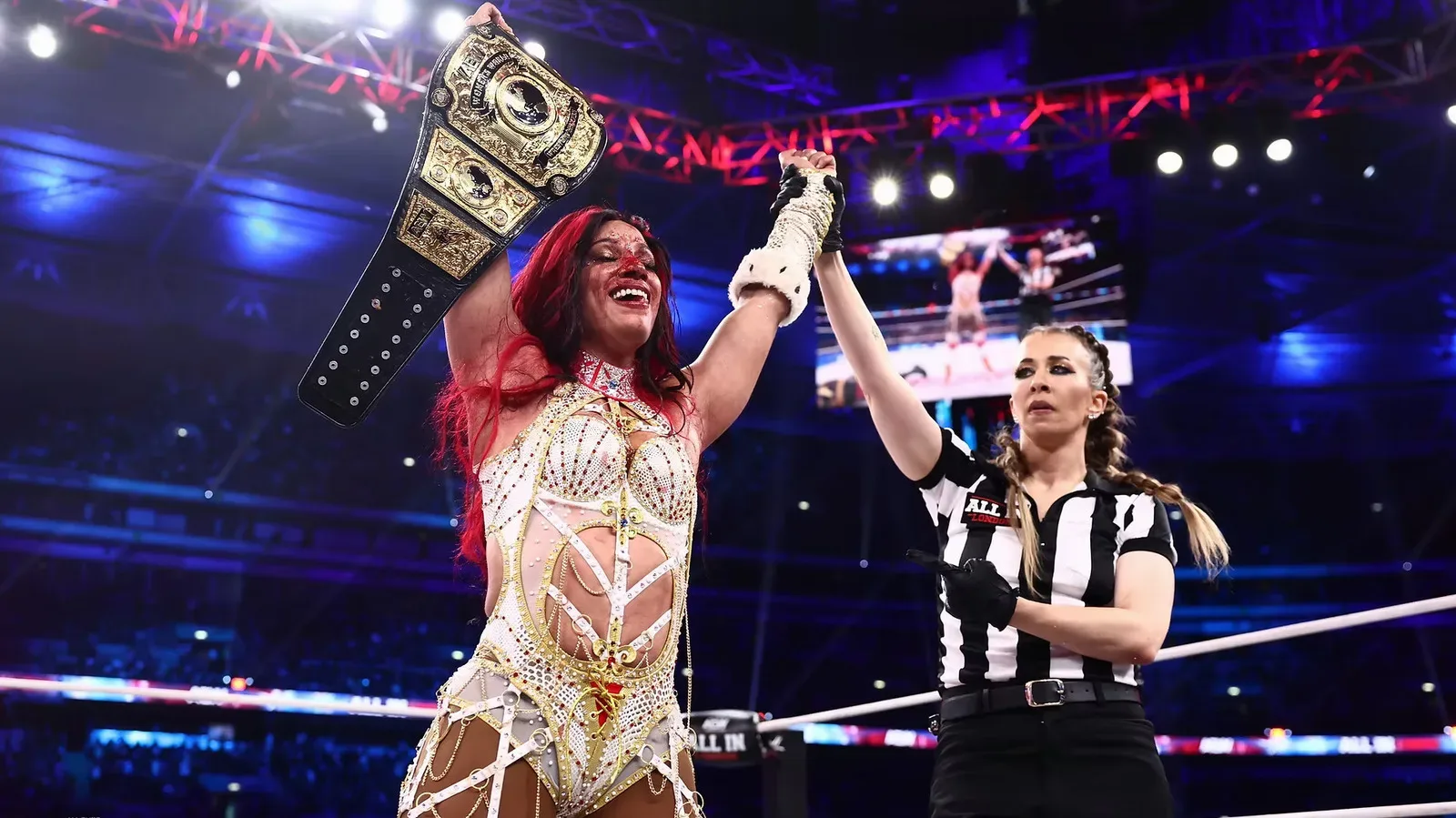
Mercedes Moné has looked back on winning the AEW Women’s World Championship at Wembley Stadium, calling the accomplishment one of the most meaningful moments of her career and tying it directly to a period of uncertainty she experienced three years earlier.
In a new edition of MoneMag, Moné reflected on the path that brought her to AEW’s All In event, where she defeated Willow Nightingale to capture the company’s top women’s championship. For Moné, the victory was not simply another major title win. It represented a full-circle return to the same building where she once watched AEW from the crowd without knowing where her own future in professional wrestling would lead.
“Winning the AEW Women’s World Championship meant everything to me,” Moné wrote. “Three years earlier, I had been sitting at All In as a fan, unsure of where I stood in wrestling or where my career was going next. I didn’t have all the answers, but I remember watching AEW that night and knowing in my heart that it was the place for me.”
That recollection adds another layer to Moné’s championship moment at Wembley. All In has become one of the biggest stages in modern professional wrestling, but the stadium also holds a very personal place in Moné’s AEW story. She attended the event as a spectator at a time when her next move was unclear. Returning to that environment three years later as a featured performer, and leaving as AEW Women’s World Champion, was the kind of outcome she said she never could have predicted.
For more background on this topic, read FTR vs. Motor City Machine Guns Best-of-Five Finale Set for AEW Dynamite/Collision.
“To return to Wembley three years later and become the Women’s World Champion was something I could never have imagined unfolding quite that way,” Moné said.
A Wembley Moment Built Around Willow Nightingale
Moné also made clear that Nightingale was the opponent she wanted for such a historic setting. Their rivalry had already carried considerable history before they met for the AEW Women’s World Championship, and Wembley gave them an opportunity to add another defining chapter to it.
Their previous meeting for the NJPW STRONG Women’s Championship was marked by an unfortunate injury for Moné, who broke her heel during that match. The All In championship bout presented another difficult physical test. Moné revealed that she broke her nose in the Wembley match, while stating that both she and Nightingale were dealing with injuries as they competed.
Rather than allowing those circumstances to define the match, Moné emphasized the way both wrestlers continued through the pain. Her assessment was that they produced a clash worthy of the occasion, an important distinction given the setting, the title at stake, and the deeply personal history between the two competitors.
“The only person” she wanted to face and make history with at All In was Nightingale, Moné explained. That sentiment speaks to the significance Moné places on their work together, even with the difficult memories attached to their past encounters. Their rivalry has involved championship stakes, physical setbacks, and major career moments, making Nightingale a natural opponent for Moné’s pursuit of AEW’s premier women’s prize.
From Uncertainty to the AEW Women’s World Championship
Moné’s reflection centered on the contrast between two versions of herself at Wembley Stadium: the fan in the stands wondering what came next, and the champion standing in the ring with the AEW Women’s World Championship in hand.
Professional wrestling careers rarely move in a straight line, and Moné acknowledged that the years preceding her AEW title win had been turbulent. She did not present the Wembley triumph as something inevitable. Instead, she described it as a moment that carried weight because of the questions she had once faced and the time it took to reach that point.
That perspective is especially notable because Moné has already achieved a great deal across her career. Major championships and landmark matches have been part of her résumé, but the AEW Women’s World Championship victory resonated differently due to the timing and location. It was a career milestone connected not only to what happened in the ring, but to the uncertainty that existed when she first saw All In from the audience.
“When I finally held that championship, I thought about the woman who had sat in that same building three years before, wondering what her future would look like,” Moné wrote. “I wish I could go back and tell her what was waiting.”
The image is a powerful one: a wrestler attending a major event as a fan, considering the next chapter of her professional life, before later returning to headline the women’s division and win its world title. It is the kind of personal connection that can make a championship win feel larger than a result on a card.
For AEW, Moné’s recollection also underlines the value of All In as a stage for career-defining moments. Wembley is not merely another venue on the schedule. Its scale, audience, and atmosphere make it a place where championship victories can take on a lasting emotional identity. Moné’s experience demonstrates that the importance of the setting was felt long before she entered the ring as a title challenger.
Fighting Through the Physical Toll
The physical reality of the championship match remains an essential part of Moné’s story. Breaking her nose against Nightingale was a painful reminder of the danger and unpredictability that comes with wrestling at the highest level. It also echoed her prior match with Nightingale for the NJPW STRONG Women’s Championship, when Moné suffered the broken heel that became a major turning point in her career.
Those incidents do not make the two matches identical, but they do form a striking connection between them. Nightingale and Moné have now shared the ring in bouts remembered not only for their championship implications, but for the adversity surrounding them. Moné’s comments suggest she sees the Wembley match as a testament to both women’s willingness to endure difficult circumstances in pursuit of a memorable performance.
It is important that Moné credited the shared effort. Her reflection was not limited to celebrating the title change or her own ability to persevere. She spoke about both competitors being hurt and pushing forward, framing the contest as a collective effort to deliver on one of AEW’s biggest nights.
That acknowledgement is consistent with the importance Moné placed on having Nightingale as her opponent. The title win was her individual achievement, but the match required another wrestler capable of meeting the moment with her. In Moné’s telling, Nightingale was integral to making the occasion historic.
Backstage Recognition After the Win
Moné’s memories of the night did not end when the match was over. She said the reaction from her peers backstage was one of the elements that affected her most after winning the AEW Women’s World Championship.
Following the victory, Moné was celebrated and applauded by colleagues, with many offering congratulations for the performance she and Nightingale had delivered. The backstage response clearly added to the emotion of the night, giving Moné validation not only as a new champion, but as a performer who had taken part in a major match while dealing with a legitimate injury.
Recognition from fellow wrestlers can carry a unique significance in an industry built around demanding travel, intense physicality, and the pressure of performing before massive audiences. Moné’s recollection of that support indicates that the performance itself mattered as much to her peers as the championship outcome did.
For Moné, the Wembley victory now stands as a landmark with several meanings at once. It was a world title win. It was a major match against a rival she specifically wanted to face. It was a test of endurance after breaking her nose in the ring. And it was a full-circle return to the venue where she had once watched AEW while uncertain about her own direction.
Those elements explain why Moné described the AEW Women’s World Championship as meaning everything to her. The title represented the destination, but her reflection made clear that the journey is what gave the moment its lasting power. Three years after sitting in the crowd and imagining what might be possible, Moné stood at Wembley as champion, surrounded by the consequences of a match she and Willow Nightingale had fought through together.
In pictures

Darryl Polo
Darryl Polo is a passionate wrestling fan covering WWE, AEW, TNA and beyond. He loves great rivalries, breakout stars and the moments that keep fans talking long after the bell. How we work.