
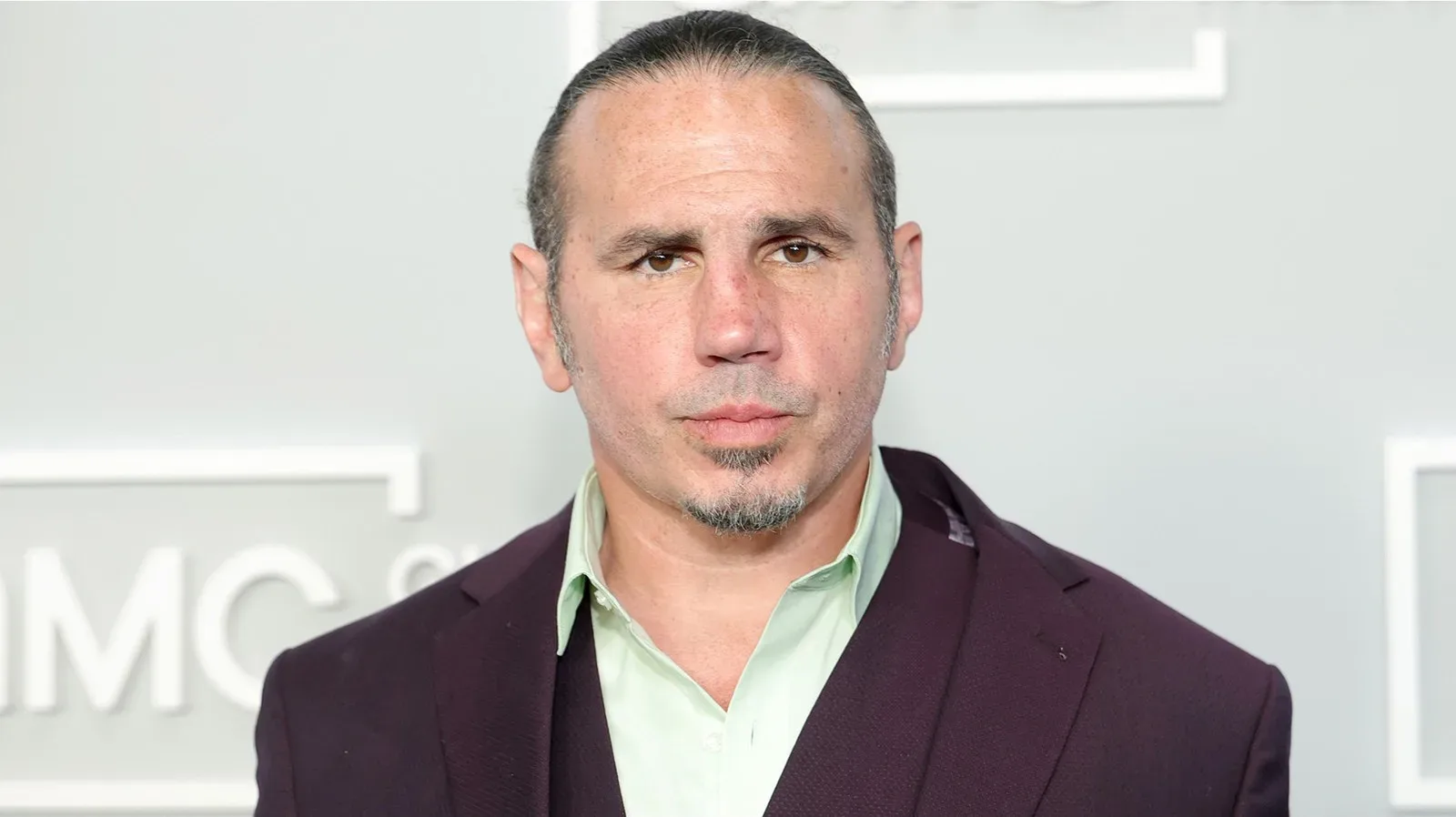
Matt Hardy has spent much of his career taking the kind of bumps that can make a wrestling crowd go quiet. Looking back at one of his most frightening incidents in AEW, however, Hardy said the decision that still stands out came after the fall. He recalled being knocked out when a spear from Sammy Guevara carried the two wrestlers past a set of tables, then waking up confused and finding that the match had not been stopped.
Speaking on The Extreme Life of Matt Hardy, Hardy said he was frustrated in the immediate aftermath. He now sees the incident as a lesson for AEW and Tony Khan, specifically about whether a match should continue after a wrestler takes a hit like the one he described. Hardy did not argue that every dangerous-looking spot has to be taken out of wrestling. His point was that once this one went wrong, finishing the match should no longer have been the priority.
Hardy recalls going past the tables and losing consciousness
The spot called for Guevara to spear Hardy through the tables. As Hardy remembered it, the two went past them instead. What remained clearest to him was the distinction between how he looked and what had actually happened to him. He did not have an open wound on his head, he said, but he had lost consciousness.
“I didn't bust my head open, but I did get my bell rung and get knocked out,” Hardy said.
For more background on this topic, read AEW’s Kasper Brothers Push Back on Criticism of the Kasper Cannonball.
Hardy described suffering a concussion and said he was confused when he woke up. That was central to his account of the match continuing. He wasn't looking back at a bump that simply hurt more than he expected. He was describing a period after the impact in which, by his own recollection, he was not fully oriented. His frustration over the match not being stopped came with that confusion still fresh.
Hardy and his brother Jeff have both built reputations around taking risks, but Matt did not bring up the incident to rank it alongside the most spectacular falls of his career. He gave relatively little attention to how the spear looked and much more to what he remembers after it. The detail he kept coming back to was that the fall had already gone wrong and there was still a match to finish.
Hardy says he was checked before the match continued
Hardy did not say that he went back to wrestling without being examined. He recalled that a doctor checked on him and that he demonstrated he could count to five. In Hardy's telling, the doctor then allowed him to continue. The counting is the detail Hardy singled out from that interaction; his recollection does not establish what else the doctor may have assessed or what information went into the decision.
There is an important difference between Hardy saying no one checked on him and Hardy saying the match should have ended despite the check he remembers. His criticism was the latter. He could recall answering the doctor and still describe himself as confused in the aftermath of the fall. For Hardy, the fact that he was able to carry on didn't make continuing the right decision.
“I think it was a good learning point for AEW and Tony Khan there, because I think they realized we probably should've stopped stuff there as opposed to continuing to wrestle,” Hardy said.
Hardy framed that as his view of what AEW and Khan took from the experience. He did not identify a formal policy change or say that Khan personally made the decision to resume the match. What he did offer was a clear answer about the choice itself: looking back, he believes stopping would have been better than sending him back to wrestle.
Hardy draws a distinction between taking a risk and finishing the match
Hardy was also careful not to present the accident as evidence that wrestlers should never attempt a high-risk spot. He described those choices as calculated risks and acknowledged that even when wrestlers plan for a particular outcome, things can go wrong. In the same discussion in which he questioned why the match continued, he accepted that the possibility of a bad landing is part of the work he has chosen to do.
Those two positions are compatible. Before the spear, the question was whether the wrestlers could execute the spot they intended. After they missed the tables and Hardy says he lost consciousness, the question was whether he should keep wrestling at all. Hardy’s willingness to take the first risk does not mean he endorses the second decision. He can accept his part in agreeing to the spot while still believing the match should have been called off when it went wrong.
Hardy sounded relieved rather than satisfied with how it ended. “I'm just lucky it wasn't worse,” he said. That is different from saying the match continuing proved he was all right. In Hardy’s account, he got through the rest of the match, but getting through it did not erase the knockout or the confusion he remembers when he came around.
Guevara, meanwhile, has been absent from AEW television. Former AEW world champion Chris Jericho recently said he would like to see Guevara on the product more often. Jericho's comments concerned Guevara's present-day visibility, while Hardy's podcast discussion looked back at one specific match and the decision made after its most alarming moment. Hardy directed his main criticism at the continuation of the match, not at whether Guevara belongs on AEW programming.
The incident stands out in Hardy's telling because the move itself was only the beginning of the problem. The tables did not break the fall as intended, Hardy says he was knocked out, and the match went on after he was checked. His assessment years removed from the confusion is straightforward: a wrestler can accept that a calculated risk went wrong and still expect the people overseeing the match to stop it. That's the lesson Hardy believes AEW and Khan took from the night, and the decision he would change if he could go back.
In pictures

Darryl Polo
Darryl Polo is a passionate wrestling fan covering WWE, AEW, TNA and beyond. He loves great rivalries, breakout stars and the moments that keep fans talking long after the bell. How we work.