
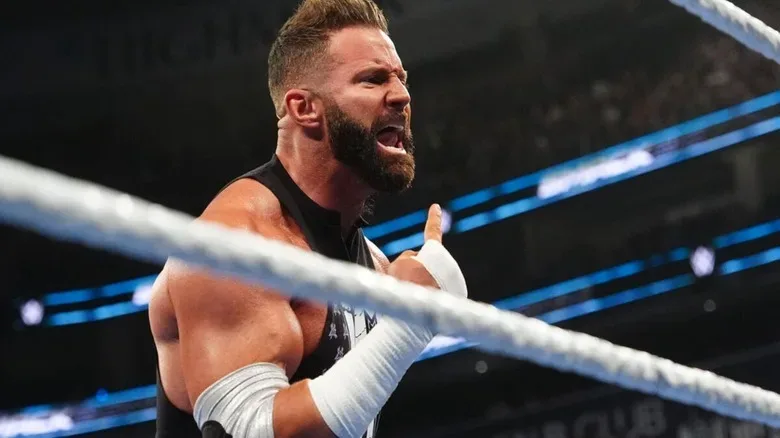
Matt Cardona has offered a blunt assessment of how wrestlers should approach their careers when they are struggling to connect with an audience: take responsibility, find a different avenue, and make something happen.
In a social media post, Cardona wrote, “If you’re a pro wrestler and you’re not over. It’s your fault. Find a way. Create your own path.” The message was accompanied by a clip from his discussion with comedian Chris Distefano, where Cardona looked back on the period that changed the direction of his career: the creation of Z! True Long Island Story in 2011.
At that point, Cardona was working in WWE as Zack Ryder. He was unhappy with his place on the card and believed that waiting for a bigger opportunity was not enough. Rather than relying entirely on television time or a creative change from WWE, he used a flip camera and YouTube to give fans a more direct look at his personality.
View the referenced post on X
The approach proved pivotal. Z! True Long Island Story helped Ryder form a connection with viewers beyond the brief matches and segments he was receiving on WWE programming. It also became an early example of a wrestler using online video and social media as a tool to build momentum independently while still signed to a major promotion.
For more background on this topic, read Jim Johnston Criticizes WWE’s Reliance on Ethnic Stereotypes in Entrance Theme Direction.
Cardona recalls wanting more from his WWE position
Speaking about the beginnings of the show, Cardona explained that he was dissatisfied with where he stood in WWE in 2011. His issue was not simply a lack of exposure; it was the difficulty of asking fans to invest emotionally in a wrestler who was frequently being beaten quickly on television.
“Back in the day, 2011, I was in WWE, but I didn’t like my spot in the card. I wanted to be a bigger superstar, and I knew there was a way to do that. This is like the infancy of social media and stuff like that. There was WWE YouTube shows, but nobody was doing it themselves.”
That distinction was central to his thinking. WWE had established digital content, but Cardona saw a chance to make material that felt more personal and self-directed. He did not need a major production operation to start. He had a flip camera, an idea, and a belief that reaching viewers outside WWE television could reshape how they viewed Zack Ryder.
“I had a flip camera, and I was like, ‘The only way to get over is to have a connection with them.’ They’re watching me get killed in three minutes, they’re not gonna cheer for this guy.”
Cardona’s point speaks to a longstanding challenge in wrestling. Match wins and losses, television positioning, character presentation, and promo time can all influence crowd reactions. But performers have often tried to find ways to create an audience investment that is not limited to what happens in a short televised match. For Cardona, the answer was to let fans see more of the person behind the on-screen character.
Z! True Long Island Story created a different connection
Cardona launched Z! True Long Island Story as a YouTube series that gave Ryder a voice outside his usual WWE appearances. The concept allowed him to blend elements of his real personality as Matt Cardona with the Zack Ryder persona fans saw on television. That was not accidental. He viewed audience connection as the foundation for changing his career trajectory.
“So I started this YouTube show, Z! True Long Island Story, to let them in, and kind of blended who Matt Cardona was with Zack Ryder. Cause I knew the audience connection was the most important thing.”
By opening up that space, Cardona gave viewers a reason to follow his work even when WWE programming was not presenting him as a top attraction. The series gave him a platform to develop recurring ideas and communicate directly with fans. More importantly, it made the audience feel involved in his rise rather than simply watching a wrestler attempt to climb the card from a distance.
Cardona said he felt that a stronger connection was likely to come eventually, but he was in a position to recognize social media’s potential early and put it to use. Platforms that now seem routine for wrestlers were still developing as tools for self-promotion at the time. Instagram had not yet become part of the landscape he was describing, but he was already active on Facebook and YouTube in his personal life.
“It was gonna happen eventually. But I was just, I guess, young enough to be using it in my real life. Like, I had a Facebook. I had a, this was before Instagram, but I was on YouTube. Why don’t I just use this as Zack Ryder as well?”
That question ultimately led to the creation of the series and became a key part of Cardona’s identity as a performer. It was not merely promotional content attached to his wrestling career. It was a deliberate effort to change the relationship between the character and the audience.
A message aimed at wrestlers seeking momentum
Cardona’s current post condenses that experience into a broader piece of advice for wrestlers: do not wait passively for a situation to improve. His wording is intentionally forceful. Saying it is a wrestler’s fault if they are not over is not a claim that every performer has identical resources, exposure, or creative freedom. Instead, his own story illustrates the philosophy behind the statement. When he believed his WWE role was not showing fans what he could offer, he looked for a format he could control.
His path in 2011 was YouTube. The broader lesson is adaptability. Wrestlers have more ways to communicate with fans than they did during the early days of Z! True Long Island Story, but that also means standing out requires a clear identity and a reason for viewers to care. A social post on its own does not create a following. Cardona’s example was built around consistent, character-driven content that added something fans were not getting from his television appearances.
The phrase “create your own path” is especially fitting in light of how Cardona framed his original decision. He did not describe waiting for WWE to launch a new show around him or simply asking for a different spot. He recognized that the available platforms could be used by the Zack Ryder character, then moved to make that happen himself.
The lasting significance of Cardona’s 2011 approach
Cardona’s comments arrive in an era when a wrestler’s public presence extends far beyond weekly wrestling television. Social media, video platforms, streaming, and direct fan engagement are now common parts of a performer’s career. Yet the value of Cardona’s recollection is in how early the idea was applied to his circumstances. In 2011, he identified a gap between the version of Zack Ryder people were seeing on WWE television and the version of the performer he wanted them to know.
Rather than treating that gap as a permanent limitation, he turned it into the premise of his own content. The fans who found Z! True Long Island Story were offered an invitation into the character’s world, and that invitation helped increase Ryder’s popularity. It demonstrated that a wrestler could use a platform outside the traditional show format to give an audience additional context, personality, and investment.
That remains the core of Cardona’s argument today. Being “over” is about connection, and connection requires a performer to give the public something memorable to latch onto. The format may change depending on the wrestler and the era, but the responsibility to search for that connection is what Cardona is emphasizing.
For Cardona, the flip camera was not a minor detail from an earlier internet era. It represented the first practical tool available to him when he decided he wanted to be more than a wrestler receiving brief losses on television. He used it to make Z! True Long Island Story, to merge Matt Cardona with Zack Ryder, and to invite fans to become part of the journey.
His latest message makes clear that he still sees that choice as the defining lesson. Wrestlers who want more from their careers, in Cardona’s view, should not settle for the boundaries of their current role. They should identify what makes them distinctive, build a connection with an audience, and make their own opportunity.

Darryl Polo
Darryl Polo is a passionate wrestling fan covering WWE, AEW, TNA and beyond. He loves great rivalries, breakout stars and the moments that keep fans talking long after the bell. How we work.