
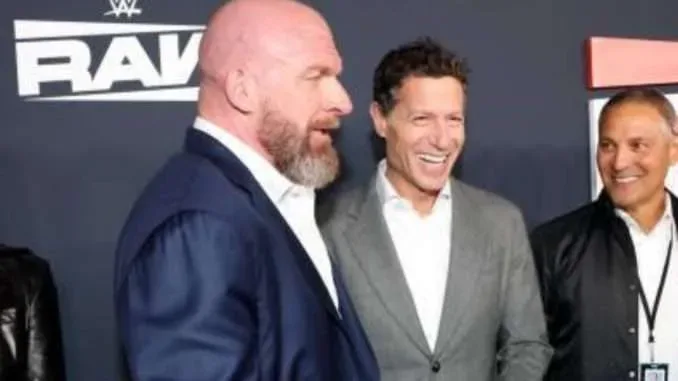
TKO President Mark Shapiro addressed WWE’s live-event business and recent major-show ticket performance during the company’s third-quarter 2026 media call, pushing back on the suggestion that WWE’s ticket sales are broadly trending downward.
TKO released its third-quarter 2026 financial results on Wednesday, with WWE revenue listed as down 1 percent for the period. The company cited a reduced number of main-roster premium live events and lower SummerSlam sales as factors in the slight year-over-year decline.
During the call, Shapiro was asked about lower sales connected to SummerSlam and WrestleMania. His answer focused on the wider set of priorities that guide WWE’s decisions, rather than looking strictly at the immediate profitability of any individual event or venue choice.
“We don’t make all of our decisions on just maximizing our profitability,” Shapiro said. “It’s about what’s best for our fans, our brand, our audience, viewership, and our media partners.”
For more background on this topic, read George Barrios Recalls His First Meetings and Working Relationship With Vince McMahon.
Shapiro’s comments offer an important look at how TKO is framing WWE’s business strategy as the company continues to place an increasing emphasis on premium live events, major stadium presentations and the value of its media relationships. A 1 percent drop in quarterly WWE revenue is modest in isolation, but the reasons cited by the company underline how heavily a quarterly comparison can be shaped by the event calendar.
WWE’s premium live event schedule does not necessarily provide the same number of main-roster shows in every three-month period. As a result, the presence or absence of a major event can affect revenue totals without automatically reflecting a major change in consumer demand. In this case, TKO specifically pointed to fewer main-roster PLEs, along with lower SummerSlam sales, when explaining the quarter’s result.
Shapiro Rejects Broad Ticket-Sales Narrative
While responding to the question, Shapiro characterized the broader idea that WWE ticket sales are down as “ghosts.” The phrasing made clear that he does not view concerns around select event sales as evidence of a larger weakness in WWE’s live business.
That distinction is significant. A major wrestling event is not sold in a vacuum. Venue size, market, local timing, ticket inventory, the number of available premium seats and the company’s long-term relationship with a city can all affect the sales picture. WWE’s decision-making process, as described by Shapiro, is built around those larger considerations.
Rather than suggesting that every major event must be held in the largest available market or in the venue with the most immediate revenue potential, Shapiro emphasized the value of returning to different regions. He specifically pointed to the Midwest and Minnesota as examples of markets WWE sees as important to its overall business.
“Going back to the midwest is important to us, and Minnesota is a strong market and it performed extremely well in the stadium,” Shapiro said. “We’re proud of that.”
The reference to Minnesota reflects a broader philosophy for WWE’s touring model. Stadium events create a major visual spectacle and offer the potential for substantial gate revenue, but the company’s goals are not limited to a single box-office number. Returning to markets outside the most frequently visited major hubs can help maintain WWE’s national presence, serve regional fan bases and support the value that its media partners derive from having programming and events reach audiences across the country.
Shapiro also placed viewership and audience engagement alongside ticket sales in explaining WWE’s approach. For a company operating across weekly television, premium live events, digital platforms, licensing and sponsorship, that wider view is central to assessing the health of the brand.
Quarterly Results Can Be Driven by Calendar Differences
The third-quarter figure should be considered in the context provided by TKO: WWE revenue was down 1 percent, with fewer main-roster premium live events and lower SummerSlam sales cited as the reasons. The company did not present the decrease as a sweeping reversal in WWE’s business momentum.
Premium live events are among WWE’s highest-profile offerings, and their placement on the calendar can have an outsized impact on quarterly financial comparisons. Fewer events naturally mean fewer opportunities for ticket revenue, hospitality, sponsorship activation and other event-related business during that particular period. That does not, by itself, settle questions about the overall strength of fan interest.
SummerSlam is traditionally one of WWE’s biggest annual shows, so its performance is closely watched. Still, Shapiro’s response indicates that TKO is evaluating the event through more than a narrow sales lens. The company is considering the long-term health of WWE’s audience, the identity of the brand, its distribution partners and the importance of serving particular markets.
That approach is consistent with the reality that WWE’s largest events are both entertainment products and major media properties. The value of a stadium show can extend beyond the tickets sold for one night. It can produce content for television and streaming partners, generate broad promotional attention and strengthen WWE’s relationship with a region that may host future programming or events.
None of that eliminates the importance of revenue. TKO is a publicly traded company, and its quarterly reports provide investors with a direct measure of business performance. But Shapiro’s message was that revenue maximization at every individual decision point is not the only standard WWE uses when selecting markets and planning its live-event schedule.
Fan Experience and Media Value Remain Central
Shapiro’s list of priorities was notable because it placed fans first, followed by the WWE brand, the audience, viewership and media partners. Each category can overlap, but they are not identical.
For fans, market selection can determine whether a major WWE event feels accessible. For the brand, returning to different regions can reinforce WWE’s position as a national touring property. For the audience and viewership, a major event’s impact can be measured by the attention it generates beyond the building. And for media partners, WWE’s ability to deliver consistent interest around its biggest programming remains a key part of the relationship.
The comments also arrive at a time when WWE’s business is frequently examined through the scale of its largest events. Stadium shows, international premium live events and high-profile media arrangements naturally bring more scrutiny to attendance, ticket prices and sales patterns. Shapiro’s response did not deny that SummerSlam sales were lower, as that was part of the explanation included in TKO’s results. Instead, he argued against treating that fact as proof of a general downturn.
That is an important difference in the company’s messaging. There can be an event-specific result that comes in below a previous benchmark while the wider business remains stable or strong. TKO’s own description of the quarter tied the 1 percent WWE revenue decline to identifiable scheduling and event factors, rather than presenting it as a collapse in demand.
“Business Is Good at WWE”
Shapiro closed his remarks with an upbeat assessment of WWE’s current condition.
“Engagement is strong, viewership is strong, and business is good at WWE,” Shapiro said.
The statement is a concise summary of TKO’s position following the third-quarter report. WWE experienced a small revenue decrease in the quarter, but the company believes the underlying indicators it considers most important remain positive.
For WWE, the next major financial discussions will continue to be shaped by how its premium live event calendar is structured, how individual stadium shows perform and how the company translates audience attention into broader media and commercial value. The company’s leadership has made clear that it will not judge every market choice solely by the largest possible immediate return.
Shapiro’s remarks do not change the reported third-quarter number: WWE revenue was down 1 percent, with fewer main-roster PLEs and lower SummerSlam sales named as contributing factors. What they do provide is TKO’s interpretation of that result. The company sees its WWE strategy as a long-term balancing act, one that includes profitability but also extends to fan access, market presence, viewership, brand strength and media-partner value.
That wider framework will remain relevant whenever WWE brings a premium live event to a market that may not appear, at first glance, to be the most obvious choice for maximum ticket revenue. From Shapiro’s perspective, the measure of success is not confined to one gate or one quarter.

Darryl Polo
Darryl Polo is a passionate wrestling fan covering WWE, AEW, TNA and beyond. He loves great rivalries, breakout stars and the moments that keep fans talking long after the bell. How we work.