
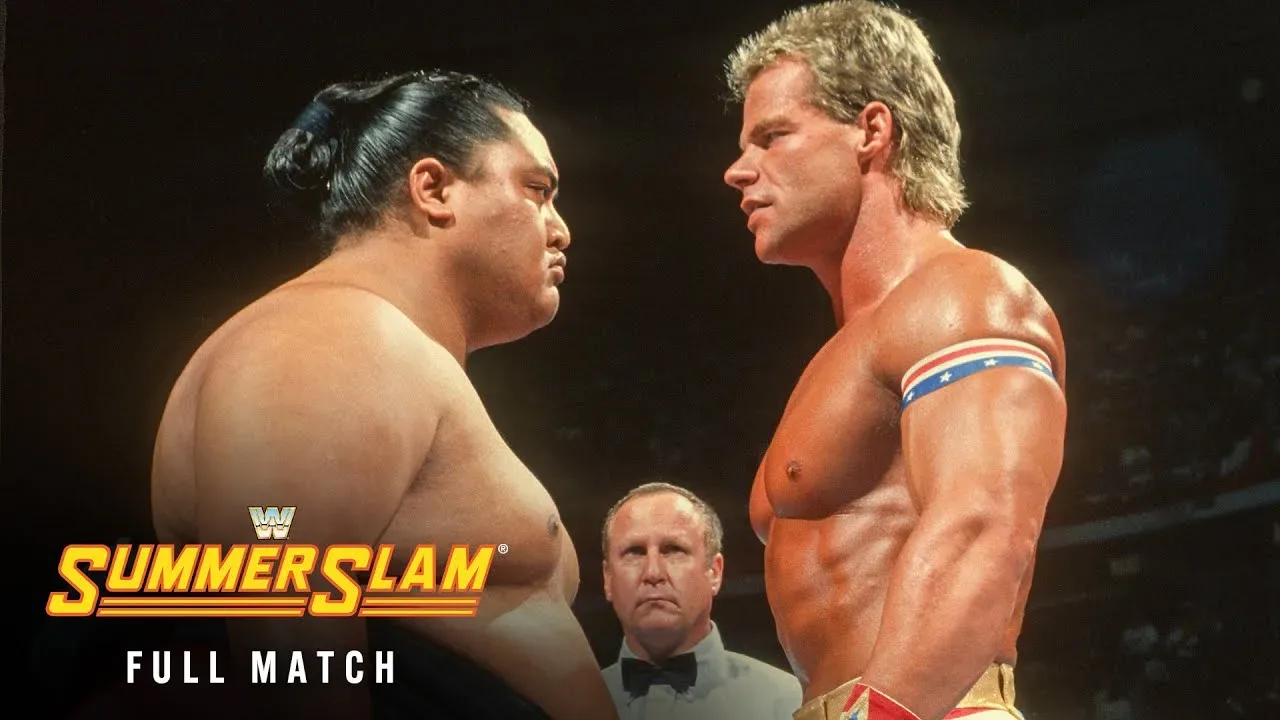
Lex Luger built much of his reputation around extraordinary displays of strength, but one opponent remained the major exception when it came to his signature Torture Rack: Yokozuna.
During a recent appearance on Going Ringside, Luger discussed the possibility of attempting the move on Yokozuna during their early-1990s WWE rivalry. The former WWE Champion said the idea was considered, but the practical challenge of getting Yokozuna into position made it far more complicated than simply trying to lift a large opponent from the mat.
“We thought of trying to, if we could get him up on somehow on the top apron and I can get underneath him. Could I walk him out? He’s the only guy I didn’t try the rack on. Yoko’s so agile. He was unbelievable. You could have got a spot where you kick him and kick him. He could have ended up in the top turnbuckle. He was amazing.”
Luger’s comments offer a look at the planning behind a moment that never made it into their matches. The Torture Rack was not merely a lift. For Luger to apply it, an opponent had to be elevated across his shoulders in a position that allowed him to stand, stabilize the wrestler’s weight and present the hold clearly to the audience. With Yokozuna’s size, the setup itself was the central obstacle.
For more background on this topic, read Lex Luger Reveals Airport Fall Nearly Changed His WWE Hall Of Fame Induction Moment.
The proposed answer, Luger explained, was to use the ring apron as a possible launching point. If Yokozuna could be positioned high enough for Luger to get underneath him, Luger wondered whether he could then walk him out and establish the hold. It was an ambitious concept, and one that illustrates the degree of thought performers can put into making a physical spectacle appear natural within a match.
Yokozuna’s Athleticism Stood Out To Luger
While Yokozuna was presented as an imposing powerhouse, Luger emphasized that his former rival was much more agile than his size may have suggested. Luger described him as “unbelievable” and pointed to the possibility of working sequences in which Yokozuna could be rocked by strikes and wind up in the corner.
That observation is especially important in the context of the discussed Torture Rack attempt. A wrestler’s size is only one factor in creating a major power spot. Timing, balance, mobility and the ability to get into a safe and believable position all matter. Luger’s recollection suggests Yokozuna’s movement and ring awareness could have helped create an opening, even if completing the lift remained an enormous challenge.
Still, Luger ultimately never attempted the Torture Rack on Yokozuna. He said Yokozuna was the only wrestler on whom he did not try the move. That distinction speaks to how demanding the maneuver could be against opponents whose body type made the initial lift particularly difficult.
Their feud was rooted in the kind of high-stakes power-versus-power presentation that made a potential Torture Rack such an appealing idea. Luger’s physique and strength were central parts of his in-ring identity, while Yokozuna’s presence gave WWE a rival who could test the limits of those traits. Even without the move being executed, the thought of Luger attempting it on Yokozuna would have fit naturally into that rivalry.
Why The Giant Was A Different Type Of Lift
Luger was also asked about applying the Torture Rack to The Giant. In contrast to the challenge Yokozuna posed, Luger said The Giant was comparatively easier to lift because of his height.
“He was actually fairly easy because he’s so tall. It’s the really short, heavy guys that are more difficult for you to really get down and time it. But… He went up pretty easy because he kind of just got under me. He laid across me. He’s a great worker.”
The explanation highlights the difference between a wrestler who is exceptionally tall and one who is shorter but carries substantial weight. In Luger’s view, height could make it easier to get into the correct position underneath an opponent. A shorter, heavier wrestler, by comparison, could create a more difficult timing and leverage issue because the person delivering the move had to get lower and find a secure way to raise them.
Luger also credited The Giant for understanding how to assist the flow of the maneuver. Saying that The Giant “kind of just got under me” and “laid across me,” Luger identified the type of cooperation required for a move of that scale. Professional wrestling’s biggest strength spots depend on both performers: the wrestler delivering the move needs the power and balance to carry it off, while the opponent needs to position themselves correctly and protect both people involved.
Calling The Giant “a great worker,” Luger made clear that the successful execution was not solely a matter of physical size. The Giant’s ability to work with Luger during the move helped make the Torture Rack possible. That stands in contrast to the theoretical Yokozuna spot, where the issue was not a lack of ability on Yokozuna’s part, but the extraordinary difficulty of finding the right setup for his particular build.
The Torture Rack As A Statement Move
The Torture Rack was a natural finishing move for Luger because it communicated strength immediately. Once an opponent was stretched across his shoulders, the visual itself became the story. It allowed Luger to showcase his power without relying on a top-rope maneuver or a complicated sequence of moves.
That is why a potential Torture Rack on Yokozuna carried such appeal. The larger the opponent, the bigger the statement. A successful attempt would have represented a major escalation in a feud built around physical dominance. But the move also had to be feasible, safe and executed in a way that looked convincing. Luger’s recollection demonstrates that those considerations were part of the conversation.
His comments also underscore a useful reality about memorable wrestling moments: not every discussed idea should be attempted. Sometimes the best choice is recognizing that a spot may be too difficult to perform reliably. Other times, an idea can remain valuable simply because it reflects the stakes and imagination surrounding a rivalry, even if it never happens in front of the crowd.
In this case, Luger remembers exploring a creative route rather than forcing an impossible lift. Using the apron and a corner-based setup could potentially have given him the height and positioning needed to get Yokozuna across his shoulders. Yet the move stayed hypothetical, leaving Yokozuna as the singular opponent Luger did not try to rack.
Luger Looks Back At A Defining Era
Luger’s recollection arrives as he continues to reflect on a career defined by major opponents, high-profile feuds and power-based storytelling. His discussion of Yokozuna and The Giant is revealing because it moves beyond the finished match and into the physical logic behind the performance.
Yokozuna receives particular praise from Luger, who remembered his agility and his ability to move in ways that could surprise viewers. The Giant, meanwhile, receives credit for the skill and cooperation that made a difficult spot more manageable. Both accounts reinforce that size alone does not determine how a wrestler works in the ring.
For Luger, the Torture Rack was a defining symbol of his own strength. The fact that Yokozuna was the one opponent he never attempted it on only adds to the move’s history. The possibility was discussed, the logistics were considered, and the idea of using the apron was explored. But the moment remained a what-if from one of WWE’s most notable power rivalries.
Elsewhere in the same interview, Luger also spoke about suffering a fall one day before his WWE Hall of Fame induction.

Darryl Polo
Darryl Polo is a passionate wrestling fan covering WWE, AEW, TNA and beyond. He loves great rivalries, breakout stars and the moments that keep fans talking long after the bell. How we work.