
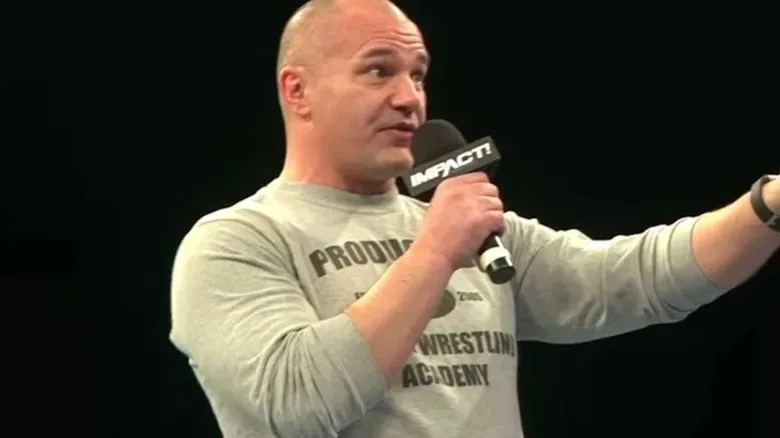
Lance Storm spent decades building a reputation as one of professional wrestling’s most technically sound and detail-oriented performers, but there is one major TNA match concept he never had to navigate as an active competitor: Ultimate X.
The Ultimate X match has long stood as one of TNA’s most recognizable creations. Rather than using ladders, competitors race across ropes suspended above the ring to reach a prize hanging at the center of the structure. The stipulation has become closely associated with the X-Division, where speed, agility, timing and a willingness to take substantial risks have often defined the action.
For Storm, the idea of entering that environment produces a mixed reaction. Speaking in a recent interview, the longtime wrestler, coach and producer admitted that he can appreciate why younger versions of himself may have wanted the challenge, while his current perspective also recognizes the physical danger involved.
“Part of me is glad I never had to, but there is a part of me, if I remember back to my 20s and 30s, I think I would have really enjoyed it.”
For more background on this topic, read Lance Storm Praises Avery Styles’ Early TNA Development.
That answer neatly captures the balance at the center of Ultimate X. The match offers a distinctive showcase for wrestlers with the athletic ability to make the suspended ropes and high-risk environment feel believable. At the same time, it is far from a routine bout. Every climb, leap and struggle for the hanging prize requires precision from the wrestlers involved, as well as extensive planning around the match’s layout and production.
Ultimate X Remains a Defining TNA Attraction
Ultimate X has maintained its importance across multiple eras of TNA because it provides something that immediately looks different from a traditional wrestling match. The ropes above the ring do not merely serve as scenery. They are the central obstacle and the path wrestlers must conquer in order to win. That visual identity has helped make the stipulation an enduring part of the promotion’s history.
The X-Division has frequently been positioned as a place where wrestlers can establish themselves through innovation, urgency and physical creativity. Ultimate X naturally amplifies those qualities. It rewards performers who can blend explosive offense with an understanding of the timing required to tell a coherent story under unusual circumstances.
Storm’s comment does not suggest regret as much as it illustrates his respect for the match. He can look back at the athletic ambition of his younger years and see why Ultimate X would have appealed to him. Yet the veteran perspective brings a different understanding of what such a bout demands and what can go wrong when performers are working in a structure where even small errors can have major consequences.
That combination of enthusiasm and caution is especially fitting coming from Storm. His in-ring career was defined by precision, discipline and a sharp awareness of the mechanics behind a match. Those traits have continued to inform his work outside the ring.
Storm Sees Producing as Editing, Not Ownership
Beyond discussing whether he would have wanted to compete in Ultimate X, Storm addressed how he approaches his responsibilities as a producer. His explanation emphasized that the role should not be about imposing his own style upon the talent in the ring.
Instead, Storm described his job as being closer to an editor than a person attempting to author every aspect of a match. The distinction matters, particularly for matches involving wrestlers whose identities have been shaped by high-paced X-Division action and specialized stipulations such as Ultimate X.
“I see the job as more an editor, not as the one producing, so to speak. Like you want everyone to have their style of match, not my style of match.”
Storm’s philosophy is rooted in allowing performers to remain themselves. A producer can offer perspective, identify places where the match can be clearer and help account for the presentation surrounding the action. But the wrestler still needs to be recognizable as the person fans came to see.
He specifically pointed to Trey Miguel and Jason Hotch as examples of talent who should not be molded into replicas of a producer. Storm’s view is that Miguel should have a Trey Miguel match, and Hotch should be able to present himself as Jason Hotch. The goal is not for viewers to identify a producer’s fingerprints so strongly that the match feels disconnected from the performers actually taking part.
“I don’t want anyone to be watching a match that I produce and think, oh, that’s a Lance Storm match. Because it’s not. They’re the ones doing the work.”
That is an important point in a wrestling environment where veteran input can be invaluable but can also potentially flatten the differences between performers if applied too rigidly. Storm believes wrestlers must understand who they are, how they should be presented and what kind of match best serves their characters and abilities.
His experience is not meant to replace that self-understanding. Rather, it is intended to strengthen it through suggestions, questions and practical guidance. With 36 years in wrestling informing his perspective, Storm can raise possibilities such as whether an idea may work better in another place or whether a key moment can be developed differently. The final presentation, however, should still belong to the talent.
The Importance of Presentation in a Complex Match
Storm also described the production side of the role in concrete terms. A match can contain strong athletic ideas, dramatic sequences and meaningful character work, but it still needs to be presented effectively for the audience watching at home and in the building.
For a match as visually demanding as Ultimate X, that concern becomes even more pronounced. The location of the prize, the wrestlers’ positions on the ropes and the split-second movement during a major stunt all require careful attention. A dramatic moment can lose impact if the camera misses the crucial visual, while a sequence that looks clear to the wrestlers inside the ring may need adjustment to ensure it translates to viewers.
Storm said part of the producer’s responsibility is making sure a good camera shot is available and making sure a moment is positioned where it needs to be. He framed that process as production work and editing rather than a mandate to transform a match into his own preferred template.
That approach is especially useful in a division that can feature rapid multi-person action. Storm noted the need to trust wrestlers who are accustomed to working X-Division scramble matches. Those performers have a familiarity with the pace, movement and improvisational awareness those bouts require. A producer’s role can be to help refine the overall experience without taking away the instincts that make the division compelling.
Respect for the Wrestlers Doing the Work
Storm’s comments reveal a consistent respect for the people who must execute the match in front of the audience. Producers can help build the framework, offer experienced feedback and coordinate with the broader production process, but the wrestlers are the ones taking the physical risks and carrying the responsibility of connecting with fans.
That is particularly relevant to Ultimate X, where the visual spectacle can never be separated from the trust required among the participants. The match is not simply a collection of risky moves. It needs to have structure, escalation and purpose. The prize at the center provides the objective, but the performers still have to make every attempt to reach it feel urgent and every setback feel meaningful.
Storm’s own relationship with the concept appears to reflect that understanding. He can imagine enjoying Ultimate X in the prime of his athletic career, when the chance to test himself in a distinctive environment would have carried obvious appeal. He can also be thankful that he did not have to put himself through the demands attached to it.
As a producer, he has found a different connection to the match and to X-Division-style wrestling. Rather than seeking to make the action resemble the kind of bout Lance Storm might have had, he wants to help the current generation deliver the best version of what they do.
It is a perspective built on experience without being bound by nostalgia. Ultimate X remains a demanding TNA attraction, and Storm’s comments make clear that he appreciates both sides of its legacy: the excitement that makes wrestlers want to be part of it and the caution that comes with knowing exactly how much is required to make it work.

Darryl Polo
Darryl Polo is a passionate wrestling fan covering WWE, AEW, TNA and beyond. He loves great rivalries, breakout stars and the moments that keep fans talking long after the bell. How we work.