
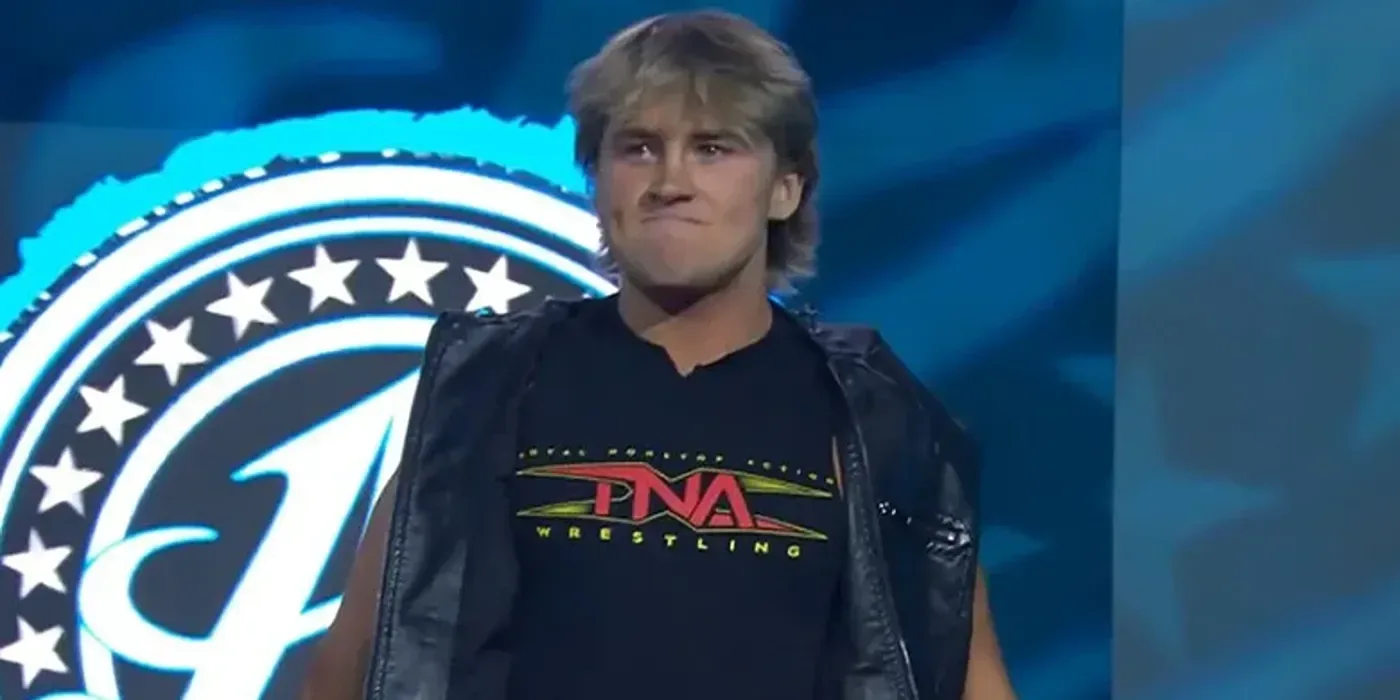
Lance Storm has offered strong praise for Avery Styles as the young wrestler continues to build momentum during his first year in the ring and his early run with TNA.
Styles has quickly become a regular presence on TNA programming after making his in-ring debut earlier in 2026 and subsequently signing with the company. He also carries a surname that immediately invites comparisons, as he is following the path of his father, AJ Styles. Storm, however, sees an opportunity for Avery to develop an identity all his own while benefiting from the example set by one of modern wrestling’s most accomplished performers.
Speaking with Love Wrestling, Storm discussed his unusual connection to both generations. The former wrestler and current producer recalled sharing a ring with AJ Styles years ago, then later having the chance to produce matches involving Avery. For Storm, that history makes Avery’s emergence especially interesting to watch.
“It’s great to see the second generation of Styles,” Storm said. “He’s a really nice kid, a very respectful kid. I think the world of him.”
For more background on this topic, read Jason Hotch Set To Represent United States In TNA World X-Cup At Destination X.
A connection spanning two generations of Styles
Storm explained that he wrestled AJ Styles once in a tag-team match in Europe for 1PW. The planned bout was intended to feature the Impact Players against AJ Styles and Christopher Daniels, a matchup that would have brought together several major names from the TNA and independent-wrestling scenes of that era.
Those plans changed when Justin Credible was unable to make his flight, meaning the originally envisioned match did not take place as scheduled. Storm nonetheless got the opportunity to wrestle AJ on that show, giving him firsthand experience of being in the ring with the wrestler who would go on to become one of TNA’s defining stars and eventually a world champion in multiple major promotions.
Years later, Storm has been involved on the production side of Avery Styles matches. That provides a different perspective than the one he had with AJ. Rather than standing across the ring from an established high-level performer, Storm is now able to observe a young talent at the start of his professional journey, including the work required to translate potential into a sustainable career on television.
Storm was careful not to suggest that he knows Avery intimately, noting that their relationship has been based on the professional interactions they have had. But he made clear that every encounter has left a favorable impression. Respect, professionalism, and a positive attitude can carry considerable value for a wrestler learning within a national promotion, particularly in the demanding environment of regular television production.
Avery Styles’ rapid first year
Avery’s progression has been notable because of how quickly his career has moved. He made his in-ring debut earlier this year, then signed with TNA and became a recurring figure on its programming. For any newcomer, making the transition from initial matches to a promotion with a regular national platform presents a significant adjustment.
That adjustment is amplified when a performer arrives with a recognizable family name. AJ Styles’ body of work sets an extraordinarily high standard. His TNA career helped establish him as a foundational figure in the company’s history, while his later accomplishments broadened his reputation across the industry. For Avery, the connection naturally draws attention before he has had the time to compile a lengthy résumé of his own.
Storm’s comments acknowledge both sides of that reality. There is a clear lineage to recognize, and Avery is openly continuing a family tradition in the sport. At the same time, Storm expressed interest in seeing how he “carves his own path” as a performer. That distinction is important. A second-generation wrestler may benefit from guidance, familiarity, and opportunities that come with a famous name, but lasting success depends on establishing individual strengths and a personal connection with the audience.
The early signs Storm described are centered less on comparisons and more on Avery’s approach. His praise focused on the young wrestler as a person: respectful, pleasant to work with, and receptive in the settings where they have interacted. Those traits do not replace in-ring development, but they can help create the foundation for it. A wrestler who listens, prepares, and earns the confidence of coaches, producers, and peers is in a stronger position to improve with each appearance.
Storm’s perspective carries particular weight
Storm’s assessment comes from someone who has experienced the industry in several roles. He built his reputation as an accomplished wrestler before moving into work that involves helping guide matches and talent. That background gives him a close view of details that may not always be obvious to viewers, from how wrestlers absorb direction to how they adapt their performances within the structure of a televised show.
His use of the phrase “I think the world of him” is therefore a meaningful endorsement for a wrestler with limited time in the business. Storm did not frame Avery as a finished product, nor did he make predictions about championships or specific milestones. Instead, he identified qualities that can matter greatly at this stage: character, respect, and the ability to make a positive impression in professional settings.
That measured framing is also appropriate for Avery’s situation. Development in wrestling is rarely linear. Talent can make rapid progress in one area while still learning timing, match structure, character work, promotion-specific expectations, and the rhythms of television. Regular exposure gives a young wrestler valuable experience, but it also places every performance under more scrutiny.
For Avery, the objective will be to use those opportunities to make his presentation increasingly distinct. The most successful second-generation performers tend to balance acknowledgment of their lineage with a willingness to evolve beyond it. They may share instincts, athletic traits, or an understanding of the business with a parent, but audiences ultimately respond to what makes the new performer different.
An injury has added another challenge
Avery has also recently been dealing with an injury. No further details regarding the nature of the issue, the timetable involved, or its potential effect on his schedule were addressed in Storm’s comments.
Injuries are an especially difficult obstacle for a wrestler early in a career. Time away can interrupt momentum, limit ring repetitions, and delay the chance to build familiarity with viewers. At the same time, managing a physical issue responsibly is a necessary part of a long-term career, particularly for someone who has only recently begun accumulating the demands of professional matches and television appearances.
Storm’s praise offers a positive note amid that uncertainty. His confidence in Avery is based on the experiences they have already shared, and it suggests that the young wrestler has made a strong impression despite the limited length of his career so far. Whenever Avery is able to resume full activity, he will have the opportunity to continue building on that foundation.
The next stage is about identity and consistency
There is understandable curiosity surrounding every new step in Avery Styles’ career. The surname ensures that attention will remain present, while his TNA appearances give fans an immediate setting in which to judge his growth. But the most useful measure of his progress will be the gradual development of his own voice in the ring and on screen.
Storm’s reflections underline why Avery’s start has drawn interest beyond the family connection. He has worked around the business long enough to see AJ Styles as an opponent and Avery Styles as a developing talent. From that vantage point, he sees a young performer who has approached his opportunities well and earned respect from someone with extensive experience.
For now, Avery’s story is still in its opening chapter. His first year has included an in-ring debut, a TNA signing, regular programming exposure, and an injury challenge. The next chapter will be defined by recovery, continued refinement, and the pursuit of a career that honors the Styles legacy without being limited by it. Storm will be among those watching with interest to see exactly how that path takes shape.

Darryl Polo
Darryl Polo is a passionate wrestling fan covering WWE, AEW, TNA and beyond. He loves great rivalries, breakout stars and the moments that keep fans talking long after the bell. How we work.