
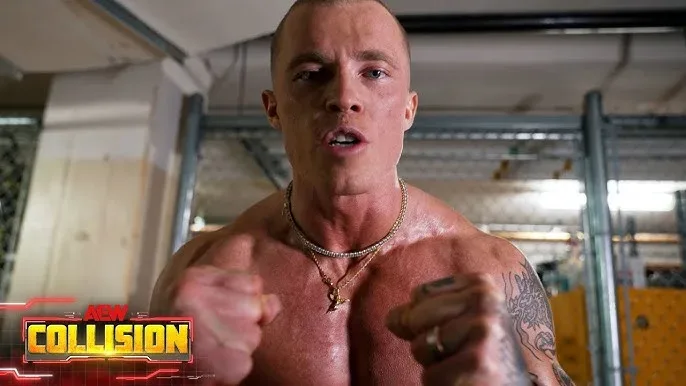
Kyle Fletcher entered AEW All In with more than the usual pressures associated with one of the company’s largest events. For Fletcher, the show represented a milestone that had been in his thoughts since the day a leg injury removed him from action earlier in the year.
Fletcher suffered the injury in April, creating immediate uncertainty around the length of his absence and what opportunities he could miss while recovering. He was eventually back on AEW programming after Double or Nothing, making a forceful return by attacking Konosuke Takeshita before resuming in-ring competition shortly afterward. But even when the full timeline was not clear, Fletcher had identified AEW All In as the event he wanted to reach.
Speaking in a recent ProtoLog, Fletcher described the feeling of finally arriving at the event after months of preparation, rehabilitation, and anticipation. He explained that All In was not simply another date on AEW’s calendar. It was the finish line he had focused on while dealing with the uncertainty of being injured.
“All In day. It’s finally here. This felt like a long time coming. I have been thinking about this day since probably the start of my injury. This was kind of always the end goal. It was always like, because I didn’t know how long I was going to be out for, it was thinking about this day and getting back in time for this.”
For more background on this topic, read Speedball Mike Bailey Eyes First South American Wrestling Tour, Details Origins Of Signature Finishers.
That mindset is understandable given Fletcher’s position in AEW. A significant injury absence can disrupt momentum at any stage of a wrestler’s career, but the timing is particularly difficult for a performer seeking to establish himself as a major singles force. Fletcher had already shown that he could thrive in high-level situations, both through his work as part of Aussie Open and through his increasingly prominent individual role. Missing a major stadium-scale event such as All In would have been a frustrating setback.
Instead, Fletcher was able to return before the event and make All In part of his active AEW run rather than a show watched from the sidelines. His comments make clear that the prospect of competing there helped give a defined purpose to the recovery process. When an athlete does not have a clear return date, an upcoming major event can become a useful point of focus, even if the schedule remains subject to medical progress.
A Long Road That Suddenly Reached Its Destination
Fletcher also spoke about the strange change in perspective that comes with a major goal drawing nearer. During an injury layoff, an event months away can feel distant enough to be almost abstract. Rehabilitation demands patience, and a wrestler must work through each stage before a return is possible. Yet once the date arrives, the waiting period can seem to have moved quickly.
“That’s normally how it goes, and then it just sneaks up on you and then it’s finally here. It feels like it’s going to be so far away forever, and then lo and behold, here we are.”
Fletcher’s return came in a notable fashion following AEW Double or Nothing. Rather than quietly stepping back into the mix, he attacked Konosuke Takeshita, immediately placing himself in a heated situation. The angle gave his comeback a sense of urgency and made it clear that Fletcher was not returning simply to rebuild gradually in the background.
That aggression fits the approach Fletcher outlined while preparing for All In. He recognized that the event would be physically punishing, joking that he expected to take a beating, but he also made it clear that he intended to hand one out as well. The statement captures the competitive mentality needed to return from an injury and step directly into the demands of an AEW event of that scale.
“So now it’s just time to do the thing. All the preparation’s got us here. Now we just get to enjoy it. Well, don’t get to enjoy it. I’ll enjoy it after it’s done. Getting my ass beat for a couple minutes probably. But I will also be doing plenty of ass beating, which will be the fun part. It’s time to go do the thing.”
The line between anticipation and execution is especially important for a wrestler coming back from time away. Reaching the show is one achievement, but performing on it at the required level is the next test. Fletcher’s comments suggest he viewed the recovery as preparation for that exact challenge, rather than treating clearance as the final accomplishment.
All In’s Importance for AEW Talent
AEW All In has become a defining event on the promotion’s schedule, carrying the type of atmosphere and visibility that wrestlers want to experience firsthand. It is an occasion where presentation, in-ring performance, rivalries, and individual moments all carry greater weight. For a talent such as Fletcher, being available for the show matters both professionally and personally.
Injury timing can be unforgiving in professional wrestling. Storylines move forward, title pictures change, new rivalries emerge, and roster members can seize opportunities while someone is unavailable. Fletcher’s absence began in April, but he avoided an extended stretch that would have ruled him out of the summer period entirely. His post-Double or Nothing appearance ensured that he could re-enter AEW’s landscape ahead of All In rather than needing to wait until after one of the year’s central events.
His stated goal also offers a look at the mental side of recovery. There is often no certainty at the beginning of an injury layoff, particularly before the full length of the absence is established. Fletcher acknowledged that he did not know how long he would be out. Still, he chose to set his sights on a major objective. That did not guarantee he would make it, but it provided a destination around which to frame the work required to return.
For wrestlers, that work extends beyond simply being healthy enough to compete. Returning to a high-profile card requires ring conditioning, confidence in movement and timing, and the ability to handle the pace and physicality expected at a major AEW event. Fletcher referred to the preparation that brought him to All In, underscoring that the process did not end when he was able to appear on television again.
Fletcher’s Momentum After Returning
Fletcher’s attack on Takeshita after Double or Nothing established an aggressive tone for his comeback. Takeshita is one of AEW’s most physically imposing and acclaimed competitors, so targeting him immediately signaled Fletcher’s intent to remain connected to important action. It also prevented the injury absence from defining his on-screen identity for long.
That is a key part of the opportunity presented by a return. A wrestler who comes back with direction can transform time away into a chapter of a larger story rather than a pause that drains momentum. Fletcher’s remarks about All In reveal that he had already been looking ahead during his time out. The public return and the personal target were tied together: get healthy, get back into the mix, and be ready when All In arrived.
There is no suggestion from Fletcher that the process was easy. His description of All In as something that felt “like a long time coming” reflects the length of the emotional journey as much as the calendar. An injury can make a wrestler feel separated from the environment in which they are most accustomed to operating. The eventual return brings excitement, but it also comes with pressure to prove that the work done during the absence has put them in position to perform at their usual standard.
Fletcher’s outlook, however, was not cautious or passive. He spoke in terms of doing the thing, embracing the physical reality of the match environment, and delivering his own punishment along with absorbing it. That is the attitude of someone who sees All In as a chance to resume forward movement rather than merely celebrate recovery.
From Recovery Target to All In Reality
By the time AEW All In arrived, Fletcher no longer had to look at the event as a distant possibility. The goal he set shortly after being injured had become real. His path included the April injury, an absence through Double or Nothing, a high-impact return involving Takeshita, and the continued preparation needed to be ready for AEW’s major show.
Fletcher’s comments provide a straightforward reflection on what it means to work toward a comeback in professional wrestling. The biggest dates on the calendar can feel impossibly far away when someone is injured, particularly when the return timetable has not yet been established. But those dates eventually arrive. For Fletcher, All In was the event that stayed in his mind throughout the process, and making it back in time was always the objective.
Now that he has reached that point, the focus turns away from rehabilitation and toward competition. Fletcher may have allowed himself a brief moment to acknowledge the journey, but his own words show that he views enjoyment as something reserved for after the bell. Before that, there is still the work of competing, fighting, and making the most of the opportunity he spent months pursuing.
Darryl Polo
Darryl Polo is a passionate wrestling fan covering WWE, AEW, TNA and beyond. He loves great rivalries, breakout stars and the moments that keep fans talking long after the bell. How we work.