
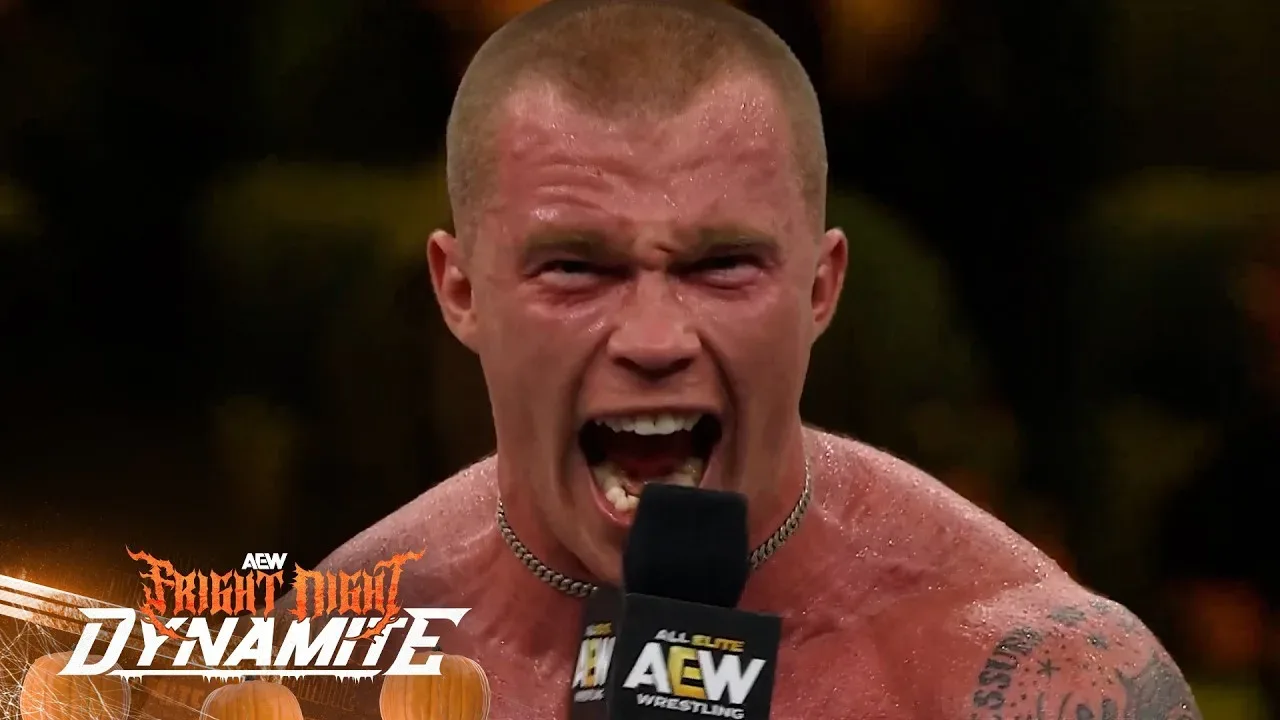
Kyle Fletcher has explained the origin of one of the most recognizable verbal trademarks in his current AEW run: “Say my full name.”
The demand has become a defining part of Fletcher’s on-screen persona. Whether he is addressing opponents, speaking to an arena audience, or pushing back against anyone who refers to him too casually, Fletcher has made it clear that “Kyle” or “Fletcher” alone is not enough. In his view, the proper address is Kyle Fletcher — every time.
That approach has given Fletcher a simple but effective character detail. It is not merely a catchphrase designed for repetition. It is a demand for status, recognition, and respect, all of which fit naturally with a wrestler presenting himself as a calculating and arrogant villain.
Speaking with Tony Schiavone and Conrad Thompson on What Happened When, Fletcher said the phrase was not initially mapped out as a major part of his presentation. Instead, it grew out of an isolated promo moment and positive feedback he received afterward.
For more background on this topic, read Don Callis Family Prevails in Men’s Blood & Guts as Adam Copeland Surrenders.
“‘Say my full name’ was something I said once in a promo and I can’t remember who, but somebody texted me and was like, ‘You should keep saying that.’ My idea behind it was when you address someone you respect, you would say their full name. ‘Hello Mr. Kyle Fletcher, how are you?’ That was the idea behind it. I wanted people to show their respect to me. The flipside, as a villain, I could refer to people by a shorthand or one name, and show disrespect in return.”
A Small Line With a Clear Character Purpose
Fletcher’s explanation reveals why the line has endured. The phrase is rooted in a recognizable social idea: formal language can communicate respect, while casual language can be used to diminish someone. Fletcher has taken that concept and applied it directly to his AEW character.
When Fletcher insists on hearing his full name, he is effectively telling fans and rivals that he believes he deserves a level of deference they are not naturally willing to give him. That tension is useful for a heel. Audiences generally do not want to comply with a villain’s demands, particularly when the demand is framed as a lesson in manners or respect. The more Fletcher pushes for that recognition, the easier it is for viewers to respond with the opposite reaction.
His point about addressing others by only a shorthand version of their names adds another layer. Fletcher does not see the phrase as a one-way request for a formal introduction. He sees it as a tool that establishes a hierarchy. He expects respect from others, while reserving the right to deny that same respect when speaking about them.
That imbalance is central to the villain role. A successful heel often asks for privileges while refusing to grant them. Fletcher’s catchphrase communicates that dynamic immediately, without requiring a lengthy explanation every time he appears on screen.
Why Repetition Matters in Wrestling
Professional wrestling has long relied on repeatable phrases to help define personalities. A distinctive line can tell the audience who a wrestler is, what that wrestler values, and how supporters or opponents are expected to react. The strongest phrases do not need to carry every part of a character on their own, but they can become a reliable entry point for the audience.
For Fletcher, “Say my full name” works because it is directly connected to his attitude. It is not separate from the character’s motivation. The phrase reflects entitlement and self-importance, while also offering an easy way for Fletcher to show irritation whenever someone does not meet his standard.
There is also an important contrast in the wording itself. Fletcher’s demand is specific rather than broad. He is not simply asking to be respected; he is dictating exactly how that respect must be spoken. That degree of control makes the line particularly suited to a performer looking to project superiority.
The phrase also gives Fletcher flexibility. It can be used during a promo, in a confrontation, following a victory, or when responding to an opponent. Because the instruction is short and clear, it can fit into many situations without losing its intended meaning. That kind of versatility can make a character trait more durable over time.
Fletcher Heads Toward Full Gear
The explanation comes at a significant point for Fletcher in AEW. Fletcher’s team was victorious in Blood & Guts on Wednesday, giving him momentum heading into one of the biggest matches currently on his schedule.
Fletcher is set to challenge Will Ospreay for the AEW Title at AEW Full Gear. The championship match places Fletcher opposite an opponent with whom he has a meaningful history, while also putting the focus squarely on Fletcher’s ambition to reach the top of the promotion.
A title challenge of that scale naturally intensifies the importance of every aspect of a wrestler’s presentation. The in-ring performance remains decisive, but promos, rivalries, confidence, and a clearly established identity all help define the stakes around a major championship bout. Fletcher’s full-name demand is now part of that identity.
It also offers a concise expression of how Fletcher sees himself entering the Full Gear match. He is not framing himself as a challenger who should be grateful for an opportunity. His character is built around the expectation that people acknowledge his standing. The phrasing allows Fletcher to present himself as someone who believes he belongs in the highest-profile situations and should be treated accordingly.
The Ospreay Challenge Raises the Stakes
Will Ospreay will enter Full Gear as the AEW Title holder, while Fletcher will arrive with the chance to claim the promotion’s top prize. The match gives Fletcher an opportunity to turn a growing character signature into part of a defining moment in his AEW career.
In wrestling, a phrase can take on a different level of meaning when it is connected to championship stakes. A demand for recognition becomes more potent if the wrestler making that demand wins the biggest title available. Conversely, the phrase can become a source of further audience reaction if the wrestler falls short after insisting that everyone recognize his greatness.
Fletcher’s comments show that he understands the role language plays in building that reaction. He did not describe “Say my full name” as an accidental line that audiences simply adopted. He described a deliberate thought process: full names signal respect, and the lack of that formality can signal disrespect. By using both sides of that idea, Fletcher has given his character a consistent verbal framework.
That framework may be especially relevant against Ospreay. With the AEW Title on the line, Fletcher’s belief that he deserves formal recognition will be tested in the most concrete way possible. Winning the championship would give the character’s claims added weight. Failing to do so would not remove the arrogance behind the demand, but it would ensure that the conflict between Fletcher’s self-image and the reaction around him remains central.
A Phrase That Has Become Part of Kyle Fletcher
Fletcher’s account is also a reminder that some of wrestling’s most memorable recurring lines begin with an organic moment rather than an elaborate plan. A single promo line caught someone’s attention, Fletcher received encouragement to revisit it, and he found a character rationale that made it sustainable.
The result is a phrase that has become closely associated with him. It is easy to understand, easy for fans to react to, and tailored to the exact kind of disrespectful confidence that defines his villainous approach. By demanding that everyone say “Kyle Fletcher,” he has created a recurring confrontation over something as basic as a name.
As Fletcher moves from a Blood & Guts victory toward his AEW Title opportunity at Full Gear, that demand will continue to follow him. It remains a compact statement of the respect he expects, the superiority he projects, and the disrespect he is willing to show others in return.
For Fletcher, the message is straightforward: do not shorten it, do not make it casual, and do not forget the name. Say his full name: Kyle Fletcher.

Darryl Polo
Darryl Polo is a passionate wrestling fan covering WWE, AEW, TNA and beyond. He loves great rivalries, breakout stars and the moments that keep fans talking long after the bell. How we work.