
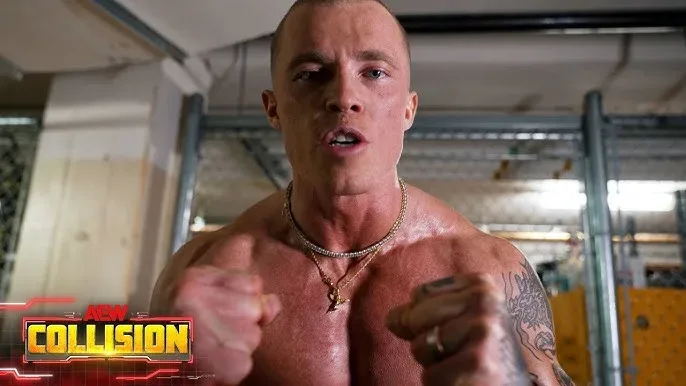
Kyle Fletcher understands why wrestling fans have made comparisons between him and Randy Orton, but he is not mistaking a resemblance for an accomplishment.
The AEW star has noticeably changed his presentation in recent years. After shaving his head and continuing to add muscle and size to his frame, Fletcher has developed a look that has led some observers to mention Orton, one of the most accomplished and recognizable wrestlers of his generation. Fletcher said the initial reaction to hearing those comparisons was flattering, particularly because of the respect he has for Orton’s career.
At the same time, Fletcher made clear that his ultimate ambition is not to become a younger version of anyone else. He wants to establish an identity and body of work that belongs entirely to him.
“When I first started hearing it, it was that reaction of, ‘Aw man, Randy Orton is great. I love Randy Orton.’ To be mentioned in the same sentence as him was awesome,” Fletcher said. “At the same time, any wrestler should want to carve their own path. I think that I’ve started to do so.”
For more background on this topic, read Kyle Fletcher Explains the Origin of His ‘Say My Full Name’ AEW Catchphrase.
Fletcher Recognizes the Scale of Orton’s Career
The comparison has primarily been rooted in Fletcher’s current physical appearance rather than a direct match-by-match similarity. Orton has spent three decades in the business and accumulated an extraordinary list of major accomplishments, including 14 world championship reigns. Fletcher did not attempt to minimize that difference. Instead, he acknowledged that the two men are at very different points in their respective careers.
“It’s hard to compare us because Randy is 30 years into the business and has won 14 world championships. Obviously, I’m not at that level yet,” Fletcher said.
That perspective is important as Fletcher continues to move into a larger role in AEW. Being compared with a wrestler of Orton’s stature can create a shortcut in public perception, especially when the discussion centers on look and presence. But Fletcher’s response showed that he sees the comparison as a compliment without allowing it to define his ceiling or his identity.
For a wrestler still building his long-term legacy, that is a meaningful distinction. The most durable stars may have influences, visual similarities, or career parallels to past names, but they eventually need audiences to associate their defining moments with their own name. Fletcher’s stated goal is for his career to reach that point.
“I would like to that, by the time my career is said and done, people will be doing the same thing to me,” Fletcher said. “I don’t take it as a negative thing. It makes me more determined to carve my own path.”
A Compliment That Comes With Added Motivation
Fletcher’s answer did not reject fan discussion or suggest that comparisons to established stars are inherently unhelpful. In wrestling, comparisons are often inevitable. They can come from a performer’s appearance, their movement, their attitude, their ring style, or simply the timing of their rise. Fans regularly use familiar names as reference points while they evaluate newer talent.
What matters is how the wrestler responds to that attention. Fletcher’s approach is to accept the praise attached to being mentioned alongside Orton while using it as fuel to continue progressing. He recognizes that admiration is not the same as equivalence, and he has set a much larger standard for himself than simply inviting a favorable visual comparison.
Orton’s legacy is defined by longevity, championships, high-profile rivalries, and an ability to remain a central figure across multiple eras. Fletcher openly noted that he has not reached that level. His remarks were not a claim that he has already done so; they were an expression of the ambition required to pursue a similarly lasting career.
That ambition has particular relevance with a major AEW opportunity ahead. Fletcher is scheduled to challenge Will Ospreay for the AEW World Title at AEW Full Gear. The match gives Fletcher a chance to pursue one of the most significant accomplishments available in the company, while also adding another major chapter to his ongoing evolution.
AEW World Title Match Raises the Stakes
A championship challenge does not erase the gap between a rising wrestler and a veteran with decades of history. It can, however, become the kind of stage that changes how a performer is viewed. Fletcher’s Full Gear meeting with Ospreay is a chance to compete for the AEW World Title in a match that carries obvious importance for both wrestlers.
For Fletcher, the timing also sharpens the significance of his comments about forging an individual path. A wrestler’s identity is ultimately shaped less by the comparisons around them than by what they do when the pressure is highest. Title matches, major events, and defining rivalries are where performers begin turning promise into a resume.
Fletcher has framed the Orton discussion in those terms. He appreciates the association, understands why it exists, and knows the accomplishments attached to Orton’s name. Yet he is focused on the work still in front of him rather than treating the comparison as a destination.
The desire to be recognized on one’s own terms is a familiar part of wrestling’s generational cycle. Every era produces talent who are initially measured against previous stars. Some comparisons disappear quickly. Others remain because audiences continue seeing legitimate similarities. The performers who become lasting names are generally those who create enough major moments that the conversation changes direction.
Fletcher wants that eventual reversal. Rather than being introduced as someone who recalls a previous star, he hopes that future wrestlers will one day be measured against what he built. That is an ambitious objective, but it is also one that reflects how highly he regards the opportunity in front of him.
“Say My Full Name” and Fletcher’s Evolving Presentation
During the same appearance, Fletcher also discussed the origin of “Say My Full Name,” a phrase tied to his current presentation. The discussion of the phrase and his response to the Orton comparisons both point to the same larger reality: Fletcher is actively developing the elements that separate him from the rest of the AEW roster.
Physical changes can be immediately visible, but presentation is broader than appearance. A distinctive phrase, a defined attitude, and the confidence to state a clear ambition all contribute to how a wrestler is received. Fletcher’s comments suggest that he is conscious of the need to make those details connect into an identity that is recognizable without relying on another wrestler’s legacy.
There is also a practical reason for that focus. In a major promotion, attention can be difficult to sustain. A strong look may earn an initial reaction, but major opportunities demand more. Fletcher is approaching a title match against Ospreay with the opportunity to demonstrate that his development is about more than the visual attributes that prompted fans to invoke Orton’s name.
His comments did not present the comparison as a burden. They presented it as a reminder of the level he wants to reach. Fletcher respects Orton’s history, welcomes the positive intent behind the discussion, and remains determined to make his own career impossible to confuse with anyone else’s.
At Full Gear, Fletcher will have an opportunity to take another substantial step toward that goal when he challenges Ospreay for the AEW World Title. Whatever the result, Fletcher’s outlook is clear: appreciation for a comparison is welcome, but carving out a lasting individual legacy remains the priority.

Darryl Polo
Darryl Polo is a passionate wrestling fan covering WWE, AEW, TNA and beyond. He loves great rivalries, breakout stars and the moments that keep fans talking long after the bell. How we work.