
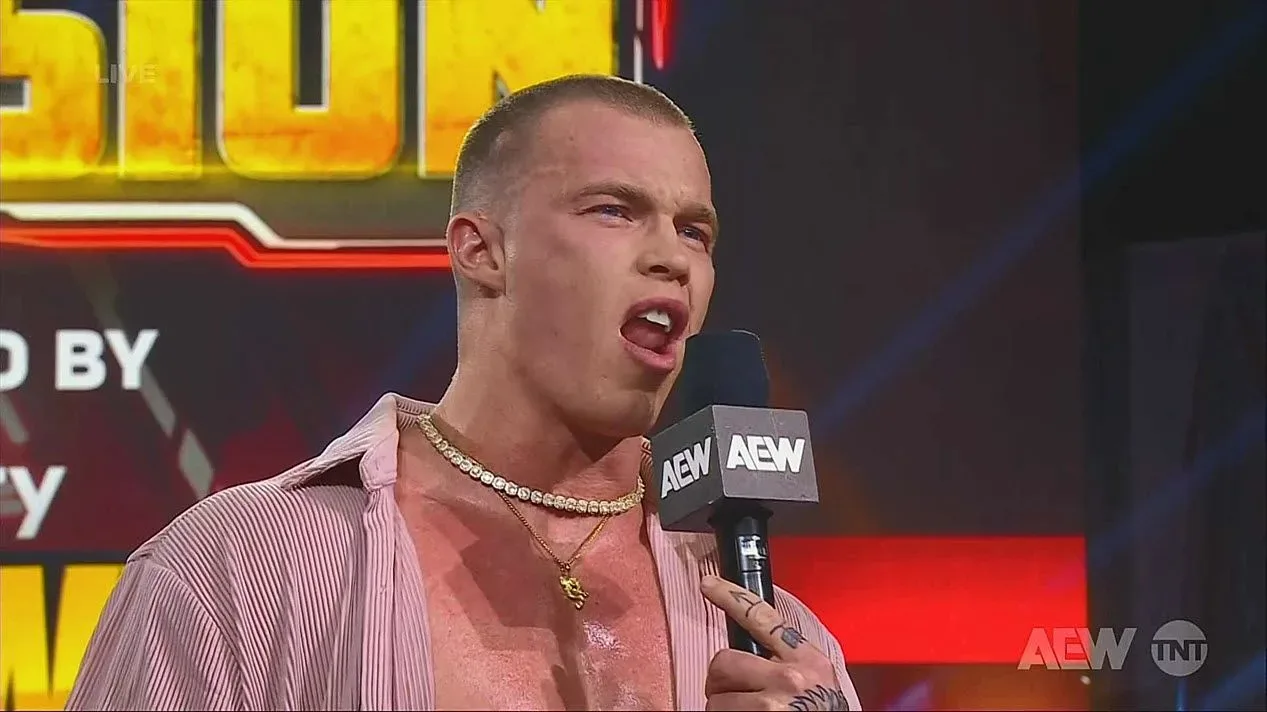
Kyle Fletcher may one day make pink an even bigger part of his on-screen look.
The AEW wrestler has built a presentation around the color, from the gear he wears to the visuals associated with his entrance and logo. Fletcher has also maintained a buzzcut for the past several years, creating a clean and recognizable silhouette that has become closely tied to his current appearance. While discussing possible ideas for his hair, Fletcher revealed that he has considered dyeing the buzzcut pink.
It is not a decision he has committed to making, and Fletcher was candid about the hesitation involved. Still, the fact that he is entertaining the possibility suggests that the idea is more than a passing joke. With his hair kept short, he also noted that a failed experiment would not necessarily be a long-term problem.
“Dude, kinda sick. I’ve thought of doing stars before. I’ve also been slightly tempted to do like dye the buzzcut pink as well. Don’t know if I’ll ever have the balls to do it, but. (Your hair’s so short.) If it was shit, I could- (You could try it on like a week off.) That is true actually.”
For more background on this topic, read Austin Creed Recalls Kurt Angle Double-Leg Attempt at Greatest Royal Rumble.
Pink already defines Fletcher’s visual identity
For Fletcher, pink is not simply an occasional accent color. It has become one of the most consistent elements of his presentation. His ring attire prominently uses the shade, while his entrance material and logo further reinforce the same visual direction. A pink buzzcut would therefore be an extension of a concept that is already firmly established rather than a sudden reinvention.
Professional wrestling has always rewarded wrestlers who can establish a clear visual identity before they say a word in the ring. Gear, music, lighting, logos, facial expressions, and even hairstyles can help create immediate recognition. Fletcher’s current look already provides that clarity, and a hair-color change would make the connection between his personal appearance and broader presentation even more obvious.
That does not mean the change is inevitable. Fletcher specifically said he does not know whether he will “ever have the balls to do it,” making clear that he remains undecided. The thought process, however, shows that he is actively considering how smaller details can affect the overall image he presents on television and at live events.
A short haircut makes the idea easier to test
One practical factor in the discussion was Fletcher’s buzzcut. Because his hair is short, there is less risk attached to an experiment that does not work visually. The conversation turned to the possibility of trying it during a week away, with Fletcher agreeing that the short length would make that approach more manageable.
That detail matters because hair changes in wrestling can become memorable parts of a performer’s evolution. A major alteration can signal a new character direction, a fresh attitude, or a deliberate effort to make a wrestler stand out during an important stage of their career. At other times, it can simply give an established presentation an added layer without changing the underlying character.
Fletcher’s comments fit more closely with the latter possibility. He did not describe a new gimmick, a storyline development, or a planned makeover. He spoke about a potential adjustment that could complement what is already working within his current aesthetic. The pink buzzcut idea is tied directly to colors and imagery fans already associate with him.
There was also a separate suggestion of adding stars to his hair. Fletcher said he had thought about that option as well. Whether he goes with stars, a full pink color, or maintains his present look, the discussion underlines the attention performers give to details that may appear small but can become part of a complete wrestling persona.
Visual continuity can strengthen a wrestler’s brand
In a crowded wrestling environment, consistency can be as important as change. Fans often identify performers through a collection of familiar cues, and repeated visual choices can make that identity stronger over time. Fletcher’s continued use of pink across his gear and entrance branding gives his presentation a unified feel. Dyeing his hair could turn that cohesion up another level.
The color has a long and varied history in professional wrestling, having been embraced by numerous notable names across different eras and styles. Fletcher’s use of it is his own, shaped by his gear, logo, entrance elements, and physical presence. The important point is not merely choosing a bright color, but making sure that color carries through the full presentation in a way that viewers can quickly recognize.
That kind of consistency is especially useful for a wrestler whose appearance has undergone changes over time. A buzzcut is already a defining trait for Fletcher on screen. Pairing it with pink could produce an instantly recognizable image, whether he is walking through the entrance, featured in a promotional graphic, or standing across the ring from an opponent.
Of course, visual changes do not automatically create momentum. The most effective presentation choices tend to work because they support a performer’s personality, ring work, and current role. Fletcher did not frame the idea as something required to transform his career. Instead, he described it as something he has been tempted to try because it may look “kinda sick.” That straightforward reasoning gives the possibility an organic quality.
Fletcher remains active in shaping his presentation
The comments also offer a small glimpse into Fletcher’s creative mindset. Wrestling presentation is often discussed in terms of major storyline turns, title pursuits, rivalries, and in-ring performances. Yet wrestlers also make choices about appearance that influence how audiences read their characters. A change as simple as hair color can become part of the larger story a performer tells through body language, wardrobe, and attitude.
Fletcher’s uncertainty is understandable. A bright pink buzzcut would be difficult to ignore, and it would invite immediate reactions from fans. That can be an advantage when the visual fits the wrestler, but it also explains why he would want to be sure before following through. His remark about using a week off to test it reflects a sensible approach: try the idea in a way that allows for a quick reset if it does not feel right.
At this point, there is no indication that Fletcher has dyed his hair or set a timetable for doing so. The notion remains a possibility, not an announced change. Fans should not assume a pink buzzcut will appear imminently simply because Fletcher has considered it.
Andrade exchange adds to a busy stretch of conversation
Fletcher’s hair discussion came around the same time as a public exchange involving Andrade El Idolo. On Sunday evening, Fletcher responded after Andrade compared him to Randy Orton. The available details establish that Fletcher clapped back at the comparison, though no additional specifics about the exchange were provided here.
The two topics are unrelated on the surface, but both put attention on Fletcher’s willingness to speak directly and project confidence. One concerns a possible aesthetic choice; the other came through an interaction with another high-profile wrestler. Together, they keep focus on Fletcher beyond the immediate action inside the ring.
For now, Fletcher’s familiar buzzcut remains intact, and his pink-heavy presentation continues without that additional flourish. But he has openly acknowledged the temptation. If he eventually decides to go through with it, the change would not arrive without context. It would be the latest step in a visual approach he has already spent considerable time developing.
Until then, the pink buzzcut remains an idea Fletcher finds appealing, even if he has not yet decided whether to take the leap.

Darryl Polo
Darryl Polo is a passionate wrestling fan covering WWE, AEW, TNA and beyond. He loves great rivalries, breakout stars and the moments that keep fans talking long after the bell. How we work.