
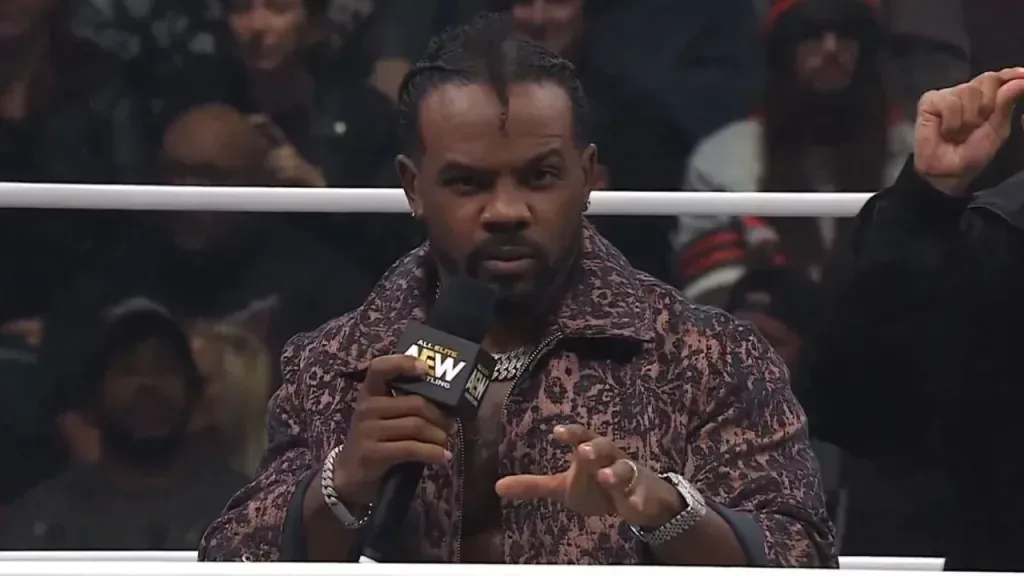
Austin Creed has shared a vivid memory from the Greatest Royal Rumble, recounting the moment he decided to test Kurt Angle’s legendary amateur wrestling credentials with a double-leg takedown attempt.
Speaking while world medalists Dymond Guilford and Adaugo Nwachukwu visited AEW talent backstage at Dynamite in Denver, Creed recalled having long wanted an opportunity to work with Angle. When that opportunity arrived in the Royal Rumble match, Creed said his curiosity got the better of him.
The result, by Creed’s telling, was an immediate and unforgettable lesson in the difference between wanting to take down an Olympic gold medalist and actually being able to do it.
“I found him in the ring, I spun him around, and I shot a double leg,” Creed said. “The way he sprawled, his ankles went to Mount Olympus and my head went to the ground.”
For more background on this topic, read Mark Briscoe Reportedly Undergoes Knee Surgery, Remains Sidelined From AEW Competition.
Creed said Angle quickly turned the situation around, flipping him over and striking him before asking why he had chosen to make the attempt. Creed’s answer was simple: he “just had to know.”
A long-awaited chance to test Kurt Angle
The story carried extra meaning for Creed because his interest in facing Angle stretched back years. Creed recalled meeting Angle when he was around 20 years old and asking about wrestling him. At that point, Creed said Angle dismissed the idea, telling him it was not worth his time.
Rather than ending the thought, that early response seemingly stayed with Creed as his own career developed. By the time they shared the ring in the Greatest Royal Rumble, Creed felt he had built enough of a body of work and enough confidence to seize the chance when it appeared.
That did not mean Angle was going to grant him a favorable exchange.
Creed’s description centers on Angle’s sprawl, one of the most basic but essential defensive movements in amateur wrestling. When an opponent shoots for a double-leg takedown, a successful sprawl involves throwing the legs back, dropping weight through the hips and preventing the attacker from getting underneath the body to complete the takedown. In amateur competition, timing, balance, pressure and instinct all matter. Against an athlete with Angle’s background, the margin for error is exceptionally small.
Angle’s reaction, as Creed remembers it, was not merely a counter in a professional wrestling sequence. It was a reminder of deeply ingrained wrestling technique. Creed’s humorous image of Angle’s ankles reaching “Mount Olympus” emphasized just how completely the former Olympic champion shut down the attempt.
Angle’s amateur wrestling reputation remains unmatched
Kurt Angle’s professional wrestling career made him one of the industry’s most decorated and recognizable performers, but the foundation of his reputation has always been his legitimate athletic background. Angle won an Olympic gold medal in freestyle wrestling at the 1996 Atlanta Games, a credential that set him apart even in an industry filled with accomplished collegiate wrestlers and athletes from other sports.
That history became central to his wrestling persona, whether he was presented as an intense competitive force, a boastful antagonist, a comedic character or a respected veteran. His ability to combine real amateur wrestling movement with professional wrestling timing helped define many of his most memorable matches.
For wrestlers who grew up watching Angle, an in-ring interaction with him can represent much more than sharing space with a veteran. It can be a chance to measure themselves against a performer whose credibility was built before he ever entered a professional wrestling ring.
Creed’s story illustrates that appeal. He did not frame the attempt as a plan to embarrass Angle or prove that he could outwrestle him. Instead, he framed it as an irresistible question. He wanted to know what it felt like to shoot in on Kurt Angle, and he got his answer almost instantly.
The Greatest Royal Rumble created a rare meeting
The Greatest Royal Rumble provided an unusual setting in which wrestlers from different generations could collide in brief, unpredictable exchanges. Multi-person battle royal matches are often built around those moments: a surprise confrontation, a callback to a past rivalry, or an opportunity for one wrestler to test themselves against an established name they would not normally meet in a singles match.
For Creed, finding Angle in the ring created exactly that kind of opening. A double-leg was a direct choice, especially given Angle’s history. The attempt was a wrestling challenge in its most recognizable form, and Angle’s immediate sprawl gave the exchange a fitting conclusion.
Creed’s account also underlines the difference between the cooperative structure of professional wrestling and the authentic athletic instincts that performers can bring to it. Professional wrestling requires communication, trust and an understanding of the intended match. Yet performers with high-level amateur backgrounds retain movement patterns developed through years of live competition. Angle’s response to Creed, as recalled by Creed, showed that those instincts remained sharp.
The physicality of the exchange was followed by a moment of humor. Angle’s question — why Creed would try it — made the encounter feel like an experienced competitor recognizing exactly what the younger wrestler had attempted. Creed’s response was not a tactical explanation. It was the response of someone who had spent years wondering whether he could challenge a legend in that particular way.
Creed reflects on wrestling’s connection to real competition
The backstage visit involving Guilford and Nwachukwu provided a natural setting for the anecdote. Both are world medalists, and their presence around AEW wrestlers brought amateur wrestling achievement and professional wrestling together in a way that encouraged discussion of the sport’s shared foundations.
Professional wrestling and amateur wrestling are distinct disciplines, but they have long been intertwined. Amateur experience has helped shape the careers of numerous major stars, while professional wrestling has often borrowed its language, holds and competitive presentation from the mat. Terms such as double-leg, single-leg, sprawl, suplex and front facelock all carry associations with grappling traditions that predate the modern wrestling business.
Angle is among the clearest examples of that bridge. His amateur accomplishments gave his professional wrestling character an immediate level of authority, while his success as an entertainer demonstrated that technical legitimacy and larger-than-life performance can complement each other.
Creed’s recollection did not need a long explanation of Angle’s résumé to make that point. The story itself did the work. A wrestler who had wanted the interaction for years finally took his shot, and Angle’s reaction was so decisive that Creed still recounts it with admiration and laughter.
A respectful lesson from an all-time great
There is a notable respect running through Creed’s story. He described a rough outcome, but not a negative experience. The point was not that Angle humiliated him. The point was that Angle answered a challenge in the way only someone with his background could.
That kind of encounter can become part of the informal education of a wrestling career. Wrestlers learn through training, travel, matches and conversations with veterans, but they also learn from brief moments when they feel another performer’s timing, strength or technique firsthand. For Creed, the attempted double-leg became one of those memories.
His account is also a reminder that some questions are worth asking even when the likely answer is obvious. Creed knew Angle’s credentials. He knew what a double-leg attempt represented. Still, the chance to test that knowledge in the ring was too tempting to pass up.
Angle’s sprawl gave him the answer, and Creed now has a story that captures both the reverence wrestlers have for Angle and the enduring impact of elite amateur wrestling skill. Years after the Greatest Royal Rumble, Creed can still recall the sequence in detail: the shot, the defense, the reversal and the blunt question from the man he had challenged.
For Creed, it was not simply an exchange in a crowded Royal Rumble match. It was a long-delayed chance to find out what happened when he tried to take Kurt Angle down — and a firsthand reminder that some Olympic-level instincts do not fade.

Darryl Polo
Darryl Polo is a passionate wrestling fan covering WWE, AEW, TNA and beyond. He loves great rivalries, breakout stars and the moments that keep fans talking long after the bell. How we work.