
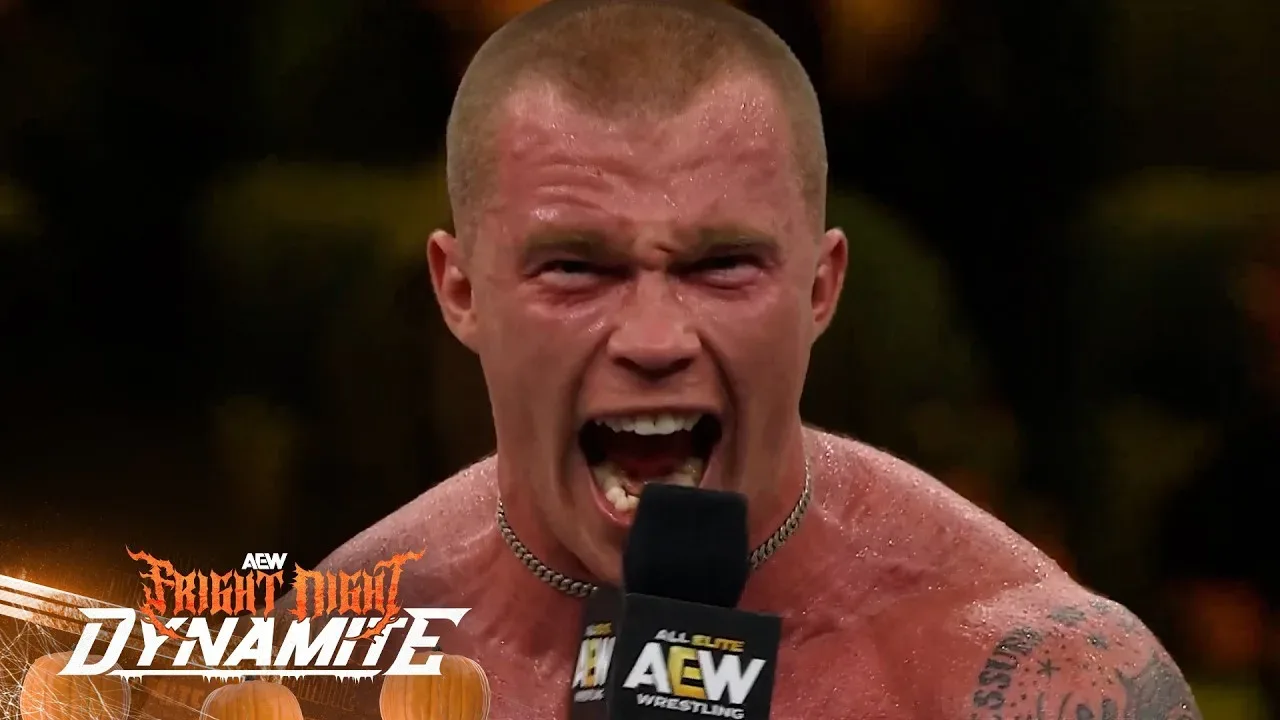
Kyle Fletcher went into his first AEW Blood & Guts match knowing exactly what the stipulation demanded of him — and with no attempt to hide how anxious he was about it.
Speaking in his latest Protolog, Fletcher documented the hours leading up to the Blood & Guts main event on AEW Dynamite. The multi-person cage match marked Fletcher’s first appearance in the annual violent spectacle, which uses two rings enclosed by a steel cage and ends only when a competitor submits or surrenders.
Before entering that environment, Fletcher described himself as “a very nervous little boy,” openly acknowledging both the physical danger of the match and the expectation that Blood & Guts will involve punishment, bloodshed and escalating chaos.
“I have to wrestle in a cage. I’m nervous. That’s about it. I’m a very nervous boy. A very nervous little boy who hopes he doesn’t bleed too much today. Or guts too much. Or too many guts. Guts would be bad. Let’s hope there’s no guts.”
For more background on this topic, read Hyperactive React To EVE Match Postponement Against The Brawling Birds.
Fletcher’s comments carried the nervous humor that has become a recurring part of his video updates, but he was clear that the fear was real. He understood that a match carrying the Blood & Guts name comes with a particular standard in AEW, and that escaping without being physically marked by the experience was unlikely.
“Yeah, only blood, no guts. Only blood. I mean, I still hope there’s no blood, but I feel like there’s probably a 0% chance of that happening. It’s everywhere. I feel like the people would be disappointed if there was no blood. Let’s just hope there’s more of everyone else’s blood than there is my blood. I’m fucking terrified. Let’s see how this goes.”
Fletcher Leaves Blood & Guts With a Major Win
Whatever nerves Fletcher had before the bell, he finished the night on the winning side of his Blood & Guts debut. The conclusion saw Fletcher force Adam Copeland to surrender after threatening Will Ospreay with a screwdriver.
That finish made Fletcher central to the outcome rather than simply another participant in a crowded cage match. In a stipulation defined by endurance and teamwork, he was the wrestler who created the decisive moment. Copeland’s surrender ended the contest and gave Fletcher’s side the victory.
The result also ensured that Fletcher’s first Blood & Guts outing will not simply be remembered as an initiation into one of AEW’s most punishing match concepts. His debut included a match-ending act that put both Ospreay and Copeland at the center of the closing drama.
Blood & Guts is not structured like a conventional singles match, where a wrestler can build a game plan around a specific opponent and a familiar finish. The cage, the multiple competitors, the weapon-heavy atmosphere and the surrender-only stakes make it a unique test. A first-timer must adjust not only to the physical limitations of the structure, but also to a constantly changing situation involving several wrestlers at once.
Fletcher’s pre-match nerves therefore reflected more than simple concern about a cage. He was preparing for a match whose identity is built around discomfort, unpredictability and the possibility of being trapped inside the structure while the action becomes more violent. His remarks showed that he recognized the scale of the assignment before he ever stepped between the ropes.
The Pressure Attached to the Blood & Guts Name
There is a reason Fletcher expected blood to be part of the night. Blood & Guts has been presented as one of AEW’s signature high-risk team match attractions, with the double-ring cage making it visually distinct from a standard steel cage encounter. Its rules also amplify the drama: the match does not conclude through a traditional pinfall, and the final decision comes when someone submits or surrenders.
That format changes the emotional stakes. The goal is not merely to score a three-count; it is to push an opponent, teammate or rival to the point where they can no longer continue or choose to give up. Fletcher’s role in the final sequence directly reflected that premise. Rather than winning with a routine wrestling maneuver, he used a threat against Ospreay to force Copeland’s surrender.
For competitors, the match can demand a different kind of mental preparation. The cage removes easy escape routes. The number of bodies creates limited space and unavoidable collisions. And the audience arrives expecting the intensity to increase as the match progresses. Fletcher’s line about fans being disappointed by a lack of blood was not a promise about what would happen, but it did underline the reputation the stipulation carries.
His anxious comments also offered a candid contrast to the confidence wrestlers often project before major matches. Fletcher did not frame the bout as another routine professional obligation. He spoke about it as an intimidating challenge, openly hoping to avoid too much blood while conceding that such optimism might not be realistic in Blood & Guts.
A Defining First Appearance in the Structure
First appearances in specialty matches can become important reference points in a wrestler’s AEW run. Blood & Guts is especially notable because it is not a stipulation used every week. Being selected for the match places a wrestler in one of the company’s featured television events, and what happens inside the cage can shape rivalries long after the immediate contest ends.
Fletcher entered the match with obvious apprehension, but he came out of it with a win and a pivotal role in the finish. Those are the facts that will define the result. His Protolog, however, adds another dimension to the night: the perspective of a wrestler confronting a new, frightening environment before eventually helping determine the outcome.
It is also notable that Fletcher did not attempt to distance himself from the fear after the fact by pretending the stipulation had not affected him. The video captured his outlook before he knew how the match would play out. At that point, he was focused on the cage, the likelihood of blood and the uncertainty of what would happen once the action began.
That uncertainty is a fundamental part of Blood & Guts. Even wrestlers experienced in high-profile bouts face a setting in which the pace, alliances and dangers can shift quickly. For Fletcher, the match represented an entirely new version of that challenge. The nervousness he described was matched by a performance that ended with his team victorious.
Fletcher Continues to Draw Attention in AEW
The Blood & Guts win arrives as Fletcher remains a prominent subject of discussion around AEW. He recently addressed comparisons between himself and Randy Orton, another indication that his work and presentation are being closely evaluated by fans.
Those comparisons are separate from the Blood & Guts result, but both conversations point to the increased attention surrounding Fletcher. A major cage match, a high-stakes finish involving Ospreay and Copeland, and public discussion of his style and potential all keep the focus on what comes next for him.
For now, Fletcher can say he survived his first Blood & Guts experience and won it. His own pre-match words make clear that he did not approach the bout casually. He was nervous, expected the worst and admitted he was terrified. But when the decisive moment arrived, Fletcher was responsible for the threat that brought about Copeland’s surrender.
In a match designed to test how far wrestlers will go under pressure, Fletcher’s debut delivered a revealing progression. Before the cage closed, he was worried about the blood, the violence and the unknown. By the end of the night, he had played a decisive part in one of AEW’s most brutal team-match environments — and left with the victory.

Darryl Polo
Darryl Polo is a passionate wrestling fan covering WWE, AEW, TNA and beyond. He loves great rivalries, breakout stars and the moments that keep fans talking long after the bell. How we work.