
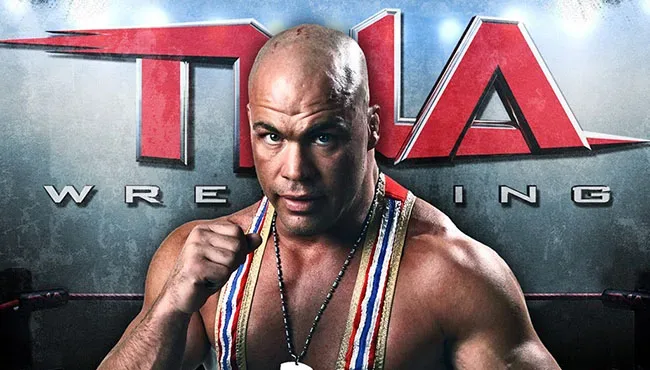
Kurt Angle has offered a measured defense of one of TNA’s most recognizable and debated ideas: the six-sided ring.
For years, the six-sided ring stood apart as a major visual calling card for TNA. Its unusual shape immediately separated the promotion from the conventional four-sided rings used throughout much of professional wrestling. That identity came with practical consequences, however. Wrestlers were not simply working in a familiar ring with a different appearance. They had to adapt their timing, movement, positioning and impact-taking to a structure that could feel very different underfoot and on a landing.
Speaking on GTV’s Man Dem Show, Angle addressed the divided reaction to the ring and explained why he ultimately did not mind working in it. The WWE Hall of Famer agreed with the concerns expressed by AJ Styles, particularly regarding how unforgiving the ring could be. At the same time, Angle said the six-sided layout created opportunities that fit his own approach to matches.
“The reason why it was so terrible [for some] is it’s really stiff,” Angle said. “The the ring’s really stiff cuz it’s a lot smaller. So, if you have a longer ring, the plywood’s longer and it gives a little bit more of a bounce. And I think that’s the reason why AJ didn’t like it, is because he did so much flying around the ring and landing on his back in that middle of that ring and that’s really stiff.”
For more background on this topic, read Leon Slater Says TNA Management Was Unaware of His Ultimate X Swanton 450 Plan at Rebellion 2025.
Angle Agrees With AJ Styles’ Concern About the Ring’s Stiffness
Angle’s explanation puts the long-running conversation around the six-sided ring into a practical context. The issue was not merely that the ring looked different or required performers to learn new spacing. In Angle’s view, the size and construction contributed to a stiffer surface, particularly in the middle of the ring where wrestlers absorb many of the hardest bumps in a match.
Styles has previously said the six-sided ring was harder to bump in, while also recognizing its usefulness as a distinctive TNA feature. Angle did not dispute that assessment. Instead, he connected it directly to Styles’ high-impact style. Styles was known for moving rapidly around the ring, taking athletic falls and frequently landing on his back after aerial exchanges. For a wrestler with that approach, a ring with less give could become an especially demanding place to work.
That distinction is important because ring design affects performers differently. A layout that creates problems for one wrestler does not necessarily create the same difficulties for another. Angle’s in-ring style was built around amateur wrestling-inspired control, takedowns, suplexes, submissions and intense exchanges in close quarters. While he still took major bumps during his career, his perspective on the ring came from a different set of priorities than that of a wrestler whose offense depended heavily on covering distance through the air.
Angle did not present the six-sided ring as an easy environment. He made clear that it required a period of adjustment when he arrived in TNA. But he also saw a tactical upside in having two additional corners available during a match.
Six Corners Meant More Options
For Angle, the clearest advantage of the six-sided ring was straightforward: there were more corners to use.
“But I didn’t mind having it,” Angle said. “Actually, it gave you more choices to shoot somebody into a corner. You have six sides instead of four. You know, it took a little bit of an adjustment. It wasn’t that easy when I first entered into TNA, but you get used to it after a while.”
That observation reflects how much the ring’s shape can influence the rhythm of a match. Corners are central to professional wrestling structure. They are used for Irish whips, turnbuckle offense, rope-assisted attacks, escapes, dramatic reversals and moments in which a wrestler can create separation from an opponent. With six corners rather than four, performers had more potential destinations to consider and more angles from which to set up the next sequence.
For an experienced wrestler such as Angle, that could become an asset once the initial learning curve passed. The extra corners gave him more choices when directing an opponent across the ring, and more possibilities when designing a sequence around movement and positioning. Rather than viewing the ring strictly as a limitation, Angle found a way to incorporate its unusual geometry into his matches.
The comments also underline a broader reality about TNA’s six-sided ring: adapting to it was part of the job. Wrestlers entering the promotion after spending time in more traditional four-sided rings had to recalibrate. The familiar visual language of a wrestling match—how far away a corner is, the direction of a whip, where a wrestler is likely to land, and how quickly they can cross the canvas—changes when the ring itself changes shape.
Angle said that adjustment was not simple at first. His eventual comfort in the ring did not come from dismissing its differences, but from becoming accustomed to them over time. That is a notably different conclusion from saying that the six-sided setup was inherently better or worse than a standard ring. For Angle, it was a distinctive working environment with a tougher surface and a different set of strategic possibilities.
A Defining Part of TNA’s Presentation
The six-sided ring remains closely associated with TNA because it did more than alter the action inside the ropes. It gave the promotion a visual identity. At a glance, audiences could tell they were watching something that looked different from the broader wrestling landscape.
That value was acknowledged even by wrestlers who had concerns about the physical toll. Styles’ view, as referenced by Angle, captures the central tension of the idea. The ring could be a powerful signature feature while still being more difficult to work in, particularly for talent whose matches involved frequent dives, fast-paced movement and hard back bumps.
Angle’s comments add another layer to that discussion. He recognized the same stiffness that troubled others, yet he did not see the design solely through the lens of impact. He saw the six-sided shape as something that could expand the available options during a match. In his case, the additional corners were not just a visual novelty; they were usable tools.
That difference in perspective helps explain why the six-sided ring has remained such a memorable subject among wrestlers and fans. It was not a cosmetic change that left the in-ring experience untouched. It altered the physical environment and required talent to decide how best to use it. Some found its stiffness difficult, while others adapted and found creative advantages in the layout.
Angle’s Perspective Is Rooted in Adaptation
Angle’s assessment is ultimately less about declaring a winner in the debate and more about recognizing that different wrestlers will respond differently to the same ring. He agreed that the smaller, stiffer setup could be punishing, especially for someone with Styles’ aerial style and tendency to land hard in the center of the ring. Yet he also found that six corners could open up more possibilities for sending an opponent into the turnbuckles and arranging the flow of a match.
His answer also speaks to the adaptability expected of top-level wrestlers. A performer entering a new environment has to learn its dimensions, its feel and the ways it changes established habits. Angle acknowledged that he did not immediately find working in the six-sided ring easy. Over time, though, he learned how to operate within it and identify the aspects that suited him.
For TNA, the six-sided ring was both a defining presentation choice and a challenge for the people performing inside it. Angle’s comments do not erase the concerns raised by Styles and others about its stiffness. Instead, they show why the ring could inspire such different reactions. What made it tougher to bump in could make it memorable. What made it unfamiliar could create new options.
Angle’s final position is clear: the adjustment was real, the surface could be stiff, and the criticism was understandable. But once he adapted, the six-sided ring gave him something he valued—more corners, more angles and more choices.

Darryl Polo
Darryl Polo is a passionate wrestling fan covering WWE, AEW, TNA and beyond. He loves great rivalries, breakout stars and the moments that keep fans talking long after the bell. How we work.