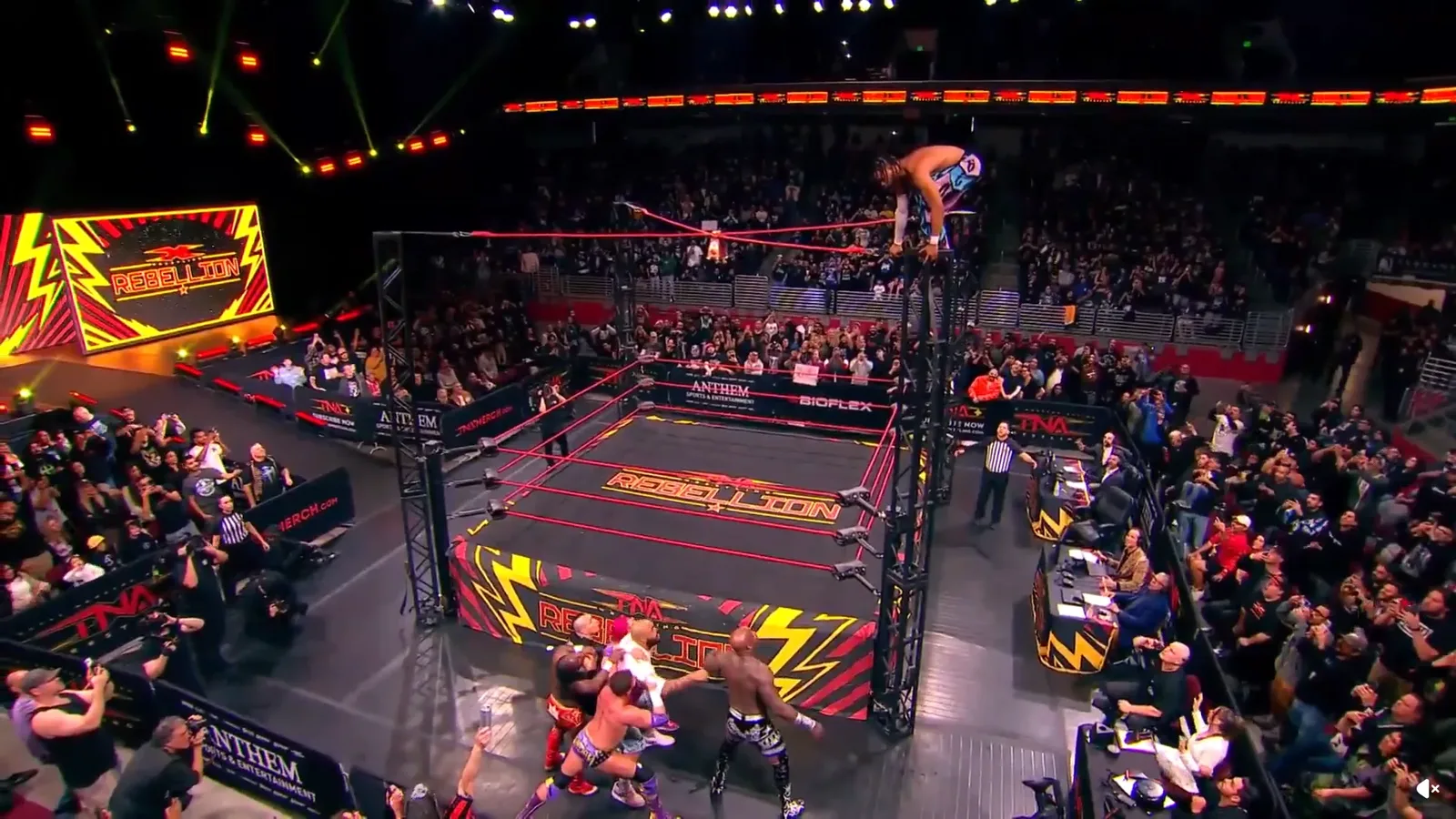
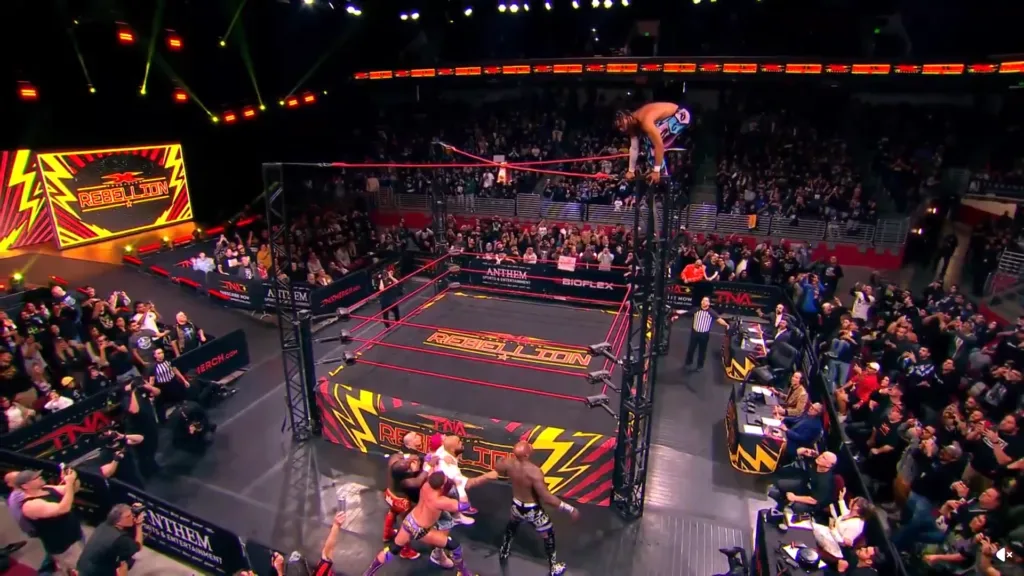
Leon Slater’s Ultimate X performance at TNA Rebellion 2025 delivered one of the most startling visuals associated with the match in recent memory. Climbing to the top of the Ultimate X structure, Slater launched himself into a Swanton 450 onto the competitors waiting below. It was a moment built for replays, but it also came with a significant element of risk that TNA management apparently did not know was coming.
Slater has now revealed that the leap was entirely his own idea and that, while the other wrestlers involved in the match were aware of the plan, company management was not. The young high-flyer described the decision as one where he had to prioritize asking for forgiveness afterward rather than seeking approval beforehand.
“It was definitely my idea. I’ll start out with that. It was definitely my idea. Nobody forced me to do it, and it was one of those things where I kind of had to ask for forgiveness and not permission.”
Ultimate X has long been one of TNA’s most distinctive attractions. The match places the championship or prize above the ring, with cables crossing over the ring area and competitors required to climb the structure and traverse the cables to claim it. The design produces an inherently precarious environment even before wrestlers introduce dives, throws, or aerial maneuvers from its elevated points.
For more background on this topic, read Leon Slater Fires Back At Grayson Waller’s TNA Criticism: “It’s All Just Talk”.
For Slater, competing in Ultimate X for the first time presented an opportunity to make an immediate mark in a match synonymous with TNA’s history of risk-taking athleticism. He said the other participants understood the value of creating a sequence that could stand out well beyond the event itself, and they were willing to be part of it.
“So, the guys in the match knew of course and they were up for it because they knew it would be one of these moments that would live forever and like I was saying, as someone that wants to be remembered and have these moments and make this history, I knew in my first Ultimate X match I had to do something to set the tone.”
Slater Wanted to Add His Name to Ultimate X History
The Ultimate X stipulation carries a reputation for career-defining risks. Over the years, the match has produced unforgettable scenes that have helped establish TNA’s identity as a promotion willing to spotlight innovative and explosive X-Division-style wrestling. Slater specifically framed his Rebellion dive as an attempt to place his name alongside prior moments that remain central to the conversation around Ultimate X.
He pointed to Elix Skipper’s famous hurricanrana from the cage and AJ Styles’ remarkable flip bump off a dropkick as examples of the type of sequences fans continue to revisit. Both stand as reminders of the way TNA’s signature specialty match can turn a single decision into a lasting part of a wrestler’s legacy.
“It would be, hopefully, replayed along with Elix Skipper, hurricanrana off the cage and A.J. doing the crazy flip bump off of the dropkick. Being in such a signature TNA match, I knew I had to leave my stamp on it.”
That perspective explains why Slater viewed the Swanton 450 as more than an isolated high spot. It was a statement of intent. A wrestler entering a celebrated specialty match can simply participate in its established traditions, or they can try to create an image that becomes part of the match’s continuing mythology. Slater chose the latter route.
There is, however, a substantial difference between a memorable risk and a risk that can be responsibly approved in advance. Slater acknowledged that management likely would have been reluctant to authorize a maneuver from the top of a structure he described as 30 feet high. Rather than put officials in the position of rejecting the proposal, he kept the plan from them.
“But like I was saying, I definitely had to ask for forgiveness and not permission because I think if I went to management and said, ‘Yeah, I’m gonna do this crazy flip off of the top of this 30-foot structure,’ they would’ve been like, ‘Eh, yeah, maybe that’s a risk we don’t take.’”
A Spectacular Moment With Real Consequences
Slater’s comments do not present the stunt as something he believes should be routinely repeated. In fact, he was clear in his assessment of the danger after the fact. The wrestler called the decision “very stupid” in retrospect and said he would not perform it again.
That candid reflection is important in a business where spectacular highlights can sometimes overshadow the preparation, danger, and potential physical cost involved. Ultimate X’s cables, supports, distance from the ring, and the need for multiple wrestlers to be positioned correctly below all increase the margin for error. A move of this nature depends not only on the person leaping, but on everyone involved being in the proper place at the proper time.
“Looking back on it, it was very stupid; I would never do it again. I’ve done it now; I don’t need to do it again.”
Slater also said that people close to him reacted with a mixture of anger and concern after seeing the leap. That response underlines just how severe the perceived danger was, even if the moment succeeded in the way it was intended to from a performance standpoint.
“I had a lot of angry and concerned messages from a lot of people close to me after that.”
Still, Slater has no regrets about the lasting impact of the moment. He believes it helped establish the kind of legacy he wants to build in TNA, and he expects it to remain part of the promotion’s visual history for years to come.
“But I’m glad I did it and I wouldn’t change it for the world because like I said, I think it is gonna be a moment that’s gonna be replayed as long as TNA lives forever, you know?”
The Balance Between Legacy and Safety
Slater’s story illustrates a familiar tension in professional wrestling. Performers are constantly searching for ways to distinguish themselves, particularly in marquee matches that reward innovation and fearlessness. At the same time, promotions have a responsibility to manage risk, protect talent, and make decisions that extend beyond the immediate reaction from the live crowd or the social-media clip that follows.
In that sense, Slater’s admission that management was unaware of the plan is not merely a piece of trivia about a famous spot. It provides context for how calculated the presentation of major wrestling moments needs to be. The talent in the match may understand the vision and be ready to execute it, but company officials are tasked with considering factors that the rush of competition can make easier to overlook.
Slater’s willingness to openly call the move a mistake from a safety perspective, while also valuing its historical significance, creates a balanced view of the moment. He is not presenting the leap as a challenge for others to exceed. Instead, he sees it as a singular act: something done once, something that worked, and something he does not need to attempt again.
That may ultimately make the Rebellion 2025 moment even more memorable. It was not designed as the opening chapter in a series of increasingly dangerous attempts. It was Slater’s one-time effort to announce himself within the tradition of Ultimate X and secure a place in the match’s long list of extraordinary images.
World Title Opportunity at Bound For Glory
The Ultimate X spotlight was a major chapter in Slater’s TNA run, but his ambitions extended to the promotion’s biggest prize. At TNA Bound For Glory, Slater was set to challenge Nic Nemeth for the TNA World Championship.
Bound For Glory was scheduled for October 11 in Tampa, Florida. A victory over Nemeth would represent a defining career milestone for Slater, shifting him from a wrestler known for breathtaking athletic feats into the role of TNA World Champion.
Whether pursuing championship gold or reflecting on the risks that shaped his rise, Slater’s comments make one point clear: he wants his work to endure. The Ultimate X Swanton 450 achieved that goal in dramatic fashion. It gave TNA a replay-worthy scene, gave fans a moment of disbelief, and gave Slater the signature stamp he believed his first Ultimate X appearance required. Yet his own warning is just as notable as the leap itself: some moments are powerful precisely because they are not meant to be repeated.
In pictures
Darryl Polo
Darryl Polo is a passionate wrestling fan covering WWE, AEW, TNA and beyond. He loves great rivalries, breakout stars and the moments that keep fans talking long after the bell. How we work.