
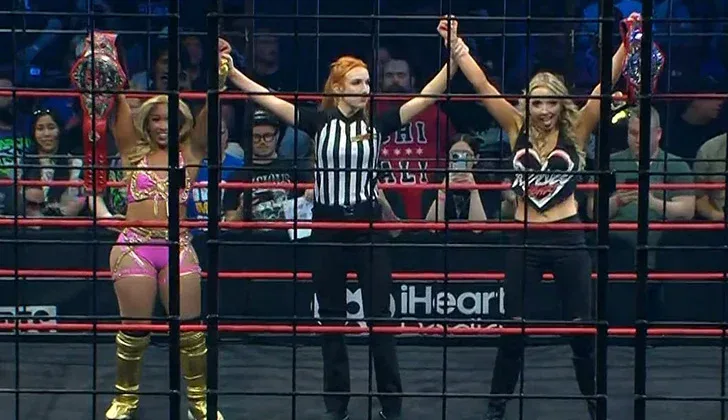
Kiera Hogan’s return to TNA has already carried the feeling of a full-circle moment for the former Knockout. After making her first appearance for the company since August 2021 at the August 23 Lockdown pay-per-view, Hogan has spoken openly about why the comeback has meant so much to her.
Hogan returned by joining Allie in the defense of Allie’s Knockouts World Tag Team Championships, marking a major moment following an extended absence from the ring. The comeback also resulted in Hogan leaving Lockdown with gold, an outcome she described as the culmination of a difficult personal and professional road back.
Speaking with Denise Salcedo on Busted Open Radio, Hogan said TNA has remained close to her throughout every stage of her career, including the time she spent away from the promotion and the period in which injury kept her out of action altogether.
“I feel like I’m home,” Hogan said. “TNA has always had my heart, no matter how far I went. I feel like it was always there for me, no matter what. They truly came together and made it into a full circle moment, me coming back to TNA and winning gold.”
The emotional impact of the return has not worn off quickly. Hogan said she has been “on cloud nine” since Lockdown, particularly after having to work her way through the uncertainty that followed shoulder surgery. Rather than easing into a light schedule, Hogan immediately found herself busy upon returning, wrestling four matches in her first week back.
A Return Years in the Making
Hogan’s August 23 appearance ended a TNA absence that dated back to August 2021. For any wrestler, returning to a familiar company after several years can be a notable career development. In Hogan’s case, the situation had another layer: she was coming back after dealing with the first major injury of her career.
She explained that the injury forced her to confront questions she had not expected to face. Wrestling had been central to her life for more than 11 years, not simply as a job but as an outlet that provided happiness, creativity, and direction. Being unable to participate made watching wrestling from a distance feel unfamiliar and, at times, painful.
“Being gone for so long was very hard,” Hogan said. “I had a lot of thoughts in my mind if I could even return to wrestling or if I could still do it. Watching from afar was something that was foreign to me.”
Hogan noted that she underwent surgery on her shoulder. She had trained when possible on the side before her TNA return, but the recovery process was about much more than simply waiting for medical clearance. It meant rebuilding confidence in her body and in her ability to perform at the level required in a physical, contact-based profession.
That challenge can be especially stark for a wrestler returning from a first major injury. A long layoff disrupts timing, conditioning, and routine, but it can also create a mental hurdle. Hogan’s comments make clear that she was not taking a comeback for granted. She had to determine, through training and repetition, whether returning was truly possible.
“It was taken away from me by force,” Hogan said of wrestling during the injury layoff. “I never thought in a million years that an injury would take me out, but you have to give it to the game. It’s part of being a wrestler and in a contact sport.”
Getting Back Into the Ring
Hogan said she was cleared roughly seven months after surgery. Once cleared, she went back to train with Mr. Hughes in Atlanta, a decision that immediately tested her resolve. Her first session back was not a brief reintroduction to the ring. Hogan said Mr. Hughes put her through two and a half hours of work.
“The first time I got back in the ring, he worked me for two and a half hours,” Hogan recalled. “I was like, ‘Oh my God, I don’t know if I can do this.’ I kept pushing and pushing.”
That initial difficulty did not stop her. Instead, Hogan continued training and began preparing to resume taking bookings. Her plan at that stage was straightforward: get back into wrestling, rebuild her momentum, and return to the independent scene if necessary. She had already accepted her first independent booking for the week after Lockdown before TNA contacted her.
That detail underlines how unexpected the TNA call was. Hogan was not waiting with an assumption that a major return was imminent. By her own account, she was focused on doing the work necessary to re-enter the wrestling world one step at a time.
“Absolutely not,” Hogan said when asked if she expected TNA to reach out. “I was just happy to be getting back to wrestling. I booked my first indie show before TNA even called me.”
Hogan said she was already training and preparing for that independent date after Lockdown when the TNA opportunity emerged. The call changed the scale of her comeback, but it arrived while she was already taking the practical steps needed to be ready.
“I’m ready to go. I’m training and preparing,” Hogan said of her mindset before the call. “It kicked off the preparation. I felt like I was slowly getting back into it but this ignited me.”
Lockdown Provides an Immediate Milestone
The timing of Hogan’s return gave TNA an opportunity to present a familiar name in a meaningful championship situation immediately. Rather than a quiet reintroduction or a lengthy period on the sidelines, Hogan entered the picture alongside Allie in a Knockouts World Tag Team Championship defense at Lockdown.
For Hogan, the event was significant not only because it was her first TNA appearance in years, but because she could frame the night as a championship-winning homecoming. Her description of the experience emphasizes the personal nature of the achievement. The gold was important, but so was the setting in which it happened: a promotion she believes has always held a place in her heart.
That sense of belonging is central to Hogan’s outlook on the move. Wrestlers often speak about the pressure of making an impact after time away. Hogan’s comments, however, point toward relief and gratitude as much as ambition. TNA represented a destination she did not expect to reach when she first resumed training, and the return arrived after she had spent months wondering whether she could wrestle again.
There is also a substantial contrast between the difficult beginning of her comeback process and the pace of her first week back. Hogan went from being worked for two and a half hours during an early training session and questioning whether she could do it, to competing four times during her opening week after returning. That quick transition speaks to the work she put in after receiving clearance and to the motivation created by the TNA opportunity.
Hogan’s Perspective on the Road Back
Hogan’s comments do not minimize the seriousness of the setback. She was candid that being separated from wrestling was sad because of how deeply the industry has shaped her life. Yet she also acknowledged the reality that injuries are part of the profession. Her response was not to dismiss the difficulty, but to keep moving once she had the chance to do so.
The return to TNA now gives Hogan a new chapter after a period in which her immediate future in the ring was uncertain. She has the familiarity of a company she calls home, a championship accomplishment from her return event, and the momentum of a busy first week back in action.
Most importantly, Hogan’s own account shows that the road to Lockdown began before the call came. She was already preparing to wrestle independently, already putting in ring time, and already pushing past the doubts that can accompany a major injury. TNA’s outreach did not create her desire to return; it accelerated a process she had already begun.
Now, with her comeback underway, Hogan is looking at a far different situation than the one she faced during her layoff. The uncertainty of whether she could return has been replaced by a championship moment and a renewed place in TNA. For Hogan, that is why the promotion’s latest chapter feels less like a new destination and more like coming home.
Keep reading on SmackDownOnYou
Darryl Polo
Darryl Polo is a passionate wrestling fan covering WWE, AEW, TNA and beyond. He loves great rivalries, breakout stars and the moments that keep fans talking long after the bell. How we work.