
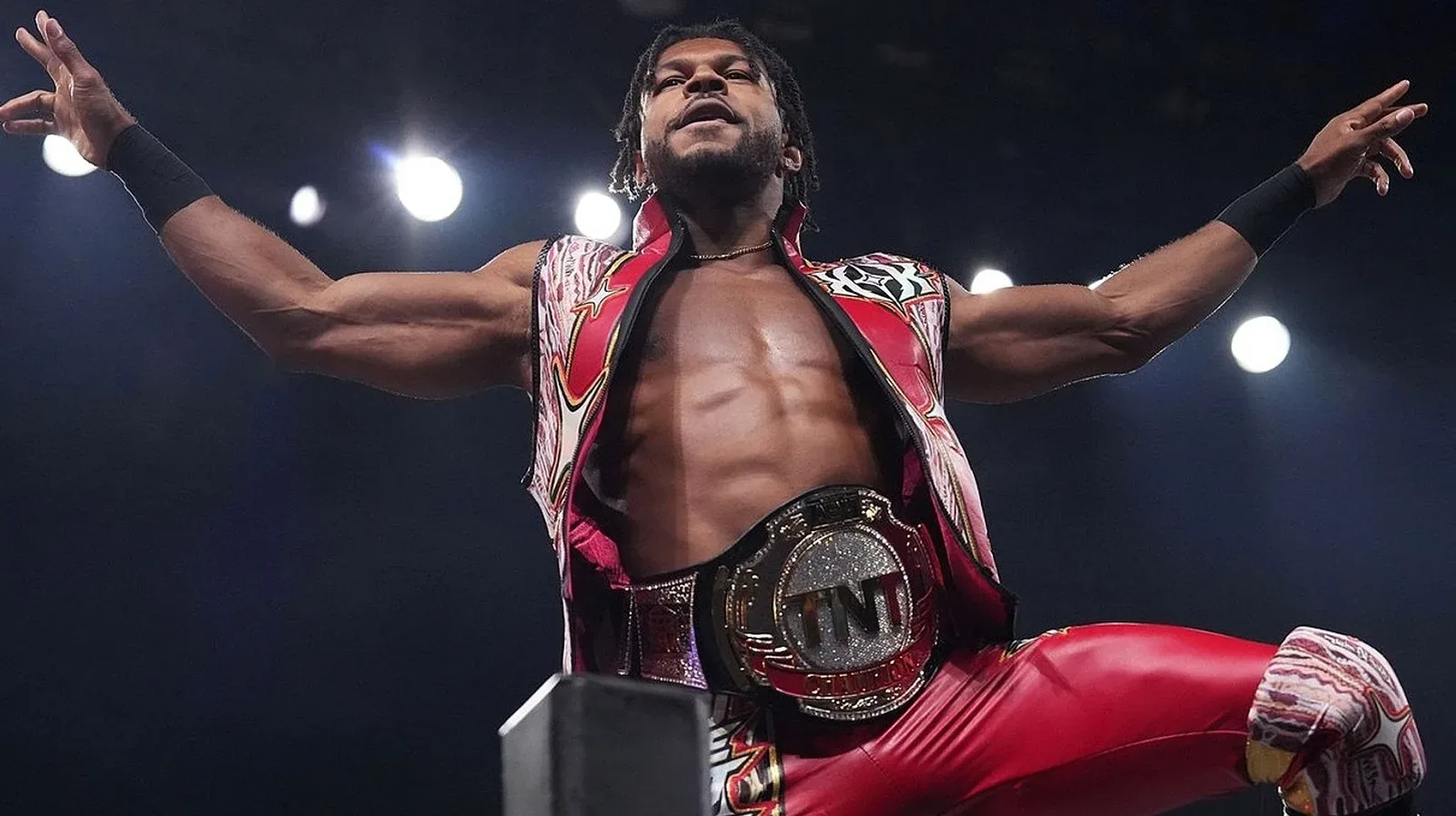
Kevin Knight is not viewing the end of his AEW TNT Championship reign as a step backward.
Knight lost the title to Darby Allin at AEW All In: London, bringing a 140-day run with the championship to a close and giving Allin his third reign as TNT Champion. On paper, it was a major change in momentum: Knight entered the event as champion after establishing himself as a difficult opponent to dislodge, while Allin left London with one of AEW's most recognizable prizes back around his waist.
But Knight believes the manner of the defeat is more significant than the result itself. Speaking on the Battleground Podcast, Knight argued that Allin needed far more than a conventional championship performance to finally get past him. With Sting and Sting's son, Steven Borden, becoming involved in the finish, Knight said the match demonstrated exactly how seriously Allin had to take him.
“I think his efforts to take the belt off of me just shows how great of a champion that I was, how dominant of a champion that I am, and how much of a threat that I am to the AEW locker room.”
For more background on this topic, read Swerve Strickland Teams With Max B For New Single ‘Coo Coo’.
That framing is central to Knight's response following All In. Rather than presenting the title loss as evidence that his championship run had reached its limit, he sees it as confirmation that he was a champion opponents could not comfortably handle on their own. In Knight's view, Allin's decision to rely on assistance did not diminish Knight. It elevated the perceived challenge he represented.
A title reign that changed Knight's AEW position
Knight originally captured the TNT Championship by winning the Casino Gauntlet Match at AEW: Dynasty. That victory gave him a prominent singles platform and put him in possession of a championship that has often served as a defining proving ground in AEW. The title has historically been associated with wrestlers trying to establish themselves, veterans seeking to reassert themselves, and standout talents looking to turn a run of strong performances into a lasting place near the top of the roster.
For 140 days, Knight held that role. The length of the reign gave him time to be recognized not simply as the winner of a multi-person opportunity, but as an active champion who had become a fixture in the division. Losing the title at All In: London certainly changes the immediate landscape, especially with Allin now holding the championship, but Knight does not believe it removes the statement his reign made.
His comments suggest that he is focused less on the physical presence of the belt and more on what the run established. Knight said a championship is not what defines him, even if it can sharpen the attention paid to him by the rest of the locker room.
“A championship doesn't define me. It never has and never will, but I think it put the rest of the locker room on notice of just how powerful I am.”
That is an important distinction for a wrestler coming out of a loss on a major pay-per-view. Former champions can either treat the defeat as a detour before shifting focus elsewhere or use the circumstances to justify an immediate pursuit of the title they lost. Knight's remarks leave room for both possibilities. He made clear that he remains confident in his own ability, and he also made clear that his issue with Allin is not settled.
Darby Allin's victory came with complications
Allin's win made him a three-time TNT Champion, further adding to his history with a title that has been one of the most important parts of his AEW career. Knight did not dismiss Allin's credentials in addressing the loss. Instead, he acknowledged that the new champion is a threat in his own right and referred to him as one of AEW's “old pillars.”
The praise, however, came alongside a sharp interpretation of how Allin had to win. Knight maintained that Sting and Steven Borden's involvement was an indication that Allin could not simply take the championship through a straightforward one-on-one battle. The implication from Knight is that Allin's victory may have changed who holds the title, but it did not settle the question of who was stronger in an uncontested setting.
“The fact that he had to go to those measures, it just lets me know, and it just lets the rest of the locker room know that, hey, I'm nothing to play with.”
That message gives Knight a clear foundation should he seek another match with Allin. In wrestling, a title change influenced by outside interference almost always creates an obvious unresolved issue, particularly when the former champion believes he had the match under control before others entered the picture. Knight has now publicly stated that he considers the involvement to be decisive enough that it remains part of the story, not merely an unfortunate detail from an eventful night in London.
It also gives the TNT Championship picture an immediate source of tension. Allin has regained the championship, but he now carries it with Knight insisting that the win required help from figures closely connected to Allin. Whether or not Allin sees the situation the same way, Knight has positioned himself as a former champion who believes he has an argument for a rematch.
Knight frustrated by Sting and Steven Borden
Knight did not hide his frustration when asked specifically about Sting and Steven Borden getting involved. His response was not solely about the loss itself. He also expressed disappointment after the scale of his entrance and the effort he put into the match at one of AEW's biggest events.
“Very disappointing. But, this isn't the end of the road. It's not the end of the story between me and Darby.”
The wording is notable because it is more than a complaint about a disputed finish. Knight is openly presenting his rivalry with Allin as unfinished business. He has not claimed that the title loss ended his ambitions, and he has not treated Allin's victory as a final statement. Instead, Knight is presenting All In as another chapter in a conflict that has yet to reach a clean conclusion.
The involvement of Sting also adds a layer of personal frustration to Knight's perspective. Sting has long been intertwined with Allin's AEW journey, and Steven Borden's presence in the outcome ensured that the finish would not be viewed only through the lens of two wrestlers competing for a championship. Knight's annoyance is understandable within the story he is telling: a champion who had fought through a major entrance, a major stage, and a major challenger only to see outside factors shape the ending.
That does not change the official record. Allin is the TNT Champion, and Knight's 140-day reign is over. Still, Knight's point is that the official result alone does not capture the full picture of what happened at All In: London. His contention is that the champion who beat him had to receive support in order to do it.
What comes next for the former champion
Knight's comments leave AEW with an obvious direction to explore. A rematch with Allin would carry a ready-made hook: Knight wants to prove that he can defeat the new champion without interference from Sting or Steven Borden, while Allin would have the opportunity to show that his third TNT title reign is not dependent on anyone else.
At the same time, Knight's broader point is that he does not intend to let a championship determine his value. That stance could allow him to pursue Allin immediately, or it could lead him toward other major opponents while maintaining that the locker room has seen what he is capable of. Either way, he is not speaking like a wrestler whose confidence has been shaken by the result.
Instead, Knight is leaning into the idea that a former champion can be more dangerous after a loss, especially when he believes the loss was not clean. The TNT Championship may no longer be in his possession, but he sees the circumstances surrounding its change of hands as proof that he remains a serious force in AEW.
For Allin, the third reign has begun with a high-profile win. For Knight, the pursuit appears far from over.
In pictures
Darryl Polo
Darryl Polo is a passionate wrestling fan covering WWE, AEW, TNA and beyond. He loves great rivalries, breakout stars and the moments that keep fans talking long after the bell. How we work.