
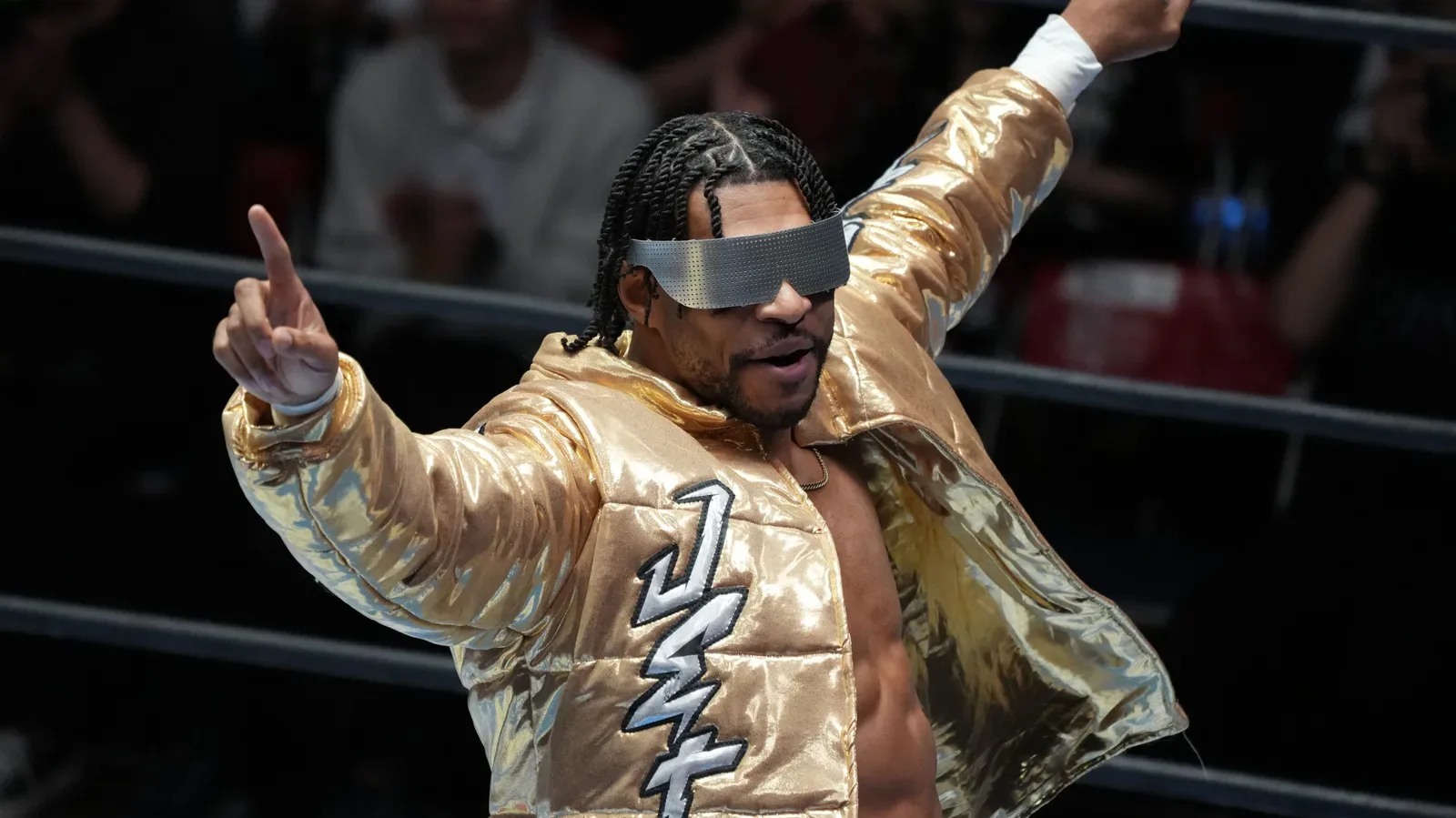
Kevin Knight’s rise in AEW has put a renewed spotlight on the training that helped build the high-flying performer before he arrived in the company. Now working alongside Katsuyori Shibata in AEW, Knight can look back on his time as one of Shibata’s pupils at the NJPW LA Dojo with considerably more perspective than he had while enduring the daily routine.
That perspective does not mean Knight is pretending the experience was easy. Training under Shibata meant adapting to a demanding structure, navigating a language barrier and learning a style of wrestling that differed sharply from the athletic background Knight brought into the business. In a conversation with Battleground Podcast, Knight described the process as overwhelmingly repetitive at the time, even if he now recognizes the value in the lessons.
The LA Dojo served as a significant developmental environment for a generation of wrestlers looking to establish themselves through New Japan Pro-Wrestling’s system. Knight trained alongside names including Clark Connors, Karl Fredericks and Alex Coughlin. Each member of that group entered a setting shaped by Shibata’s exacting standards and his distinctive approach to professional wrestling instruction.
For Knight, the adjustment was particularly substantial. He had to become familiar with the Japanese wrestling style while also working through the unusual conditions of the COVID-19 pandemic, when wrestlers performed matches without fans in attendance. Those factors made his early development more challenging, but Shibata’s method of training was the element that required perhaps the greatest adaptation.
For more background on this topic, read NJPW Destruction in Kobe Full Card Set for September 27.
Repetition Defined the Daily Routine
Knight said that the monotony of the LA Dojo sessions was difficult to appreciate while he was living through it. The group would repeat the same basic preparation and drills day after day, an approach that could feel restrictive for someone eager to improve, stand out and move forward in a wrestling career.
“At the time, I feel like I hated the monotony, the monotony of it all,” Knight said on Battleground Podcast. “We did the same thing every single day, the same warm up, the same rolls, the same squats, the same drills.”
In a training system like the one Shibata fostered, repetition is not simply about physical conditioning. Repeating rolls, squats, warm-ups and wrestling drills can establish muscle memory, discipline and consistency. It can also reveal whether an athlete is capable of maintaining effort and focus when the work is no longer new or exciting. For a dojo prospect, that durability is often as essential as natural explosiveness or charisma.
Knight’s comments illustrate the tension at the heart of rigorous wrestling training. A wrestler may want constant new information, individualized feedback and opportunities to show what makes them different. A trainer may instead want to see the basics performed correctly so many times that there is no hesitation when it matters inside the ring. Shibata’s program clearly leaned toward the latter approach.
That did not always make communication straightforward. Knight noted that detailed feedback was limited, in part because Shibata’s English was not strong enough to allow for constant technical explanation. Rather than receiving lengthy verbal breakdowns after every drill, the trainees had to study Shibata’s reactions and make judgments about whether they were meeting his expectations.
“There wasn’t much detailed feedback, if I can say that correctly, because you know, Shibata’s English isn’t the best,” Knight said. “So we just had to go off of vibes, you know, straight vibes.”
That dynamic placed greater responsibility on the students. Knight explained that they had to feel out whether Shibata approved of what they were doing, trust their instincts and try to understand the precise qualities their trainer wanted without always being able to discuss them in detail. It was a challenging environment, but one that demanded awareness beyond simply following spoken instructions.
Learning to Read Shibata’s Expectations
Shibata’s reputation as a wrestler and trainer makes Knight’s description unsurprising. The former NJPW star has long been associated with a physical, stripped-down presentation built around credibility, control and intensity. His approach naturally asks wrestlers to understand the importance of timing, body positioning and the purpose behind an action, not merely the sequence of moves.
Knight said the language barrier heightened the difficulty of working within that approach. Shibata’s style was already unique, and the inability to freely seek a detailed explanation of every concern made it harder to know immediately whether a drill or sequence was being executed as intended.
“We had to, you know, really trust our instincts in there with Shibata-san, because he has a very unique way of training,” Knight said. “And with that language being in front of his unique way of training, it was very hard to engage, you know, if we were doing it correctly, or what he was exactly looking for.”
There is a valuable lesson in that uncertainty. Professional wrestling requires performers to process information in real time. They must react to opponents, audiences, officials and changing match situations while still protecting one another and telling a coherent story. The ability to observe, adjust and respond without needing every detail verbally spelled out can become an important tool in that environment.
For Knight, the experience also contrasts with the training he has received from other respected figures. He specifically noted that Shibata’s system was difficult in ways that differed from working with KUSHIDA and WWE’s Natalya. Different trainers can provide different languages, priorities and methods, but Shibata’s routine appears to have made a lasting impression because it forced Knight to find answers through repetition and observation.
The results of that development can be seen in Knight’s continued progress. Since joining AEW in 2025, he has brought speed and athleticism that are immediately apparent, but the qualities developed in a dojo environment can be less visible while remaining just as important. Poise, timing and an ability to control one’s pace are all traits that help turn athletic ability into a sustainable in-ring identity.
Patience Became Shibata’s Most Lasting Lesson
When asked about the most important wisdom Shibata gave him, Knight did not point to a specific maneuver or a complicated wrestling concept. Instead, he identified a simple instruction that has affected both his work and his mindset: patience.
“I would say patience,” Knight said. “He would always say ‘Be patient,’ whether that’s in the ring or out of the ring.”
That message was especially meaningful because of Knight’s previous experience in football. Football rewards immediate acceleration, fast decisions and explosive movement. Knight said that he came from a world where the expectation was to do everything quickly. In wrestling, however, speed without control can undercut the impact of a moment. A wrestler has to know when to move rapidly, when to pause and when to allow an audience to understand what it has just seen.
Slowing down can be counterintuitive for an athlete known for dynamic movement, yet it is fundamental to match construction. A pause can make a strike feel heavier. A moment of eye contact can establish conflict. A deliberate transition can give a crowd the time needed to react emotionally. Patience is not inactivity; it is the control to make every action happen at the right time.
“I always think about that, because I came from a football world, where you’ve got to do everything fast, fast, fast,” Knight said. “So being able to be patient and slow everything down was so foreign to me.”
Knight said he continues to apply that guidance beyond wrestling mechanics. He reminds himself that he does not have to operate at full speed at every moment, whether he is speaking, competing or handling another part of his life. The lesson has helped him find a more measured approach, and he believes it has paid off.
“I can slow myself down, whether I’m talking, wrestling, whatever it is,” Knight said. “And yeah, just having that patience has gotten me to where I’m at, and it’s paying dividends.”
Knight’s recollection of the LA Dojo is ultimately not a story about enjoying every squat, roll or repeated drill. It is a story about understanding their purpose later. The monotony that frustrated him became part of a foundation, while the limited verbal communication pushed him to become more observant and self-reliant. Most importantly, Shibata’s insistence on patience gave Knight a counterbalance to the urgency that came naturally from his football background.
As AEW coworkers, Knight and Shibata now occupy a different stage of their respective careers than they did in the LA Dojo. But Knight’s account makes clear that their connection remains rooted in those difficult developmental years. What once felt like an endless routine helped teach Knight that the fastest way forward is not always to move faster.
In pictures


Darryl Polo
Darryl Polo is a passionate wrestling fan covering WWE, AEW, TNA and beyond. He loves great rivalries, breakout stars and the moments that keep fans talking long after the bell. How we work.