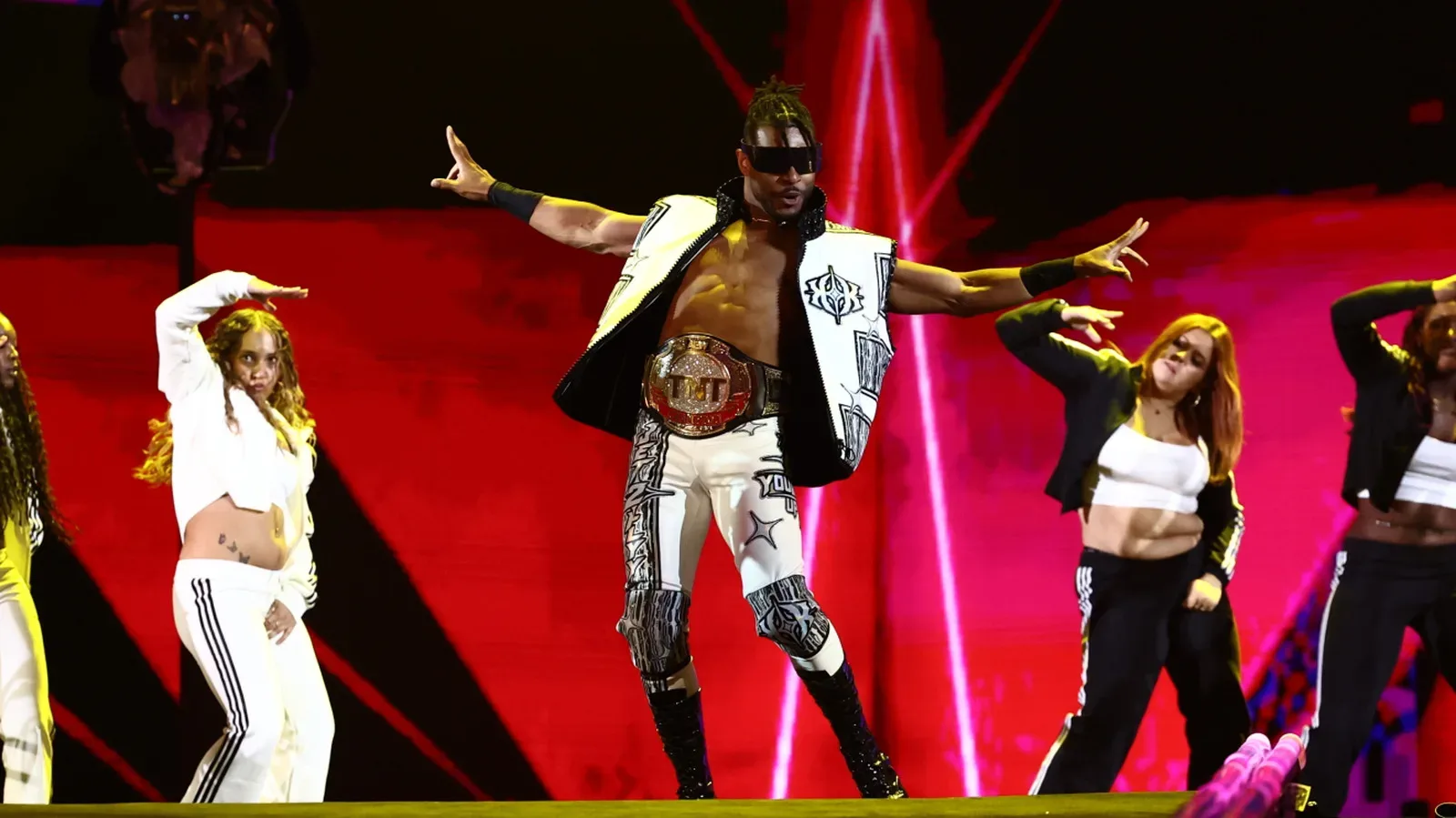
Kevin Knight has offered a measured perspective on one of professional wrestling’s most persistent conversations: the competitive divide between AEW and WWE fans. Speaking ahead of AEW All In London 2026, Knight said that promotional loyalty is a natural part of sports and entertainment fandom, but he also emphasized that it does not reflect the relationships many wrestlers share behind the scenes.
The AEW performer pointed to his own connections with talent in WWE as evidence that online arguments rarely tell the full story. Knight named Trick Williams and Je'Von Evans among the wrestlers he considers friends, while also discussing the broader support system shared by Black wrestlers working throughout the industry.
His comments arrive at a time when discourse around AEW and WWE can become especially intense online. Ratings discussions, attendance figures, creative decisions, title changes, television rights, and major event comparisons all regularly fuel arguments between fans. Knight did not dismiss that competitive energy outright. Instead, he framed it as a familiar consequence of passionate fandom.
“I think since this is an artform, since we're in the public eye, that tribalism and all of that fandom is going to naturally come,” Knight said.
For more background on this topic, read Nyla Rose Says Forklifts And Airplanes Were Among Her Unused Ideas For Jade Cargill Feud.
Knight compared wrestling’s environment to the allegiance that follows football clubs. Fans can strongly support one side and oppose another, even when the people involved are capable of maintaining mutual respect away from the competition. In wrestling, that distinction can be easy to lose when performers are discussed primarily through the lens of which company employs them.
“This club is not going to like this club,” Knight said while making the comparison, noting that supporters can still be friends in real life while passionately standing behind their own team. His larger point was that wrestling fans are not unusual for investing emotionally in their preferred promotion. The issue is not necessarily that fans choose favorites; it is remembering that performers themselves are often connected across the wider business.
Friendships Beyond Company Lines
Knight specifically cited WWE’s Trick Williams and Je'Von Evans, saying, “Me and Trick are homies. Je'Von Evans.” He also included AEW’s Swerve Strickland in his discussion of wrestlers supporting one another, stressing that company branding does not erase personal bonds or shared experiences.
That perspective is particularly relevant in an era when wrestlers frequently encounter each other through independent wrestling, training, previous promotions, conventions, media appearances, and the simple overlap that comes with working in a comparatively close industry. A public perception of AEW versus WWE can create the impression of a rigid wall between rosters, but Knight’s comments underline that the reality is more personal and less adversarial.
There is still genuine competition between major promotions. That competition can create opportunities for wrestlers, provide fans with different styles of programming, and raise the profile of major events. Knight’s comments did not suggest that fans should stop caring about AEW or WWE. Rather, they challenged the assumption that support for one promotion requires hostility toward the other—or toward the people working there.
For Knight, that wider view is tied closely to the experience of Black talent in wrestling. He said he supports everyone, while recognizing that Black performers have historically faced significant obstacles and limited representation in the industry. His focus was not merely on individual success, but on the importance of wrestlers being able to recognize and encourage one another’s progress.
Representation and a New Standard
Knight reflected on growing up with comparatively few Black wrestlers visible on wrestling television. That history gives added weight to the present landscape, where Black wrestlers occupy prominent roles across major promotions, compete in high-profile matches, lead divisions, and hold championships.
Within AEW, Knight highlighted Willow Nightingale, Mercedes Moné, Maya World, and Swerve Strickland. He also pointed to The Hurt Syndicate as a group whose presence is difficult to overlook. The names represent different places within the wrestling landscape, but Knight’s message centered on the collective significance of Black performers being visible in prominent spaces.
“This is the standard now,” Knight said. “That's the goal that we're all trying to go for.”
That statement carries an important distinction. Knight was not describing representation as a novelty or a temporary trend. He presented it as an expectation for the modern wrestling business. In his view, Black talent should no longer be treated as rare exceptions on a roster. The objective is a landscape in which their presence in featured roles, championship programs, factions, and major-event matches is understood as normal.
“We're not anomalies anymore,” Knight said, adding that The Hurt Syndicate are “doing their thing” and that “it's hard to ignore us.”
The sentiment speaks to a broader evolution in how representation is discussed. Visibility alone is meaningful, but Knight’s remarks also point toward sustained opportunity. The standard he described is not simply having a handful of performers appear on television. It is seeing Black wrestlers given room to develop distinct identities, tell varied stories, work at different levels of the card, and be judged as complete performers rather than reduced to a narrow set of expectations.
In AEW, the wrestlers Knight named bring different strengths and experiences to that picture. Strickland has been a defining singles presence, while Nightingale and Moné stand among the company’s most recognizable women’s division stars. Maya World is also part of the group Knight chose to acknowledge. The Hurt Syndicate’s collective profile further adds to the range of Black talent represented in the promotion.
Knight Also Praises WWE Talent
Knight’s message was not confined to his own company. He also praised WWE names including Carmelo Hayes, EK Prosper, and Oba Femi, saying the depth of talent across the men’s and women’s divisions is extensive enough that he could “go on for days.”
That willingness to recognize performers in another promotion is central to his stance on tribalism. Knight’s comments make clear that admiration does not have to be limited by a wrestler’s current employer. Fans may have their preferred shows, favorite rosters, and strongest opinions about the direction of AEW or WWE, but the performers themselves can still celebrate each other’s accomplishments.
Hayes, Prosper, and Femi were named as examples of the talent Knight sees across WWE’s system. Along with the AEW wrestlers he mentioned, their inclusion reinforced his belief that Black talent are building a stronger and more visible foundation throughout contemporary wrestling.
Knight’s viewpoint also leaves room for competitive fandom without treating rivalry as personal animosity. There is nothing unusual about fans debating which promotion they enjoy more. Wrestling has long thrived on strong opinions, and the modern social-media landscape ensures those opinions are voiced instantly and often forcefully. But Knight’s account of friendships across company lines offers a useful reminder that performers are not simply avatars for fan arguments.
As AEW heads toward All In London 2026, Knight’s comments place the focus on both community and progress. He sees the inevitable competitive spirit of wrestling fandom, but he also sees a community of wrestlers who support each other regardless of company affiliation. For Black performers in particular, that support carries the added context of a history in which representation was far less common.
His conclusion is direct: the current generation should not be viewed as an exception to wrestling’s norms. The goal is for this level of visibility, opportunity, and mutual support to remain the standard going forward.
In pictures
Darryl Polo
Darryl Polo is a passionate wrestling fan covering WWE, AEW, TNA and beyond. He loves great rivalries, breakout stars and the moments that keep fans talking long after the bell. How we work.