
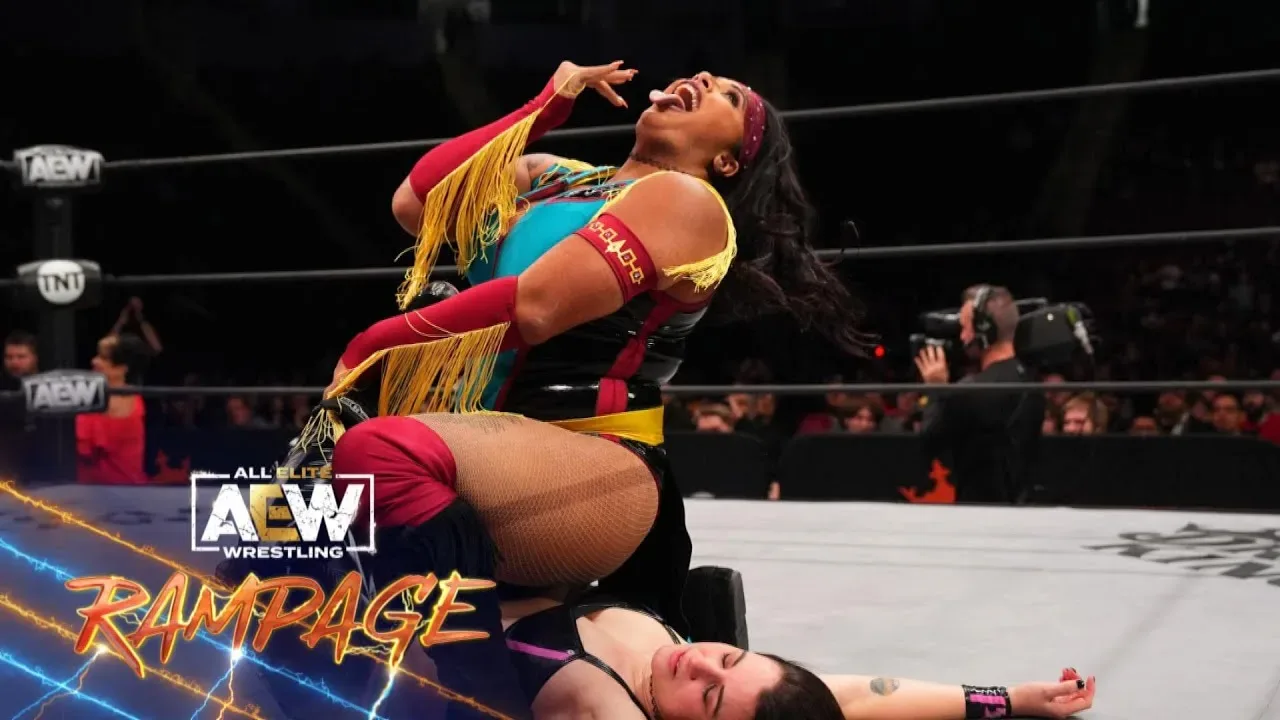
Nyla Rose’s 2022 rivalry with Jade Cargill was one of the more entertaining examples of a championship feud being driven as much by personality as physical confrontation. Rose did not merely challenge Cargill for the AEW TBS Championship; she stole the title belt and spent weeks needling the undefeated champion, turning the championship into a prop in an escalating campaign of taunts.
Looking back on that run, Rose revealed that the version fans saw on AEW television could have been even more extravagant. During an appearance with Denise Salcedo of Instinct Culture, Rose said she was given significant freedom to bring forward ideas for how to antagonize Cargill. That freedom produced plenty of pitches, though it also led to repeated rejections based on logistics, cost, scheduling and legal concerns.
“Pulling back the curtain a little bit, they pretty much gave me free rein, and I don’t think they realized…I got told ‘no’ so much. Not because my ideas were bad, but because ‘we don’t have the budget for that. We don’t have the timing for that. There is no way we can legally do that.’”
Among the ideas Rose brought to the table were requests that would have significantly raised the scale of the storyline. She recalled asking whether a forklift could be obtained for the following week, only to be told that it was not possible. Rose also floated an airplane as another potential element of the angle.
For more background on this topic, read Young Bucks Detail the Career-Spanning Easter Eggs in Their AEW All In London Gear.
“When they were like, ‘We want you to be you. What do you got?’ ‘Can you get me a forklift by next week?’ ‘No, can’t do that.’ ‘What about an airplane?’ ‘No, we can’t do an airplane.’ I had so many ideas for that little run, but that was a lot of fun, and to see people still enjoying that to this day is fantastic.”
A Title Theft That Set The Tone
The central hook of the program was straightforward: Rose got hold of Cargill’s AEW TBS Championship and refused to let the champion have it back without a fight. In wrestling, physical possession of a title belt is often used as visual shorthand for a challenger’s claim to a championship. Rose took that concept in a more mischievous direction, treating the belt as something she had successfully stolen rather than something she had officially won.
That distinction mattered. Cargill remained the recognized champion, while Rose used the belt to get under her opponent’s skin and to create a constant reminder that the title was not entirely secure in the champion’s hands. The angle gave Rose an opportunity to lean into an antagonistic, comedic edge without undercutting the fact that she was a credible threat once the rivalry reached the ring.
For Cargill, the situation created a different kind of challenge than a conventional contender simply demanding a match. Rose’s behavior made the feud personal and forced Cargill to pursue the person who had taken something that represented her dominance in AEW’s TBS division. The champion’s response was consistent with the aura she had cultivated: Cargill was determined to reclaim the belt and reaffirm that Rose had not disrupted her reign.
Creative Freedom Also Means Practical Limits
Rose’s comments offer a useful look at the balance involved in television wrestling production. Talent can be encouraged to arrive with character-driven ideas and broad creative pitches, but even a strong concept must be weighed against the realities of producing a weekly national program. A request may be rejected because it cannot be safely arranged in time, because the cost does not fit the planned segment, or because permissions and legal requirements make it unworkable.
Rose was clear that the repeated refusals were not presented to her as judgments on the quality of her ideas. Rather, they were practical decisions. A forklift is not simply a visual gag that can be placed on a television set at short notice. It introduces transportation, space, operation and safety considerations. An airplane, meanwhile, would naturally bring an even larger list of scheduling, location and legal obstacles.
That does not make the ideas unimportant to the story. The pitches illustrate how Rose viewed the feud: she wanted it to feel bigger, stranger and more relentless. The storyline that aired may not have featured industrial equipment or aviation, but it still communicated the key creative objective. Rose wanted Cargill to feel as though her opponent could appear with another way to embarrass or irritate her at any moment.
That spirit was evident in the title theft itself. It was a simple device with an immediate visual payoff, and it played directly to both competitors’ strengths. Cargill was an imposing champion whose presentation centered on confidence and control. Rose was able to puncture that control by behaving unpredictably, making the feud less about a routine ranking-based challenge and more about whether Cargill could make Rose pay for crossing a line.
Full Gear Brought The Rivalry To A Close
The program culminated at AEW Full Gear 2022, where Cargill defeated Rose and got her championship back. The result restored order to the division after Rose’s campaign of provocation and allowed Cargill to continue her reign with the TBS title firmly back in her possession.
While the conclusion followed the familiar structure of a champion overcoming the challenger who had tormented her, the route to that finish gave the match additional stakes. Rose had spent the preceding weeks establishing that this was more than a standard title defense. The title belt had become the symbol of the rivalry, so Cargill’s victory also served as a decisive answer to every taunt that came before it.
Rose’s recollection of the feud was notably positive despite the long list of ideas that did not make it to air. She characterized the run as fun and expressed appreciation that fans continue to remember it. That reaction reflects the value of a distinctive mid-card championship program: not every storyline needs the largest arena spectacle available to make a lasting impression. A clear character conflict, a memorable premise and committed performances can give a feud longevity.
Why The Program Still Stands Out
The Rose-Cargill rivalry stands out in part because it used the TBS Championship as an active storytelling object. Championships are always important in theory, but a belt can sometimes become little more than a visual accessory between defenses. By taking the title and using it to taunt its actual holder, Rose made the physical belt central to the weekly narrative.
It also showed the range Rose could bring to a television rivalry. Her comments about forklifts and airplanes fit the tone of a performer thinking beyond a single promo or match layout. Whether those concepts would have worked on screen is impossible to know, and they never moved beyond the pitch stage. What is clear is that Rose approached the storyline with an interest in finding unusual ways to intensify Cargill’s frustration.
For Cargill, the feud provided a foil who did not try to outmatch her through seriousness alone. Rose targeted the champion’s pride, presentation and attachment to the title, creating a conflict that could develop through segments as well as in-ring action. The Full Gear result ultimately reinforced Cargill’s standing, but Rose’s work helped give that defense a personal hook.
Rose also addressed her current absence from AEW elsewhere in the same interview. Her comments regarding the Cargill program, however, place the focus on a past chapter she clearly enjoyed: one built around a stolen championship, escalating chaos, and a collection of unusually ambitious ideas that ranged from the feasible to the decidedly difficult to put on television.
Darryl Polo
Darryl Polo is a passionate wrestling fan covering WWE, AEW, TNA and beyond. He loves great rivalries, breakout stars and the moments that keep fans talking long after the bell. How we work.