
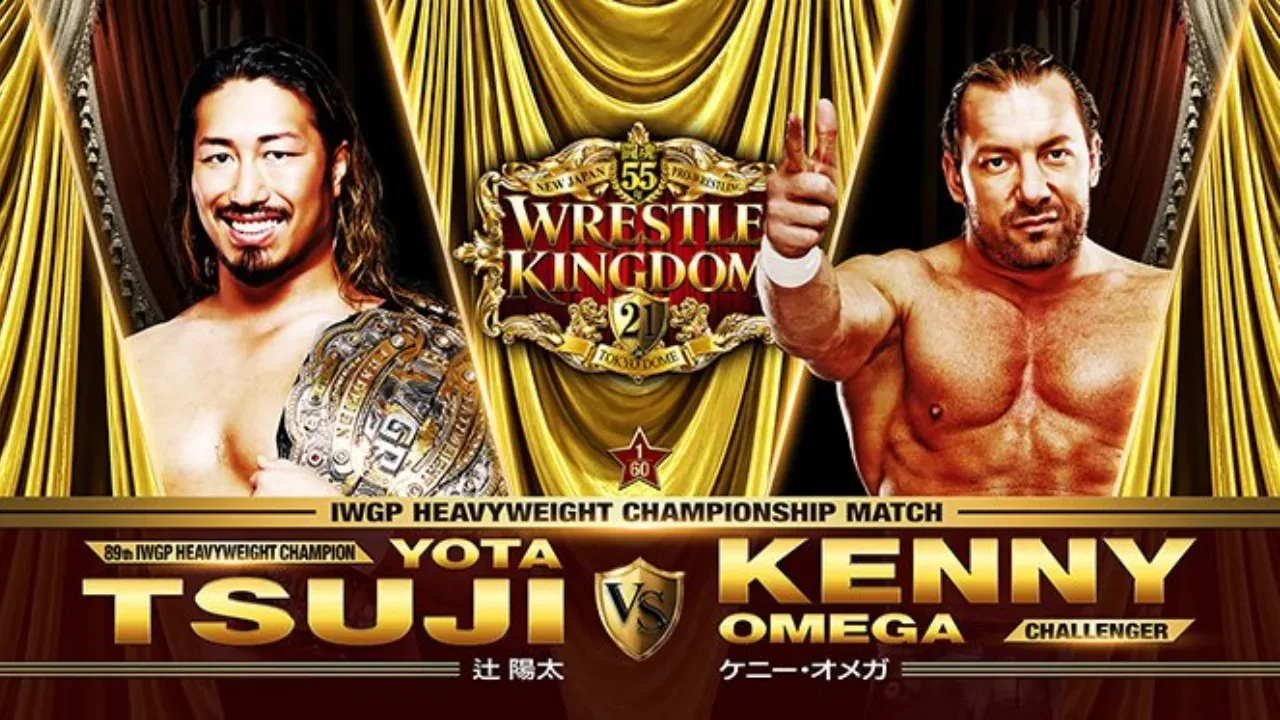
Kenny Omega has made a major commitment ahead of his return to the Tokyo Dome title picture. Omega will challenge Yota Tsuji for the IWGP Heavyweight Championship at Wrestle Kingdom 21, and he has stated that New Japan Pro-Wrestling would become his top in-ring priority if he leaves the event as champion.
The championship match is set for January 4, 2027, at the Tokyo Dome. It represents a potentially defining moment in Omega’s long relationship with NJPW, the promotion where he became one of the most prominent wrestlers in the world and previously held the company’s top heavyweight prize.
While Omega remains under contract with AEW, he explained that a second run with the IWGP Heavyweight Championship would require a clear commitment to the New Japan audience. He said he would not view his obligations through the lens of one promotion taking precedence by default, describing the relationship as one that should work both ways.
“I’m very cognizant of when (Konosuke) Takeshita was the title holder and there was concern that the fans felt he had misplaced his priorities, that he needed to appear more for the Japanese fans,” Omega said. “That was a real learning experience for me. As much as I want to hold that belt on American television, I can’t abandon the fans that supported me here.”
For more background on this topic, read Kenny Omega Hails Yuya Uemura vs. Ryohei Oiwa as a Modern Wrestling Standout.
Omega’s remarks directly address one of the central questions surrounding any wrestler who holds a major championship while working across multiple platforms: where will that champion make the bulk of their appearances? For NJPW fans, the value of the IWGP Heavyweight Championship is closely tied not only to its prestige but also to the champion’s visibility in Japan and willingness to defend against the promotion’s leading challengers.
Rather than treating an IWGP title reign as an opportunity to simply bring the belt into another television environment, Omega said he would place NJPW matches ahead of his AEW calendar. He also promised to defend against the wrestlers who earn title opportunities.
“So if I become the champion in New Japan, that becomes my number one priority,” Omega said. “I have (a) contract with AEW, but it is 50:50 and it’s time to stop thinking that this is one-sided. So my commitment is that if I am champion, New Japan matches will be prioritized over my AEW schedule, and I will face any rightful challenger that comes my way. I want to strengthen all sides on this relationship.”
Omega frames a potential reign around responsibility to NJPW fans
The comments place significant emphasis on Omega’s history in Japan. His rise in NJPW helped establish him as a global main-event figure, particularly through his work in the heavyweight division and his past championship success. A return to the IWGP Heavyweight Championship would therefore carry a different kind of expectation than a one-off crossover appearance or a title defense staged primarily outside the promotion.
Omega made clear that he understands those expectations. His reference to fan concerns during Konosuke Takeshita’s time as titleholder suggests that he has taken note of the importance Japanese fans place on a champion being available and present. The issue, in Omega’s view, is not merely whether the championship is seen in the United States. It is whether the people who regularly support NJPW feel that their champion is serving the promotion and its schedule.
That distinction matters as Wrestle Kingdom 21 approaches. The Tokyo Dome event is traditionally one of the biggest dates on the NJPW calendar, and the IWGP Heavyweight Championship match is positioned at the center of the company’s immediate future. Tsuji enters the bout with the opportunity to defend the title against a wrestler whose name remains strongly connected to some of New Japan’s most memorable modern heavyweight championship moments.
For Omega, the challenge is not just about winning a championship he has held before. It is also about explaining what he believes the role of champion should be in the current relationship between NJPW and AEW.
A 50-50 approach to AEW and New Japan
Omega did not suggest that an IWGP championship victory would end his relationship with AEW. Instead, he acknowledged his AEW contract while insisting that the arrangement should not be viewed as a one-way street. His use of “50:50” underlines his belief that both sides of the relationship should be strengthened.
That is an important element of his message. Omega is not presenting NJPW priority as a rejection of AEW, nor is he saying the IWGP Heavyweight Championship should be removed from American television entirely. In fact, he noted that he would like to hold the belt on American television. But he paired that ambition with a firm statement that he cannot “abandon” the fans who supported him in Japan.
The balance he described would be tested by the demands of holding a top title. An IWGP Heavyweight Champion is expected to be available for major NJPW events, respond to the promotion’s leading contenders, and carry the championship through the next stage of the company’s main-event scene. Omega’s pledge is that those responsibilities would be placed before AEW scheduling when the two are in conflict.
His stated willingness to face “any rightful challenger” is equally notable. Championship reigns are judged by the opponents a champion faces as much as by the title win itself, and Omega has made a direct public commitment to meeting the challengers NJPW determines have earned that position. The precise shape of any potential title reign, including opponents and dates beyond Wrestle Kingdom 21, remains unknown. However, Omega has already outlined the principle he says would govern it.
Yota Tsuji stands between Omega and another IWGP reign
Before any schedule can be prioritized, Omega must get past Tsuji at Wrestle Kingdom 21. Tsuji is the reigning IWGP Heavyweight Champion and will carry the championship into the Tokyo Dome match on January 4. Omega’s comments are therefore a statement of intent, not a guarantee that he will be champion after the event.
The matchup creates a clash between the reigning titleholder and one of the most recognizable names associated with NJPW’s modern international expansion. Tsuji has the chance to preserve his reign against an opponent who knows the pressure of the Tokyo Dome and the responsibility that accompanies the IWGP Heavyweight Championship. Omega, meanwhile, has the chance to regain the title and begin a new chapter with a clearly articulated promise to the NJPW audience.
Omega’s history makes the prospect especially compelling. He has already experienced the highest level of success in New Japan, and he understands both the visibility and scrutiny that come with the company’s top championship. His comments suggest that he sees a possible second reign not as a nostalgic return, but as a commitment requiring greater attention to the needs of the current NJPW fanbase.
There is also a practical message in what Omega said. By making the pledge before the title match, he has set an expectation for himself rather than waiting until after a possible victory. If he defeats Tsuji, fans will have a direct statement to measure his reign against: New Japan matches will be prioritized, rightful challengers will be accepted, and the relationship with AEW should be treated as mutually beneficial rather than one-sided.
Wrestle Kingdom 21 now carries an added layer
The IWGP Heavyweight Championship contest at Wrestle Kingdom 21 already has enormous stakes because of the title itself. Omega’s declaration adds another layer to the match. The winner will determine not only who leads NJPW into 2027, but also whether the championship’s immediate future includes a titleholder who has publicly promised to place New Japan first on his wrestling schedule.
For Tsuji, retaining would keep the championship with the reigning titleholder and prevent Omega from turning that pledge into reality. For Omega, a victory would mean returning to the top of NJPW with a stated plan to be present for the promotion and its fans.
January 4 at the Tokyo Dome will answer the first question: whether Omega can defeat Tsuji for the IWGP Heavyweight Championship. Should he do so, the next question will be just as significant—how his promise to prioritize NJPW takes shape throughout a potential new reign.

Darryl Polo
Darryl Polo is a passionate wrestling fan covering WWE, AEW, TNA and beyond. He loves great rivalries, breakout stars and the moments that keep fans talking long after the bell. How we work.