
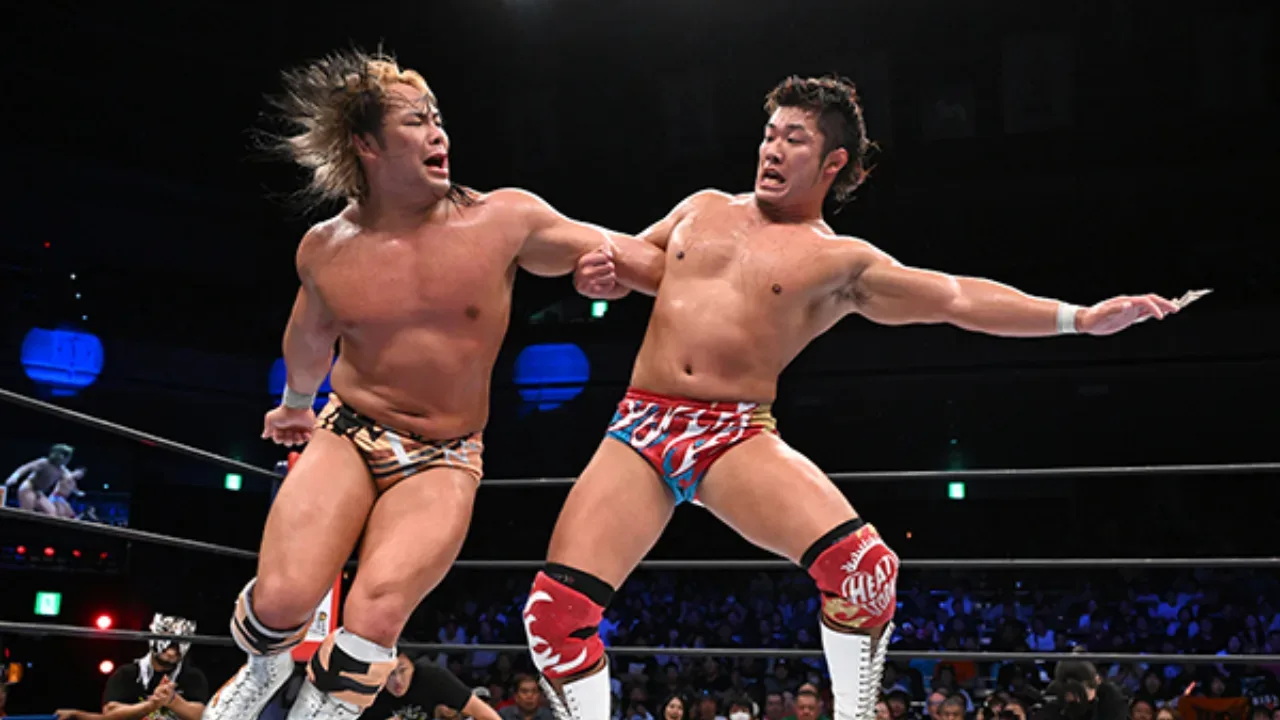
Kenny Omega has offered major praise for Yuya Uemura and Ryohei Oiwa following their meeting in the final of the 2026 NJPW G1 Climax, calling the match a rare and beautiful example of what professional wrestling can accomplish through its fundamentals.
Uemura and Oiwa faced one another over the summer in the tournament’s climactic match, and the bout quickly became a point of discussion among fans. Rather than being defined by escalating danger or an emphasis on spectacle, their contest drew attention for the way both wrestlers worked within their own styles and built emotion through technical wrestling.
Omega did not watch the final as it happened, but said the reaction it generated led him to seek it out. After doing so, he came away impressed not simply by the quality of the match, but by what it represented in an era where wrestling can often be judged by how far performers are willing to push physical risks.
“I didn’t watch the final live, but once it became a hot topic on social media, I thought to myself, I have to sit down and watch it and see what the fuss is about,” Omega said. “What I noticed was that we have guys in AEW who are willing to risk life and limb every match and things are getting more and more violent and dangerous, and drifting away from the basics of wrestling that make pro-wrestling this beautiful art form.”
For more background on this topic, read Maya World Targets TBS Title Win Before GTA 6 Release on AEW Dynamite.
Omega’s comments were not framed as a dismissal of high-risk wrestling. His own career has included major matches built around athleticism, striking, endurance, elaborate counters and dramatic escalation. Instead, he pointed to Uemura and Oiwa as wrestlers who found a different route to the same emotional destination. In his view, the G1 final stood apart because the two competitors did not appear to be chasing a familiar template.
“Oiwa and Uemura were able to draw so much emotion from those basic techniques,” Omega continued. “They didn’t try to imitate anybody; they went in with their styles and it was something that stood out from any wrestling we’ve seen in the last 10, 20 years. It was a beautiful match.”
Omega sees value in wrestling’s fundamentals
The G1 Climax has long been a setting where New Japan Pro-Wrestling places enormous importance on in-ring identity. Tournament matches require competitors to establish themselves against varied opposition over a demanding schedule, while the final carries the weight of determining the wrestler who emerges from that field. The Uemura-Oiwa showdown arrived with that backdrop, but its lasting conversation has centered on the kind of wrestling presented rather than on a single dangerous moment.
That distinction was central to Omega’s reaction. He described a professional wrestling landscape in which the pressure to exceed what came before can move performers further toward violence and danger. Uemura and Oiwa, he said, demonstrated that intensity does not have to come exclusively from raising the physical stakes.
Technical exchanges, control of the body, counter-wrestling and the struggle for position can all create drama when presented with purpose. Omega’s praise suggests he saw those elements functioning at a particularly high level in the G1 final. The emotional investment, in his assessment, came from the audience understanding the competitors’ struggle and becoming absorbed in the details of how they fought rather than waiting only for an increasingly hazardous sequence.
That is a significant endorsement from Omega, whose standing as an in-ring performer has been shaped by his ability to work across multiple styles and environments. His catalogue includes bouts that have demanded explosive pace and major physical commitment, but he has also consistently identified versatility as an important part of his approach to wrestling.
Omega said the Uemura-Oiwa final gave him optimism because it showed fans remain willing to embrace an approach rooted in those essential skills.
“I was happy as well that the fans were able to be so invested in it,” Omega said. “It gave me hope, you know, that rather than pushing the envelope, we can have technical, fundamental wrestling succeed.”
A message with relevance beyond one match
Omega’s observation reaches beyond a single tournament final. Modern wrestling contains a broad range of styles, and the most celebrated matches are often those that make their chosen approach feel urgent. A match does not need to reject athletic innovation or physicality to emphasize fundamentals, just as a technically driven contest does not need to lack intensity. The key point in Omega’s comments is that Uemura and Oiwa were able to make relatively basic tools feel meaningful.
For younger wrestlers, that can be an important lesson. The desire to create viral moments or meet the expectations set by increasingly ambitious wrestling may lead performers to believe that every major match must be bigger, faster or more perilous than the last. Omega’s response to the G1 final offers a counterargument: a clear identity, a grounded structure and audience investment can be just as powerful.
His emphasis on Uemura and Oiwa not imitating anyone is also notable. Both wrestlers brought their own styles to a match that was evidently distinct enough to draw widespread attention. In an industry where comparison is unavoidable, Omega credited them for avoiding the trap of simply recreating a past classic or borrowing the surface-level traits of another wrestler’s celebrated formula.
That individuality is often what allows a match to endure. Fans may remember the moves and turning points, but they also remember whether a contest felt authentic to the people involved. Omega’s description of the bout as something unlike wrestling seen over the last decade or two speaks to how strongly that authenticity came across to him.
Omega turns his attention toward Wrestle Kingdom 21
While reflecting on Uemura and Oiwa’s G1 final, Omega is also preparing for a major New Japan appearance of his own. He is set to headline Wrestle Kingdom 21, where he will challenge Yota Tsuji for the IWGP Heavyweight Championship.
The upcoming title match places Omega in one of the promotion’s biggest annual settings, with the IWGP Heavyweight Championship at stake. Tsuji will enter as champion, while Omega arrives with the perspective of a wrestler who has worked across promotions and has spent considerable time considering the different ways a match can connect with an audience.
Omega acknowledged that he has not been able to display every part of his wrestling foundation in AEW. He linked that to a style that he feels has developed in a more violent direction, even as he has continued to pursue the all-around identity that has long been important to him.
“When I’ve wrestled from promotion to promotion, I’ve always wanted to show that I’m an all-rounder, but I haven’t been able to show that aspect of the fundamentals in AEW yet, because the style has evolved into something quite violent,” Omega said.
Whether Omega’s Wrestle Kingdom 21 challenge against Tsuji ultimately leans toward technical wrestling, explosive action or a blend of both remains to be seen. What is clear is that the Uemura-Oiwa final made a deep impression on him at a time when he is preparing for one of the most prominent matches on New Japan’s calendar.
For Omega, the 2026 G1 Climax final was more than a well-received tournament match. It was proof that professional wrestling’s foundational language remains capable of producing something fresh. Uemura and Oiwa, in his estimation, showed that the art form does not always need to become more dangerous to become more compelling.

Darryl Polo
Darryl Polo is a passionate wrestling fan covering WWE, AEW, TNA and beyond. He loves great rivalries, breakout stars and the moments that keep fans talking long after the bell. How we work.