
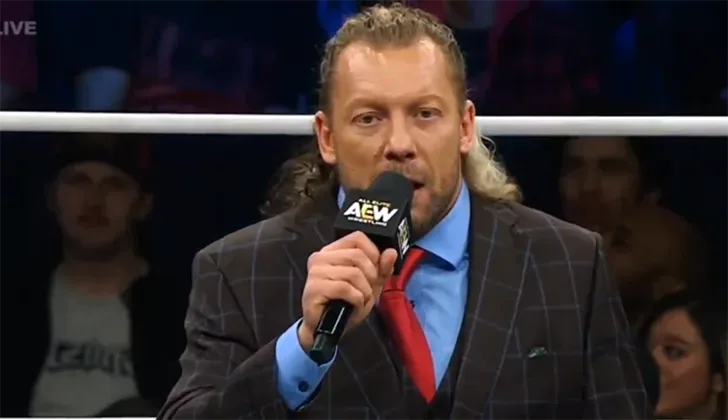
Kenny Omega’s path to becoming one of modern professional wrestling’s most internationally recognized performers was never limited to one country, one style or one traditional route. Before his rise through DDT, New Japan Pro-Wrestling and ultimately AEW, Omega was a wrestler from Winnipeg trying to determine where he could best develop his craft. For him, Japan was not simply an overseas destination or a calculated career move. It was the place where his wrestling interests and his wider personal passions already converged.
During an appearance on Crunchyroll’s The Anime Effect, Omega discussed the decision that led him to pursue a career in Japan. The former AEW World Champion explained that he carefully considered the advantages of remaining in North America, including the comfort of being closer to home and family. But once he measured those benefits against what Japan represented to him creatively and personally, he felt the answer became increasingly clear.
“I sort of started to feel like when I really sat down, and I weighed all my options, and I would look at the pros and the cons,” Omega said. “Okay, let’s see if I try to make a career out of wrestling in America. What are the pros and cons? Okay, so the pros are I’m closer to home. I can get home in a jiffy if something goes wrong, you know, whether it be my pets or my parents, whatever. I have a fast track home. I can get there and take care of things if I need to.”
Omega acknowledged that he had built some connections in the United States, including friendships made around Deep South Wrestling. That promotion operated in McDonough, Georgia, and was part of the developmental landscape that preceded WWE’s current NXT structure. Still, the appeal of staying in America did not outweigh his growing certainty that Japan fit both the kind of performer he wanted to become and the life he wanted to experience outside the ring.
For more background on this topic, read Darby Allin Set To Defend AEW TNT Championship Against Myron Reed On Collision.
Japan Matched Omega’s Wrestling Vision and Personal Interests
For Omega, the decision was informed by much more than match opportunities. He had already developed an extensive appreciation for Japanese culture, ranging from food and anime to dramas and video games. The list of reasons to embrace Japan kept expanding, and that enthusiasm reflected itself in the wrestling he was consuming as well.
“Once I started to weigh all the options, I just started to see very little pros to trying to, I guess, hone my craft in America over the idea of going to Japan because once starting to put, ‘Okay, I like, you know, the food, I like the anime, I like the live-action dramas. Boom. I love their video games. Boom.’ And just this list grew and grew and grew and grew and grew,” Omega said.
The in-ring side was equally decisive. Omega recalled that much of the footage he studied was coming from Japanese promotions rather than the styles that were more readily available around him in North America. All Japan Pro Wrestling, New Japan Pro-Wrestling, Pro Wrestling NOAH, Dragon Gate and DDT were among the companies that held his attention. That viewing habit was a revealing indication of where his instincts already lay.
“Even when I’m studying tapes, I’m always studying mostly like Japanese stuff,” Omega said. “Stuff that’s happening in All Japan, New Japan, NOAH, Dragon Gate, DDT. And I thought, like, it’s very rare that we even put in, like, World of Sport, lucha libre, or even, like, WWE stuff. So I thought, I mean, to me it just seems like my heart is there.”
That self-assessment became the foundation for a pivotal career choice. Omega said he was already deeply invested in Japan from both a wrestling and cultural standpoint by the time he had to make a serious decision about his future. He viewed an opening to work there as the most natural next step, rather than a gamble taken solely for the sake of changing scenery.
His opportunity ultimately came through Jersey All-Pro Wrestling. Omega had become a regular presence with the promotion, and that exposure helped open the door for him to head to DDT in Japan. The move began a journey that would eventually make him a central figure in Japanese wrestling before he helped launch AEW as one of its marquee stars.
Omega Wanted to Earn His Place
While Japan was his preferred destination, Omega was firm about one aspect of the pursuit: he did not want to finance his own way into a wrestling opportunity. He believed he had the ability to belong there and wanted an invitation based on that ability, rather than arriving unannounced and hoping a company would find a spot for him.
“I really wanted to promise myself, I said, I know that I’m good enough. I know that I deserve to be there. I will go there without, like, paying myself to go there,” Omega said. “Because that’s another option. A lot of people just kind of flatten themselves out and say, ‘Hey, I’m in town. Can you use me?’”
Omega said Winnipeg and the local scene where he was working had started to feel like a dead end. He was prepared to take a more aggressive chance to change that situation, but the DDT opening emerged before he needed to make that leap. His comments underscore the balance of confidence and uncertainty that existed at the time: he had a strong belief in his own potential, yet he still needed the right break to transform that potential into an international career.
That break became consequential not only for Omega, but for the style and persona that fans would later associate with him. His work in Japan allowed him to continue evolving in an environment that supported distinctive characters, athletic risk-taking and an expansive range of match presentations. It was also an environment compatible with the interests that had already drawn him toward the country long before he arrived as a wrestler.
Why Hajime no Ippo Still Connects With Omega
Omega’s connection to Japanese culture has long been evident in his presentation and public interests, but his discussion also turned to a more serious side of sports storytelling. He named Hajime no Ippo as the anime that most strongly resonates with him as an athlete. After recently revisiting the series, Omega said his perspective has changed because he now has more experience with injuries, disappointment and physical sacrifice.
“I’d recently watched over Hajime no Ippo, by watching the whole thing over again, by being sort of in a position where I’ve experienced more as an athlete, more injuries, more heartbreak, more suffering,” Omega said. “Yeah, it’s absolutely hard around, especially if you know where it goes in the manga as well, where Ippo has essentially become punch-drunk because of his fighting style and taking too many hits.”
He praised creator George Morikawa for presenting the human cost of combat sports in a way that feels authentic to athletes who have lived through physical setbacks. Omega noted that injuries can rapidly change the course of a tournament, a season or a championship pursuit, even when the issue appears small at first. That reality is particularly relevant to professional wrestling, where physical performance is central to a wrestler’s ability to tell a story and remain visible in a crowded field.
Omega sees a clear connection between the isolation of boxing and the individual pressure of wrestling. Even with a locker room, trainers and fans around them, performers must ultimately find something personal to reveal when the bell rings. In Omega’s view, that internal quality is what can turn a match from an athletic exhibition into a lasting memory.
“You have to find what it is on the inside that you can show to the world that, you know, what makes this match special, what makes this story special, what makes you special,” Omega said. “And you have to be sure that you exude that when you’re out there in the ring and do it in the biggest of ways.”
He added that wrestlers should strive to leave an impression, whether positive or negative, because being remembered is essential after making the sacrifices demanded by the profession. That philosophy has been evident throughout Omega’s career, from his work in DDT and New Japan to his defining AEW performances.
Omega’s AEW Return Remains Unclear
Omega has been absent from AEW television since losing the title to Will Ospreay at AEW All In: London last month. There is currently no confirmed timetable for his return to AEW programming.
His longtime friend and AEW co-founder Matt Jackson recently expressed confidence that Omega will eventually return “better than ever.” Until there is a formal update, however, questions remain about when fans will next see Omega in an AEW ring.
For now, Omega’s reflections offer a useful reminder of how much of his career was shaped by following the place that already felt right to him. Japan was not merely a chapter in his rise. It was the setting where his wrestling ambitions, creative influences and personal interests found a shared direction.
Darryl Polo
Darryl Polo is a passionate wrestling fan covering WWE, AEW, TNA and beyond. He loves great rivalries, breakout stars and the moments that keep fans talking long after the bell. How we work.