
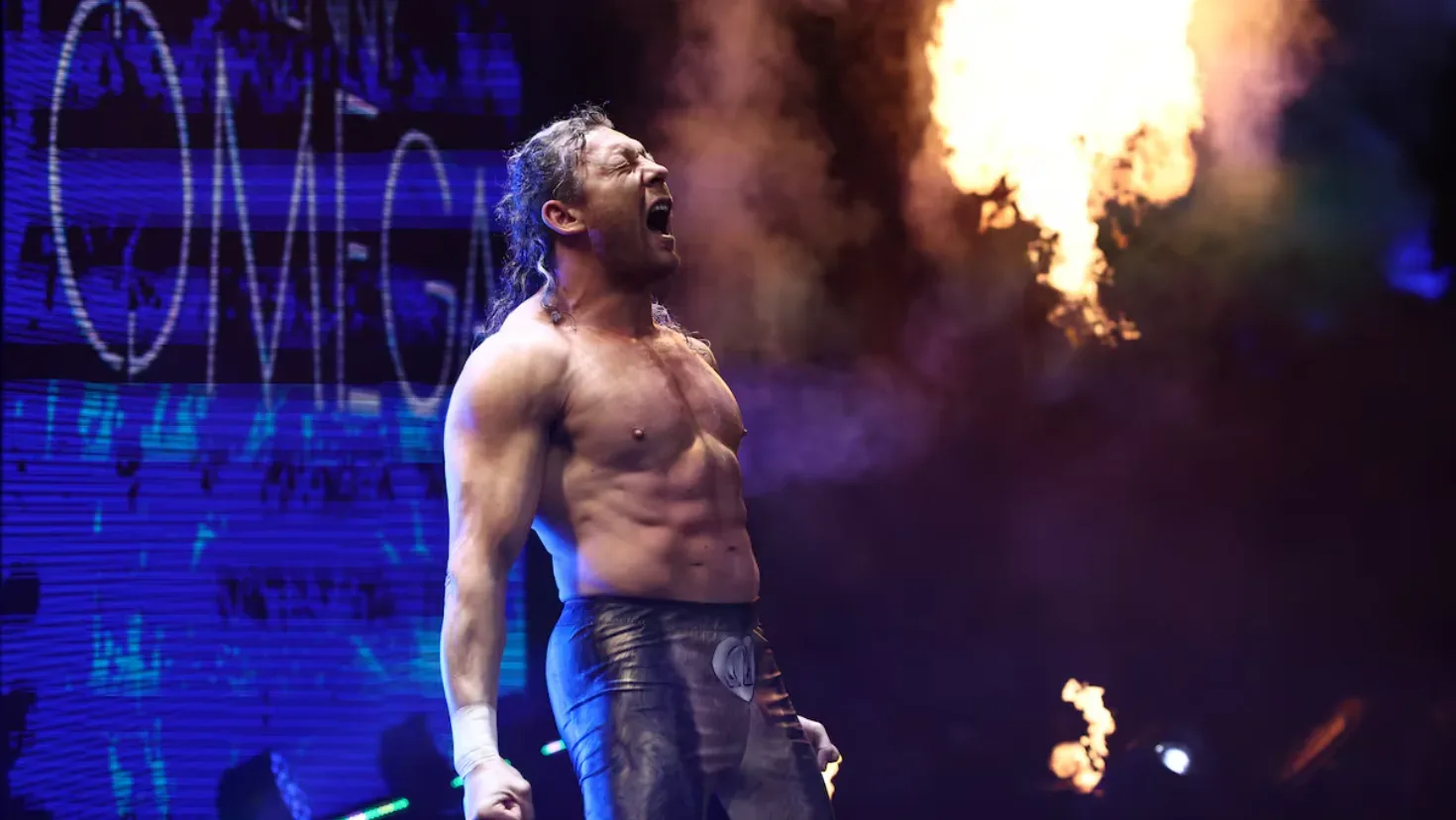
Kenny Omega has built much of his reputation on treating major matches as opportunities to do more than simply deliver an expected main-event performance. Whether the setting calls for an athletic showcase, a dramatic championship clash or a bout designed to leave a lasting impression on a live crowd, Omega’s approach is rooted in finding ideas that can elevate the entire contest.
Speaking on The Anime Effect Podcast, the two-time AEW World Champion discussed the mindset he brings into his most important bouts. Omega said he consistently tries to do his best in the ring, but explained that the biggest matches are where he feels the strongest need to search for something unexpected.
“I always do the best that I can but I do try to go outside the box when the option’s there and for my big matches, absolutely, always try to think outside the box because in my biggest of matches, I think that both myself and my opponent, for the most part, have the best of intentions to make the match as a whole look good rather than just make themselves look good. So I’ve been lucky in that regard.”
Omega’s comments highlight a philosophy that places the match itself at the center of the creative process. Rather than viewing a marquee encounter solely as a chance to showcase his own strengths, he described the importance of working with an opponent who shares the goal of making the overall presentation as strong as possible.
For more background on this topic, read Kenny Omega Calls Paul Turner AEW’s ‘Main Event Referee’ After Will Ospreay Match.
That distinction can be particularly important in championship-level wrestling. A major match is often expected to satisfy several demands at once: it must advance the stakes surrounding the rivalry, give the audience memorable moments, establish the importance of the result and allow both competitors to emerge from the contest with their standing enhanced. Omega’s remarks suggest that his preferred route to meeting those expectations is collaboration rather than competition for attention.
Omega’s Focus Is on the Complete Match
The phrase “outside the box” can mean different things in professional wrestling. It does not necessarily require a match to abandon its basic structure or rely on spectacle for its own sake. In Omega’s case, his explanation centered more on intention. The aim is to find the ideas, sequences and emotional turns that serve the total match, instead of simply creating isolated moments for one performer.
For a wrestler operating at Omega’s level, that is a significant part of the challenge presented by high-profile bouts. The expectations are naturally greater when a world title, a major event main event or a defining rivalry is involved. Fans arrive with a clear sense that the match is supposed to matter. The wrestlers, in turn, must give the contest a sense of escalation without losing sight of why the audience is invested in the first place.
Omega indicated that he has been fortunate to share the ring with opponents who enter those situations with similarly constructive intentions. His point was not that either wrestler should disappear from the match. Instead, it was that the strongest work comes when both competitors understand that their individual performances are most effective when they contribute to a larger story.
That collaborative dynamic is especially valuable when wrestlers are asked to create something memorable under the pressure of a major stage. Every big match needs a rhythm, and that rhythm depends on trust. One wrestler must be willing to give the other room to shine, while both need to recognize the moments when the story requires them to shift momentum, sell a setback or make a decisive sequence feel consequential.
Omega’s comments also speak to the balancing act between innovation and clarity. An unexpected idea only helps if it fits the match. A surprise sequence, a new wrinkle in the action or a bold closing stretch can make a bout feel distinct, but those choices have to reinforce the stakes rather than distract from them. The objective, as Omega described it, is not simply to be different. It is to make the match better.
A Recent AEW World Title Run Ended at All In
Omega’s most recent AEW World Championship reign lasted 53 days. That run ended when Will Ospreay defeated him in the main event of AEW All In at Wembley Stadium.
The result placed Omega and Ospreay in a setting that matches the kind of high-stakes environment Omega was discussing. A world championship main event at Wembley Stadium carries immediate significance on its own, but it also places an enormous creative burden on the wrestlers involved. The title is the clearest prize in AEW, the location adds scale to the occasion and the main-event position creates an expectation that the match will provide a fitting conclusion to the event.
Omega’s philosophy offers a useful lens through which to view that type of contest. The central question in a match of that magnitude is not merely which wrestler can produce the most impressive individual highlights. It is whether the performers can make every major moment feel like part of a coherent struggle for the championship. The crowd’s investment depends on the belief that the action is building toward a meaningful outcome.
Ospreay’s victory ended Omega’s 53-day reign, but it also underscored the importance of the shared objective Omega outlined. When championship stakes are involved, both the departing champion and the new titleholder have a role in making the transition feel important. The losing wrestler has to make the challenger’s achievement feel earned, while the winner has to rise to the occasion in a way that establishes the value of the victory.
Why the Marquee Match Mindset Matters
Omega did not present his approach as a guaranteed formula. He acknowledged the role that good fortune has played in finding opponents who want to make the match look good as a whole. That humility matters because professional wrestling requires more than planning. Chemistry between two performers can shape how well ideas translate in front of an audience, particularly when the pressure is highest.
A wrestler may enter a bout with ambitious concepts, but the final product depends on timing, communication and an ability to react to the crowd. A major match can change in real time based on the audience’s response. A sequence that was expected to receive one reaction may call for an adjustment; a moment of momentum may need more room to breathe; an emotional beat may become the most important part of the contest. The best preparations leave room for those developments.
Omega’s emphasis on making the entire match look good reflects an understanding of that reality. The audience does not experience a bout as a collection of separate accomplishments. It experiences the full arc: the opening exchanges, the escalation, the danger, the reversals and the final decision. A performer’s individual contribution becomes more memorable when it is placed in service of that overall arc.
For Omega, thinking beyond the obvious is therefore tied to a larger responsibility. The big match should feel bigger because the wrestlers recognized what the occasion demanded. It should have ideas that distinguish it from a routine encounter, but those ideas must be connected to the stakes and to the relationship between the competitors.
His recent title loss to Ospreay at AEW All In provides a clear reminder of how quickly the championship landscape can change at the highest level. Omega’s latest reign may have lasted 53 days, yet the significance of a title run is not measured only in duration. It is also shaped by the stages on which the champion competes, the opponents he faces and the matches that define the run.
As Omega continues to discuss the craft behind his biggest performances, his message remains straightforward: the best marquee matches are not built around one wrestler trying to outshine the other. They are built around two competitors working toward a shared goal, with the match, the story and the audience’s experience taking priority. For a performer known for aiming high when the spotlight is brightest, that commitment to the complete picture remains central to his approach.
Omega made the comments during an appearance on The Anime Effect Podcast.
In pictures
Darryl Polo
Darryl Polo is a passionate wrestling fan covering WWE, AEW, TNA and beyond. He loves great rivalries, breakout stars and the moments that keep fans talking long after the bell. How we work.