
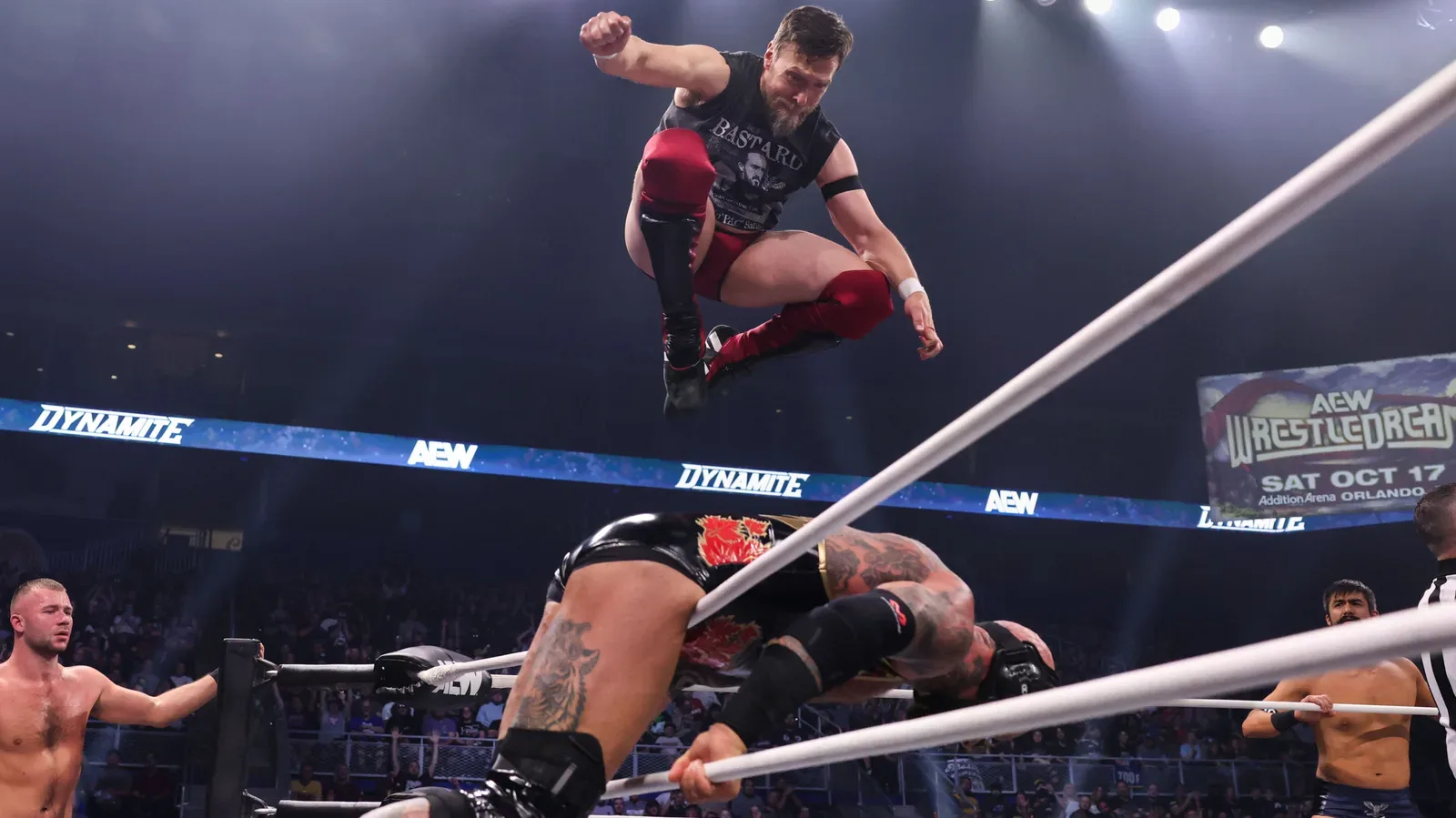
Josh Alexander has reflected on the emotional circumstances surrounding the September 30 episode of AEW Dynamite, describing the night as cathartic after competing in a tribute main event that also featured an unexpected opportunity to share the ring with Bryan Danielson.
The show was held in tribute to PAC following his death, with AEW’s locker room also mourning the recent passing of Andy Williams. Danielson returned to competition during the episode, reuniting with the Death Riders for a main-event match against the Don Callis Family. Alexander was part of the Don Callis Family side of that bout and later spoke about the mixture of shock, sadness, appreciation and release that came with wrestling on such a difficult night.
For Alexander, the eventual match with Danielson was not something he had been expecting when he arrived for Dynamite. He explained that Danielson personally broke the news to him on Wednesday afternoon, beginning with a simple question about whether Alexander had heard what the match would be.
“I mean, it was Wednesday afternoon. Bryan actually approached me. He said hi, and he’s like, ‘Did you hear about the match?’ I go, ‘No.’ And he goes, ‘It’s Death Riders against DCF [Don Callis Family].’ And I was like, ‘Okay.’”
For more background on this topic, read The Young Bucks Remember PAC as a Friend Who Guided Them in Japan.
Alexander said he knew Jon Moxley was already set to wrestle, but he did not initially know who would join him for the Death Riders. That uncertainty made Danielson’s next words all the more startling.
“And in my head I was like, I knew Mox was wrestling already and I was just like, ‘Who’s the other guy?’ And he’s like, ‘Oh, it’s me,’” Alexander recalled.
Alexander said he briefly stepped away before the reality of the situation registered. He returned to Danielson to make sure he had heard correctly.
“And I just moved away and then I went, ‘Whoa, what? Did you say you’re in the match?’ He’s like, ‘Yeah.’ And I went, ‘Okay.’ And he just starts laughing.”
Danielson’s return added a major personal element to an already unusual and emotional night. Alexander was pleased to be in the ring with Danielson, but that excitement existed alongside the grief being felt throughout the building. The wrestlers and staff were remembering PAC while also sharing stories about Williams, another peer whose death had recently affected the community.
The circumstances created what Alexander described as a deeply complicated experience. Professional wrestling is built around competition, preparation and performance, but it can also become a setting where performers process loss together. On this occasion, the main event was not simply another televised match. It was a chance for people who knew and worked with PAC to do the job they love on a night dedicated to someone who loved that same profession.
Alexander said the experience led him to speak with Danielson after the match and express how unlikely the moment felt.
“And then this one thing happens and I was just like, I turned to Bryan afterwards and I was just like, this was the weirdest silver lining moment of my life. I never thought this was going to happen. Thank you,” Alexander said.
The phrase “silver lining” captures the contrast at the center of the night. There was no escaping the reason for the tribute, nor the pain felt by those who had lost friends and colleagues. At the same time, Alexander received a rare opportunity to work opposite Danielson during Danielson’s return to the ring. Rather than presenting that opportunity as more important than the grief surrounding the show, Alexander framed it as something that happened within an otherwise heartbreaking situation.
Alexander also emphasized why performing can carry special significance in moments of mourning. Wrestling is a physical and public profession, yet the people involved often experience its most meaningful moments together backstage and inside the ring. The act of going out to wrestle can give performers a way to honor someone directly, particularly when that person shared the same passion for the craft.
“It’s like cathartic for us to go out and do what we love to do and that we know that the person that passed away loved to do and try to honor them,” Alexander said.
That catharsis was not limited to those booked in the match. Alexander’s comments made clear that the feeling extended through the AEW locker room as people traded memories of PAC and Williams. In a profession where wrestlers spend extensive time traveling, training and appearing at events together, those relationships can develop far beyond what audiences see during a television broadcast.
The September 30 main event brought the Death Riders and the Don Callis Family together under circumstances that were markedly different from a standard rivalry-driven bout. AEW presented Danielson’s return as part of the tribute show, and Alexander’s recollection shows how quickly the plan became real for those involved. Even he did not know Danielson would be his opponent until the afternoon of the event.
That lack of advance notice only heightened the personal nature of the encounter. Alexander’s immediate reaction was measured, but his account of walking away and then returning in disbelief illustrates the weight that Danielson’s participation carried. Danielson laughing at Alexander’s stunned response gave the exchange a brief, human moment of levity before both men took part in a main event shaped by far more serious emotions.
Alexander did not use his reflection to turn the night into a discussion solely about the match itself. Instead, he returned repeatedly to the people AEW was honoring and to the emotional state of those around him. The tribute show allowed the locker room to gather, remember and continue doing the work that connected them to PAC and Williams in the first place.
It also left Alexander thinking about the importance of showing affection and appreciation while people are still present. He said the recent losses had reminded him to take photographs with the people he loves and to tell them that he loves them. He did exactly that backstage at Dynamite.
That response is a reminder that the impact of a tribute show reaches beyond the segment or match seen by viewers. For the wrestlers involved, the day can include quiet conversations, shared recollections and gestures that may never become part of the televised presentation. Alexander’s decision to take photos and voice his feelings to loved ones was a personal reaction to an environment where the fragility of time and relationships was impossible to ignore.
AEW’s September 30 episode therefore carried several layers for Alexander: the sadness of losing PAC, the additional grief surrounding Williams’ death, the collective act of honoring them through wrestling, and an unexpected in-ring meeting with Danielson. Those elements did not cancel one another out. They existed together, which is why Alexander’s description of a “weirdest silver lining moment” is so fitting.
For Alexander, getting to wrestle Danielson was meaningful. But his larger takeaway was about community, memory and recognizing the people who matter before another opportunity to do so is gone. The tribute main event gave AEW’s wrestlers a chance to honor PAC in the most immediate way they knew: by stepping into the ring, doing the work they love, and dedicating that work to someone who loved it as well.
In pictures

Darryl Polo
Darryl Polo is a passionate wrestling fan covering WWE, AEW, TNA and beyond. He loves great rivalries, breakout stars and the moments that keep fans talking long after the bell. How we work.