
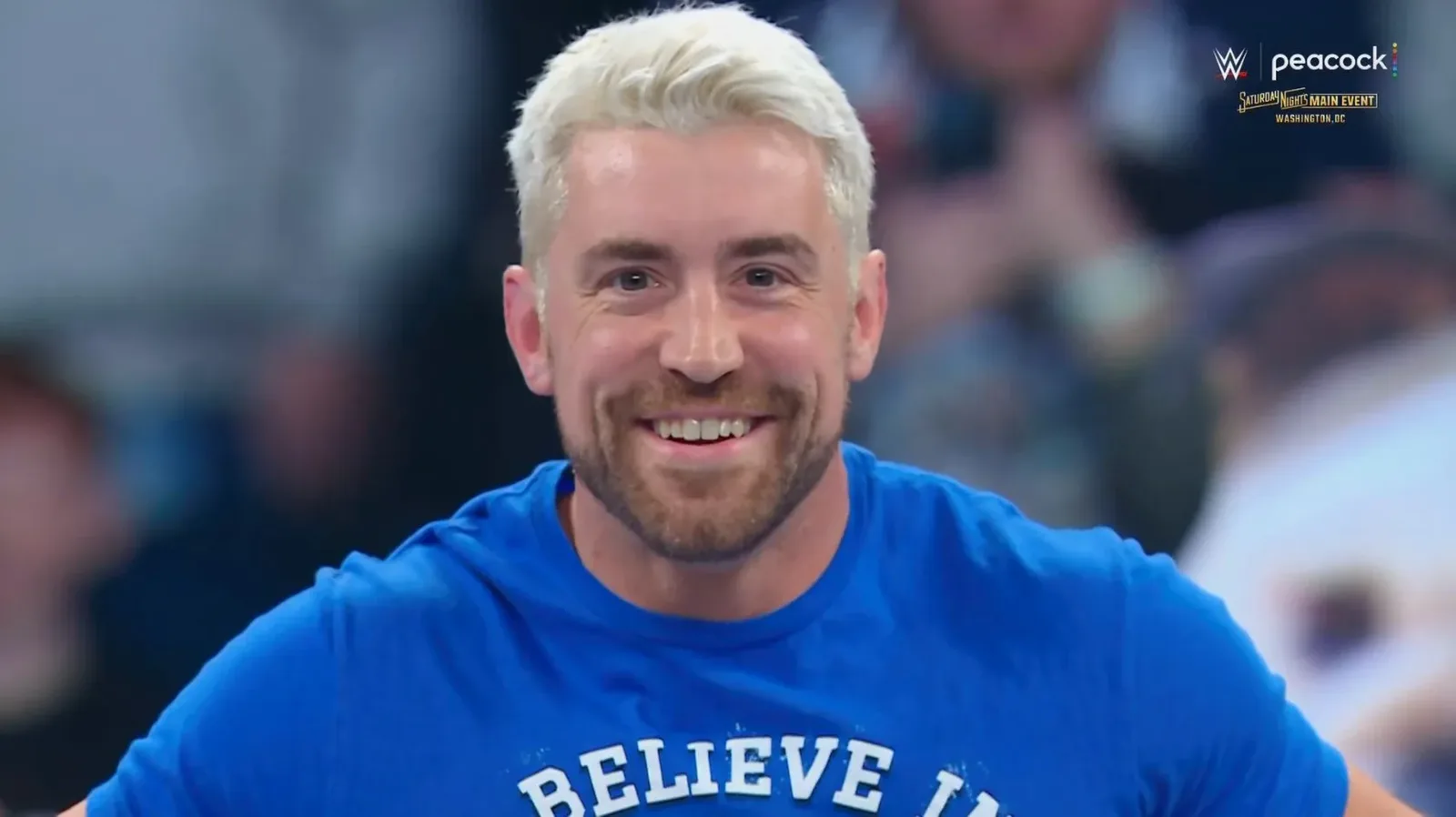
Joe Hendry has made music an unmistakable part of his identity in professional wrestling, but he has made clear where his main priority remains after the release of Beyond Belief.
Speaking on Backstage With Blair, Hendry addressed whether the arrival of his new album could signal a larger shift toward music as the next major focus of his entertainment career. His answer was direct: while he has enjoyed the process of making music and remains open to future projects, Hendry sees himself as a wrestler before anything else.
“I’m a pro wrestler first. So there’s been a- we’re doing a lot of music. I think we got, I think I got to get in there and start throwing some people around as well. So I think this has been an amazing project. I’ve loved doing it, but ultimately I am a pro wrestler first. So I think I’m excited to, to get stuck into wrestling in the ring again. But yeah, doors always open for more musical projects.”
The comments arrive in the wake of the release of Beyond Belief, an album Hendry put out earlier this week. For Hendry, the record is not a departure from the persona and creative approach he has brought to wrestling. Instead, it is another expression of a career in which songs, videos and performance have regularly worked alongside his in-ring presentation.
For more background on this topic, read Gail Kim Launches ‘Getting Over’ Series With Deathmatch Wrestling Episode.
Music has long been part of Hendry’s wrestling presentation
Hendry’s musical ability has been intertwined with his wrestling career rather than operating as an entirely separate endeavor. He has used his talents in several ways, from theme music to pointed musical segments aimed at opponents. Those tracks have often been framed as diss songs and paired with comedic music videos, giving Hendry a distinctive method for building anticipation around rivalries.
That blend matters because pro wrestling is built around more than the action after the bell. Promos, entrances, character work and visual presentation all contribute to how a performer connects with the audience. Hendry’s music has given him another language for that connection. A song can establish a tone quickly, deliver a joke, target an adversary or make a message memorable before a match even begins.
At the same time, Hendry’s latest remarks draw an important line between a valuable creative tool and his central profession. He does not view the album as a replacement for wrestling. He describes Beyond Belief as an “amazing project,” but he also emphasizes that his appetite to compete and perform in the ring remains intact.
That distinction is especially notable in an era when wrestlers often develop projects across music, acting, streaming, podcasts and other forms of entertainment. Those avenues can expand a performer’s reach, but they can also raise questions about whether wrestling remains the primary focus. Hendry’s answer is that the ring still comes first, even while he welcomes the chance to continue creating music.
‘Beyond Belief’ opens a door, not an exit
The title Beyond Belief naturally fits the larger themes associated with Hendry’s work as a performer. His wrestling career and musical output have both leaned into a larger-than-life approach, with songs becoming part of the way he communicates his character and interacts with opponents. Releasing a full album gives that creative side a more substantial platform than a single entrance track or rivalry-focused video.
Still, Hendry did not present the album as a final destination. His wording suggested that it is one project within a broader career, and that there is room to revisit music without allowing it to displace wrestling. “Doors always open for more musical projects,” he said, leaving no doubt that he intends to keep that side of his work active when the opportunity is right.
That flexibility is central to the appeal of the crossover. A wrestler’s music can serve multiple purposes depending on the moment. It can function as a personal artistic release, an extension of a television persona, promotional material for a match or simply a way to engage fans beyond the usual format of a wrestling show. Hendry has experience working in that overlap, and Beyond Belief gives him another piece of material that can exist alongside his in-ring ambitions.
His comments also indicate that the demands of an album project have not lessened his desire for physical competition. Hendry joked that, after doing so much music, it is time to “start throwing some people around as well.” Beneath the lighthearted phrasing is a clear statement of intent: the next priority is getting more deeply involved in wrestling in the ring again.
A performer built around multiple forms of expression
Hendry also reflected during the interview on the beginnings of both his wrestling and music careers. The two paths have become closely associated over time, but they represent different disciplines with different challenges. Wrestling requires the ability to perform live under physical pressure, tell stories with opponents and adapt to an immediate crowd response. Music demands its own writing, recording and performance process.
Bringing those disciplines together can be difficult, especially when a performer wants the music to feel like more than a novelty. In Hendry’s case, the musical work has repeatedly been incorporated into the presentation in a way that supports the wrestling. The comedic diss tracks and accompanying videos have helped give rivals a different kind of spotlight while allowing Hendry to show personality outside a conventional verbal promo.
That is why the release of Beyond Belief carries interest beyond a typical side project. It comes from someone whose music has already been part of his public identity as a wrestler. The album provides a more focused opportunity for listeners to engage with that aspect of Hendry’s work, while his comments ensure there is no confusion about the hierarchy of his career goals.
Professional wrestling remains the foundation. Music remains an important complement.
What Hendry’s comments mean going forward
Hendry did not announce a specific in-ring date, a new match or a defined next program in the interview. He also did not suggest that music will be put on hold indefinitely. Instead, he described a balance: an enthusiasm for returning his attention to wrestling and a willingness to pursue more music when the right project presents itself.
That measured approach fits the way his career has been presented. His songs and videos have been most effective when they enhance the wrestling rather than distract from it. By reaffirming that he is “a pro wrestler first,” Hendry has set an expectation that Beyond Belief should be viewed as an addition to his body of work, not a signal that he is moving away from the ring.
For fans of Hendry’s musical material, there is reason to take encouragement from his final note that the door remains open. More songs, videos or other projects are clearly possible. For fans most interested in seeing him compete, the stronger message is that Hendry is eager to get back to the part of his career he identifies as his primary calling.
Joe Hendry’s immediate message is simple: Beyond Belief has been a rewarding creative project, but the wrestler behind the music is still focused on doing what he considers his first job—getting into the ring and wrestling.

Darryl Polo
Darryl Polo is a passionate wrestling fan covering WWE, AEW, TNA and beyond. He loves great rivalries, breakout stars and the moments that keep fans talking long after the bell. How we work.