
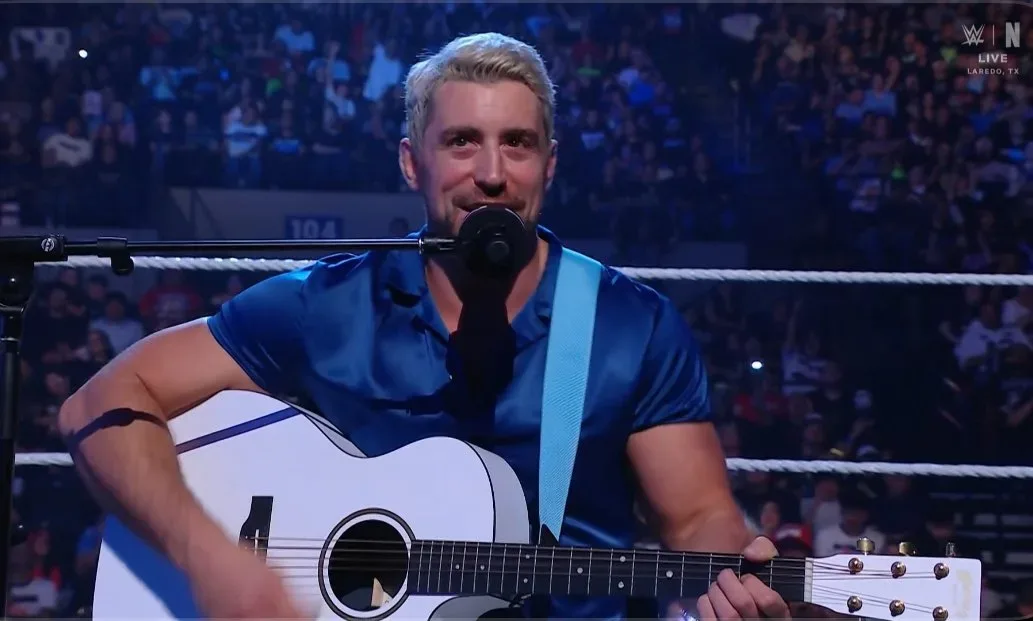
Joe Hendry has offered a measured perspective on one of the most persistent challenges facing performers in WWE and throughout professional wrestling: finding a way to fully commit to creative direction that may not always match an individual's personal preference.
Speaking with the Michael Fairman Channel, Hendry was asked about moments, segments, or ideas presented by WWE creative that he may not necessarily have agreed with. Rather than framing those situations as a conflict between a wrestler and the company, Hendry emphasized the collaborative nature of the business and the responsibility he feels to make the material work for the audience.
“I think in professional wrestling, your job is to give it your absolute best with the collaboration that you have, and that’s what I always try to do,” Hendry said.
His answer reflects an outlook built around execution. Professional wrestling gives performers a highly visible role in shaping characters, delivering promos, and reacting in real time to crowd response, but it also requires talent to work within a larger structure. Television time, long-term stories, rivalries, production needs, corporate priorities, and the creative direction of a weekly program all factor into what ultimately reaches viewers.
For more background on this topic, read Joe Hendry Leaves Door Open to a WWE Heel Turn: ‘Never Say Never’.
For Hendry, the central objective is not to treat every creative decision as an individual statement. It is to help create compelling entertainment alongside everyone else involved in putting a WWE segment or match together.
“I always try to give the best I can with the tools that I have available, and that’s what pro wrestling really is because it’s a collaboration,” Hendry continued. “You’ve got these, you know, you are your own brand, but ultimately you’re working together to try and entertain the audience, and that’s, you know, it’s a group of people working together to try and do that. So my goal is to try and execute for the company as best I can.”
Hendry Sees Wrestling As A Collaborative Medium
Wrestlers are often viewed by fans through the lens of their individual personas. A successful act can feel inseparable from the performer portraying it, especially when that act has a distinct voice, presentation, entrance, or connection with the crowd. Hendry’s comments acknowledge that reality when he describes a wrestler as “your own brand.” At the same time, he made clear that a performer’s individual identity exists inside a much broader collaborative process.
That process can involve fellow wrestlers, producers, writers, announcers, camera crews, directors, referees, trainers, and many other contributors. A segment that appears straightforward on television may depend on numerous people understanding the same intended tone and timing. The same applies to a match, where the in-ring performers must balance their own strengths with the demands of a story, the allotted time, the placement on the card, and the desired crowd reaction.
Hendry’s approach places the audience at the center of that process. Even when a talent member has a different instinct about a specific choice, the goal remains delivering a worthwhile show. That does not mean every idea will be universally embraced by fans, nor does it mean every performer will see every creative decision in exactly the same way. His point is that a wrestler’s professional obligation is to bring maximum effort to the material and help the overall presentation succeed.
It is an especially relevant topic in WWE, where every on-screen character is part of an interconnected television product. One wrestler’s promo can set up a later match. A backstage scene can establish motivation for an angle that develops over several weeks. A loss can be used to advance a character arc or elevate an opponent. Individual performers may have personal ideas about how those moments should unfold, but the final presentation has to serve the larger direction of the program.
Commitment Can Shape How Fans Receive An Angle
Creative disagreement is not unique to wrestling. It is common across entertainment, sports, and any field where a group must turn different ideas into one finished product. In wrestling, however, the issue is often more visible because performers inhabit their characters in front of a live audience. Fans can quickly detect whether a wrestler appears confident in a role, invested in a story, or connected to the premise of a segment.
Hendry’s comments suggest that commitment is the most useful response when an idea is not exactly what he would have chosen himself. A performer can still add intensity, timing, charisma, athleticism, and emotional clarity to a piece of creative. Those elements may determine whether an audience understands a character’s motivations and whether an angle gains traction after it airs.
That effort also matters in matches. Wrestlers often have to make the most of circumstances that are outside their control, from limited time to changing crowd dynamics or a particular role assigned within a feud. Hendry’s philosophy is that the responsibility is to use the available tools and make the strongest possible contribution. It is a pragmatic answer that avoids assuming creativity is a single-person process.
There is also a distinction between having an opinion and refusing to participate in a collaborative direction. Hendry did not claim that he agrees with every idea. Instead, he explained that disagreements or differing preferences do not change the standard he sets for his own performance. His priority is to execute for WWE to the best of his ability.
The Balance Between Personal Brand And Company Direction
Hendry’s reference to being one’s “own brand” is notable because modern wrestling places substantial value on recognizable personalities. Fans follow performers not only through weekly shows, but also through interviews, live events, merchandise, and the wider discussion surrounding the industry. A wrestler’s individual identity can be a major part of what makes an act resonate.
Still, Hendry views that identity as something that must function within the company’s larger plans. The strongest presentation is not necessarily one where every wrestler operates separately. It is one where performers retain distinct qualities while contributing to stories that give the audience reasons to keep watching.
That perspective can be important for any wrestler navigating a high-profile environment. A creative decision that appears limiting in isolation may lead into a later opportunity, establish a new side of a character, or provide another wrestler with a moment that benefits the broader story. Conversely, an idea that appears simple on paper can become memorable when a performer finds the right delivery and fully commits to it.
Hendry’s answer did not detail a particular WWE segment or identify any creative pitch he disliked. Instead, he discussed the general mindset he brings to such situations. By keeping the focus on collaboration and audience entertainment, he presented an approach rooted in professionalism rather than public frustration.
A Professional Approach To The Unpredictability Of Wrestling
Professional wrestling is built on adaptation. Plans can shift, crowds can react in unexpected ways, and stories can evolve rapidly. Performers need to be ready to adjust while maintaining the core identity of their characters. That adaptability is one reason why collaboration is so central to the business.
Hendry’s comments point to an understanding that success is not always about receiving an ideal circumstance. It is about responding effectively to the circumstance that is in front of you. In his view, the wrestler’s role is to give full effort, use the available tools, and work with the people around them toward the shared aim of entertaining viewers.
That message is likely to resonate with fans who recognize the many moving parts behind a wrestling program. While viewers may naturally debate storylines, character choices, and match outcomes, Hendry has outlined the standard he applies to his own work: complete commitment to the collaboration and the best possible execution for the company.
Elsewhere in the same conversation, Hendry also discussed the possibility of a future heel turn. For now, his remarks on creative offer a clear look at how he approaches his WWE responsibilities. Whether the idea is closely aligned with his own preference or not, Hendry intends to bring his absolute best to the screen and to the audience.

Darryl Polo
Darryl Polo is a passionate wrestling fan covering WWE, AEW, TNA and beyond. He loves great rivalries, breakout stars and the moments that keep fans talking long after the bell. How we work.