
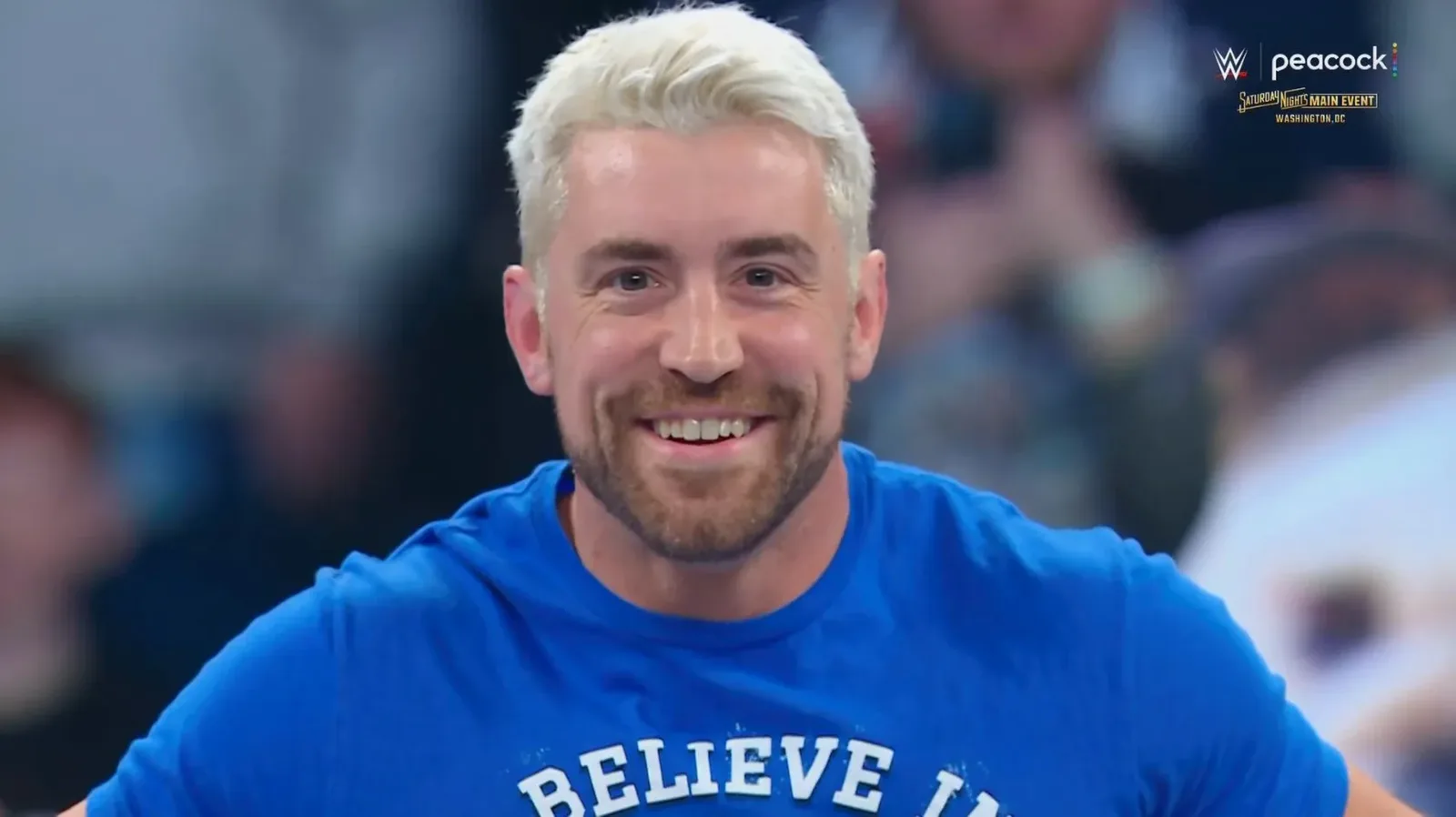
Joe Hendry has spent the last several years building a connection with wrestling audiences as a babyface, but he is not ruling out a return to more antagonistic territory during his WWE run.
Speaking in a recent interview, Hendry was asked whether a heel turn could be in his future. His response did not offer a firm prediction, but it made clear that he sees no permanent limits on where his character could go in WWE.
“Yes. I mean, never say never. You just never know. Anything can happen in the WWE. It’s funny. I originally, this is the character that I’ve designed and the person that I’m portraying was designed to be hated and people just happened to like it you know so.”
That answer is especially notable because the version of Hendry presented to WWE audiences has been received as a fan favorite. His personality, musical elements, and confidence have encouraged crowd participation rather than hostility, even though the character’s foundations were not originally intended to produce that reaction.
For more background on this topic, read Samantha Irvin Says She Politely Declined WWE Record Deal Offer.
Hendry’s comments point to a familiar reality in professional wrestling: a character’s intended alignment and the reaction it receives can become two very different things. A performer may be introduced with the traits of an arrogant or irritating heel, only for fans to embrace the act because it is entertaining, memorable, or distinct from the rest of the roster. Hendry appears to view his own path through that lens.
A Character Fans Chose to Support
Hendry said the character he designed was meant to be hated. That does not mean the act has lacked the tools associated with a popular babyface. Rather, the same traits that can make a wrestler an effective villain — self-assurance, a sharp edge, and a willingness to make himself the center of attention — can also make that wrestler compelling to audiences.
In Hendry’s case, those traits have helped make him recognizable across multiple stages of his career. He has been a babyface for the past several years through his time in TNA, NXT, and on the WWE main roster. The crowd response has become part of the character’s identity, and that reception has helped sustain his presentation as a supporter-friendly act.
However, Hendry’s remarks also acknowledge his history. Earlier versions of his persona leaned more heavily into heel behavior, including the use of diss tracks and other character choices designed to get under opponents’ and viewers’ skin. Those elements are important context for his latest comments because they show that a heel interpretation would not necessarily require an entirely new gimmick.
Instead, a change could potentially come from the way existing aspects of the character are directed. The confidence that currently invites fans to sing along could become more dismissive. The humor could be aimed more aggressively at rivals. The musical material that audiences associate with Hendry could take on a more confrontational purpose. None of those developments have been announced, but Hendry’s “never say never” answer leaves room for that possibility.
Why “Anything Can Happen” Matters in WWE
Hendry’s point that “anything can happen in the WWE” is a straightforward recognition of how quickly wrestling stories can shift. Alliances change, rivalries intensify, and performers can be pushed in different directions depending on the needs of a particular program. A babyface does not have to remain a babyface forever, especially when the character has previous heel roots to draw from.
At the same time, Hendry did not say a turn is imminent. His remarks were conditional and open-ended rather than a teaser of a specific upcoming segment or storyline. There is no stated timeline, no identified opponent, and no indication that WWE has made a decision to alter his current alignment. The clearest takeaway is simply that Hendry is open to the possibility.
That distinction matters. Wrestlers are regularly asked about hypothetical matches, opponents, turns, and career goals. A willingness to consider an idea is not confirmation that it is in motion. Hendry’s answer reflects flexibility, while his present status remains rooted in the positive audience response that has followed him in recent years.
Still, the fact that he framed the current character as one that was “designed to be hated” gives the conversation more substance than a routine non-answer. Hendry is not distancing himself from the possibility of being booed. He is highlighting that being booed was part of the creative DNA of the persona from the beginning.
The Value of a Flexible Persona
For a wrestler, having a character that can plausibly work on either side of the audience divide can be a major advantage. It gives creative direction more options and allows a performer to adapt without abandoning the qualities that made the act stand out in the first place.
Hendry’s past provides that flexibility. His diss tracks and heel-leaning material established a framework for provoking opponents and drawing negative reactions. His more recent babyface run in TNA, NXT, and WWE has shown that fans can also embrace the same broad character package. The result is a persona that has already existed in more than one form.
That does not mean every future storyline needs to revolve around a turn. It does mean Hendry has acknowledged an avenue that could be explored if circumstances call for it. In wrestling, audience support can be one of the strongest indicators of a character’s effectiveness, but it is not always the only factor. A storyline may call for a wrestler to challenge that support, test the loyalty of the crowd, or reveal a less likable side of the persona.
Should Hendry ever move in that direction, the key question would be whether WWE presents it as a total break from what viewers know or as an evolution of traits that have always been present. His own comments favor the latter interpretation. The character was originally intended to generate dislike; fans simply responded differently than expected.
Hendry’s Confidence in His WWE Ceiling
The discussion about a possible heel turn arrives alongside Hendry’s broader confidence in what he can accomplish in WWE. In another recent interview, he said he knows in his heart that he can become a top draw for the company. That belief aligns with the certainty that has long been central to his on-screen persona.
Confidence is often one of the most useful qualities for a wrestler to carry into a major environment. It can fuel a fan-favorite presentation, where audiences rally behind someone who believes he belongs at the top. It can also fuel a heel presentation, where that same belief becomes excessive, self-serving, or insulting to everyone around the character. Hendry’s comments suggest he understands both applications.
For now, there is no announced character change to report. Hendry remains a performer whose recent run has been defined by favorable crowd reactions across TNA, NXT, and WWE’s main roster. But he has made it clear that he does not view that role as the only possible version of Joe Hendry.
“Never say never” is not a promise that a turn is coming. It is an acknowledgment that Hendry’s character has a history beyond its current babyface reception, and that WWE’s storytelling environment can change quickly. If the moment arrives for Hendry to revisit the more hostile side of his act, he has indicated that the possibility is very much on the table.

Darryl Polo
Darryl Polo is a passionate wrestling fan covering WWE, AEW, TNA and beyond. He loves great rivalries, breakout stars and the moments that keep fans talking long after the bell. How we work.