
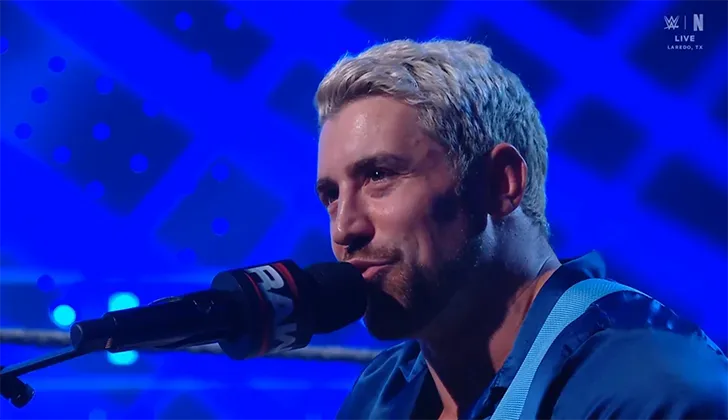
Joe Hendry’s rise in WWE has been built around an unusually versatile mix of in-ring ability, crowd connection, comedy, and original music. His latest project, Beyond Belief, brings those elements together in album form, but Hendry says the release did not begin as a carefully mapped-out full-length record. Instead, it grew from a single proposed release, several quickly developed ideas, and a willingness to adjust when WWE plans changed.
That adaptability also sits at the center of one of Hendry’s most talked-about recent songs, “Fire Logan Paul.” What began as a very different song tied to an anticipated WWE debut shifted after on-screen information changed and Hendry learned more about his immediate direction. The revised concept targeted one of WWE’s most visible and polarizing personalities, and the response was much larger than Hendry expected.
Hendry discussed the making of Beyond Belief, his songwriting process, the origins of “Fire Logan Paul,” and the retro promotional campaign for the album during an appearance on Insight with Chris Van Vliet. The WWE Music album is scheduled to arrive on October 5.
An Album That Began With One Proposed Single
Hendry explained that the path to an album emerged during a period when he was working in NXT and believed he might be moving to SmackDown. He recalled traveling to the blue brand at the time of a Christmas song involving The Miz, only to be asked by Becky Lynch whether he had been called up.
For more background on this topic, read Kevin Nash Says a WWE Return Feels Different Without Vince McMahon.
“I think so?” was Hendry’s uncertain response. As it turned out, he had not been officially called up at that point. Still, the experience helped lead to conversations with WWE Music about releasing audio from one of his live SmackDown performances.
Rather than simply issue the live version, Hendry proposed making a proper studio recording. The idea then expanded. WWE Music’s Neil suggested an EP, and Hendry realized he had already created another track for NXT that could be part of the project. He then wrote a song called “Going Up to SmackDown,” reflecting what he believed was about to happen in his WWE career.
With several songs already in place, the decision was made to keep building rather than stop at an EP. Hendry said the project rapidly became an album, with 10 tracks written over a remarkably short window of roughly three or four days.
That speed is notable considering Hendry’s music is not presented as a detached side project. His songs are an extension of his wrestling identity, often taking aim at rivals, responding to current storylines, or giving audiences a memorable phrase to sing along with. In WWE, where timing and presentation matter as much as the underlying idea, the ability to create quickly can be especially valuable.
How a Raw Debut Song Became ‘Fire Logan Paul’
“Fire Logan Paul” was ultimately added to Beyond Belief, but Hendry said its first version had nothing to do with Paul. The original plan was for Hendry to debut on the Raw after WrestleMania with a song built around the lyric, “Raw, Raw, Joe Hendry signed to Raw.”
The intended punchline would have played off the familiar SmackDown phrase, with Hendry using a rhyme tied to being signed to Raw. However, WWE had already announced that Hendry would be appearing on Raw the following week. With Michael Cole mentioning it and a graphic appearing, Hendry felt the original surprise-driven setup no longer worked.
“We need to pivot here,” Hendry recalled thinking.
Once he found out he would be working with The Vision, Hendry looked for the biggest possible target. He explained that one lesson he has taken from wrestling is to challenge the most prominent and formidable name available. In this case, Logan Paul fit the description because of the level of attention, fame, and controversy attached to him.
Hendry said the new words fit the song’s existing musical framework immediately. The result was “Fire Logan Paul,” a track that turned a change in creative circumstances into a direct shot at a major WWE figure. Hendry acknowledged that the song took off beyond what he and the team initially anticipated, making its place on the album an obvious decision.
The story is a revealing example of the fast-moving nature of WWE creative. A performer can prepare material for one scenario, only to see an announcement, match assignment, or television direction force a recalibration. Hendry’s answer was not to discard the musical foundation he had created, but to find a new hook that was more relevant to the moment.
That process also demonstrates why Paul was an effective subject for a wrestling song. Whether fans support or oppose him, Paul generates a strong reaction and is instantly recognizable well beyond the usual WWE audience. A lyric centered on him had a built-in point of entry, while the phrase “Fire Logan Paul” was simple enough to become a chantable refrain.
Building Songs Around the Strongest Hook
For Hendry, the hook comes before almost everything else. He said he is currently reading Rick Rubin’s book on creativity and connected with the idea of creating the circumstances for inspiration to arrive. That description aligns with Hendry’s own experience making Beyond Belief, as he said concepts for nearly all of the songs arrived within a day or two before he spent additional time refining them.
His musical education has also shaped that approach. Hendry named Weezer as a major influence and said he learned a great deal by playing guitar along with the band’s songs. He sees many of those songs as structurally straightforward, driven by clear melodies and direct verbal hooks.
Rather than beginning with a full verse and attempting to find a chorus later, Hendry generally starts with the central phrase he believes will connect. “Fire Logan Paul” is the clearest example: once the title line was in place, he could build the rest of the song around it.
That is particularly suited to wrestling music. A crowd does not need a complex lyrical narrative to participate in a performance. It needs a memorable idea, an easy phrase, and a reason to emotionally invest in the subject. Hendry’s work has repeatedly embraced that formula, using songs as extensions of promos and character work rather than merely background music.
A Deliberate Throwback for the Album Campaign
WWE also leaned into Hendry’s personality while promoting Beyond Belief. The album received a commercial styled after the exaggerated music advertisements common in the 1990s. Hendry confirmed that the nostalgic feel was intentional, citing classic greatest-love-songs compilations as a key inspiration.
The voiceover nearly became a late problem. Hendry said he was preparing to fly out when he realized the commercial still needed narration. With a professional microphone available at home, he stepped in to record it himself.
The commercial’s intentionally specific retro style fits Hendry’s broader creative sensibility. The presentation is earnest enough to sell the album while being self-aware enough to play up the absurdity of the format. That balance has long been central to Hendry’s appeal: his material is humorous, but the commitment to the idea is complete.
Hendry also praised WWE’s video team and the number of people involved in bringing the campaign together. He pointed to the freedom of choosing a narrow 1990s reference and fully committing to it as one of the enjoyable parts of the process.
Another example is “Tables, Ladders, and Chairs,” a song Hendry described as having every line based around a gimmick match, with the visual presentation showing the relevant match as each lyric lands. The concept is exactly the kind of wrestling-specific creative exercise that allows Hendry to merge his musical instincts with the vocabulary of WWE.
What Beyond Belief Represents
Beyond Belief arrives at a busy time for Hendry, who said he is grateful to be used frequently and enjoys staying booked. The album gives WWE an opportunity to further develop one of its more distinctive performers through a format that feels authentic to his established identity.
It also preserves a snapshot of a fast-changing stretch in Hendry’s career. “Going Up to SmackDown” came from one expectation. The abandoned Raw song came from another. “Fire Logan Paul” emerged when those circumstances shifted. Rather than hiding those changes, Hendry has made them part of the story behind the music.
Hendry most recently wrestled on the September 17 edition of WWE Main Event, where he was defeated by Ethan Page. While that result did not go his way, the approaching release of Beyond Belief gives Hendry another platform to capitalize on the audience interest surrounding his songs.
For Hendry, the album’s creation appears to reflect the same principle that has guided much of his WWE work: identify the strongest available idea, make it memorable, and be ready to change direction when the moment demands it. In the case of “Fire Logan Paul,” a scrapped debut concept became one of the project’s defining tracks.

Darryl Polo
Darryl Polo is a passionate wrestling fan covering WWE, AEW, TNA and beyond. He loves great rivalries, breakout stars and the moments that keep fans talking long after the bell. How we work.