
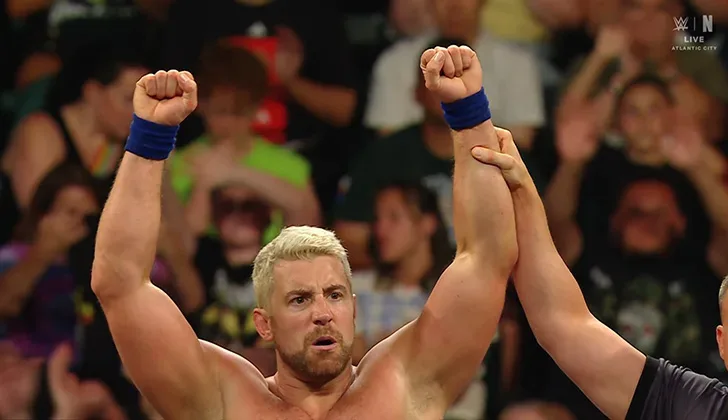
Joe Hendry is looking at the next phase of his WWE run with a combination of confidence, ambition and an acceptance that not every creative risk will land exactly as intended.
Speaking while promoting his forthcoming WWE Music album, Beyond Belief, Hendry reflected on the evolution of his presentation and ring work since his profile began to rise. He also addressed the discussion around his segment with Danhausen, outlined why he sees a potential program with Logan Paul as a natural fit, and explained the mindset that helps him move forward when criticism arrives.
Beyond Belief is scheduled to arrive on October 5. The release represents another major piece of Hendry’s identity as a WWE performer, with music, humor and audience participation remaining central elements of the character that has helped make him stand out. Yet Hendry made clear that he does not want the entertainment-driven side of his act to overshadow the progress he believes he has made between the ropes.
Hendry sees continued in-ring development as essential
Hendry acknowledged that wrestlers whose characters are especially distinctive can face a particular kind of scrutiny. A memorable entrance, a comedic hook or a musical presentation may win attention quickly, but it can also create a perception that the performer must work harder to establish credibility bell to bell.
For more background on this topic, read Nic Nemeth Explains Why He Pitched WWE Injury Angles to Vince McMahon.
“I feel it’s because when you are like a character wrestler, you’re always going to be judged more harshly for your in-ring ability and things like that,” Hendry said.
Rather than treating that pressure as a negative, Hendry described it as motivation. He pointed to the value of sharing the ring with wrestlers who bring different strengths and more experience, saying that those opportunities have allowed him to learn in real time throughout his career.
“But to be honest with you, I take comfort in the fact that I feel really confident because how you get better at wrestling is wrestling people who are better than you, wrestling people who you can learn something from,” Hendry said. “I’m so fortunate in that all throughout my career, I’ve had the chance to work with people who I’ve been able to learn things from in real time, and I just feel like I’ve come so far in-ring since my stuff started blowing up a couple of years ago.”
That outlook is particularly relevant in WWE, where Hendry is operating on a worldwide stage with heightened attention on every match, segment and creative choice. His character has been built around songs, viral moments and a direct connection with the crowd, but Hendry’s comments show that he views his work as an ongoing process rather than a finished product.
He believes the pace of improvement can be rapid when a performer is surrounded by strong opponents and is willing to assess their own work honestly. Hendry said he already feels a significant difference in his performance level even over a relatively short period.
“But I even feel like I’ve come so far in a couple of months, and I just think where am I going to be in January this year? Where am I going to be in two years’ time? It’s exciting to me,” Hendry said.
For Hendry, the key is refusing to allow a past version of himself to dictate expectations for the present. He invoked advice often associated with The Miz: ignore the outside noise and remain focused on the work. Hendry’s own version of that approach is rooted in constant progression.
“The way I’m able to block out all the noise is because if I’m criticized, it’s like you’re criticizing me for who I was yesterday, and that person is already dead. That’s kind of how I look at it,” Hendry said.
It is a forceful way of framing professional growth. Hendry is not arguing that feedback has no value; instead, he is emphasizing that his response to criticism is to improve rather than remain tied to an earlier performance, match or segment.
Logan Paul is a matchup Hendry wants when the time is right
One potential WWE opponent immediately caught Hendry’s interest: Logan Paul.
Paul has been absent due to injury, but Hendry said he would be eager to explore a rivalry when Paul is able to return. The prospect is easy to understand from a character standpoint. Both men are comfortable in high-visibility entertainment settings, both know how to generate online discussion, and both have a presence that can command an audience before a match even begins.
“Yeah, absolutely. I think that’s the feud,” Hendry said when asked if he has his eyes on Paul. “I think that would be cool for me and Logan to see what would happen there.”
No match or program between Hendry and Paul has been announced. Still, Hendry’s interest signals the level of opponent he is aiming toward as he continues building his WWE résumé. Paul’s return would inevitably draw major attention, and Hendry clearly sees an opening for a rivalry with substantial personality, promotional potential and an unpredictable audience reaction.
The possibility also has an added layer because Hendry’s music has already intersected with Paul in a viral way. His “Fire Logan Paul” song became a notable part of the wider conversation around Hendry’s act. With Beyond Belief now approaching, a feud between the two could offer WWE a chance to blend the musical side of Hendry’s persona with a major in-ring storyline.
For now, it remains an idea rather than an established direction. Hendry did not suggest that talks had taken place or that a match was imminent. He simply made his preference clear: it is a feud he would like to see tested.
Danhausen segment taught Hendry about performing on a global platform
Hendry also addressed the reaction to his segment with Danhausen, describing it as an adjustment in the realities of working within a globally visible WWE environment.
He did not dismiss the audience response or claim that every viewer received the segment in the desired way. Instead, Hendry spoke candidly about what changes when a creative moment draws widespread feedback across a much larger platform. In prior situations, he said, a segment that did not fully connect could simply be followed by the next show and the next opportunity. In WWE, the response can remain visible and intense for much longer.
“I’ll say this: it was an interesting experience for me,” Hendry said. “Because what I’ve learned is that when you do something that isn’t received how you’d want it to be received, in previous companies it’s just whatever, on to the next. Whereas now, because of the global platform that we have, these moments don’t just go away. You’re getting so much feedback, good and bad, from people that you’re not used to, and it was an adjustment, I think, for a small period of time there.”
The important part of Hendry’s response was his insistence that the answer is not to retreat from experimentation. He said he spoke with Alex Williams about the need to learn while moving through WWE’s nonstop calendar. The schedule does not allow much time to dwell on a single reaction, whether positive or negative. A performer has to absorb the lesson, adjust and continue.
“When we’re doing what we do, it’s 52 weeks a year,” Hendry said. “It’s like you have to learn the lessons as you go, and go, okay. You use that, take the feedback, and go, okay, this is the direction we’ll go next time, and you have to just get back on the horse and keep going.”
That process has led Hendry to a broader conclusion about his pathway to success: he wants to take major creative swings. In his view, the upcoming album is one. So are bold promotional concepts, including a commercial built around the notion of giving Joe Hendry every championship, along with matches involving tables, ladders and chairs.
Such choices naturally carry risk. A performer cannot reasonably expect every segment, lyric, commercial or match concept to connect at the same level. Hendry accepts that reality, but he believes the alternative—playing cautiously and avoiding the possibility of a miss—would not serve his audience or his own potential.
“I think learning that, I’ve realized the pathway to success for me is taking big swings,” Hendry said. “I think that this album is a big swing. Putting out the commercial and give Joe Hendry every single belt and tables, ladders, and chairs. Those are big swings, and I have confidence in them.”
He added that the occasional setback is part of the cost of pursuing ideas that can genuinely break through.
“I think that when you take big swings, the cost of that is not everything that you do is gonna hit 100%, but I will say this is, I can hand on heart say that we genuinely tried our best to deliver for the audience, and I always do,” Hendry said. “That’s all I’m trying to do is just entertain the audience as best I can. I’m not going to necessarily be successful 100% of the time, but I think the hit rate is pretty good, and I’m proud of the effort that goes in.”
Beyond Belief arrives as Hendry looks ahead
Hendry last wrestled on the September 17 edition of WWE Main Event, where he was defeated by Ethan Page. The loss does not change the central theme of Hendry’s current outlook: he is focused less on a single night and more on the long-term trajectory of his WWE career.
That trajectory includes continued in-ring development, bigger creative ideas, an album release and the possibility of eventually sharing the spotlight with a name such as Logan Paul. It also includes a willingness to confront mixed reactions without allowing them to define him.
With Beyond Belief arriving October 5, Hendry is putting another significant piece of his creative identity in front of WWE’s audience. His comments suggest he understands exactly what that entails. Big swings can generate excitement, criticism or both. But Hendry’s belief is that growth comes from continuing to take them, learning from the response and ensuring that the wrestler audiences see tomorrow is better than the one they saw yesterday.

Darryl Polo
Darryl Polo is a passionate wrestling fan covering WWE, AEW, TNA and beyond. He loves great rivalries, breakout stars and the moments that keep fans talking long after the bell. How we work.