
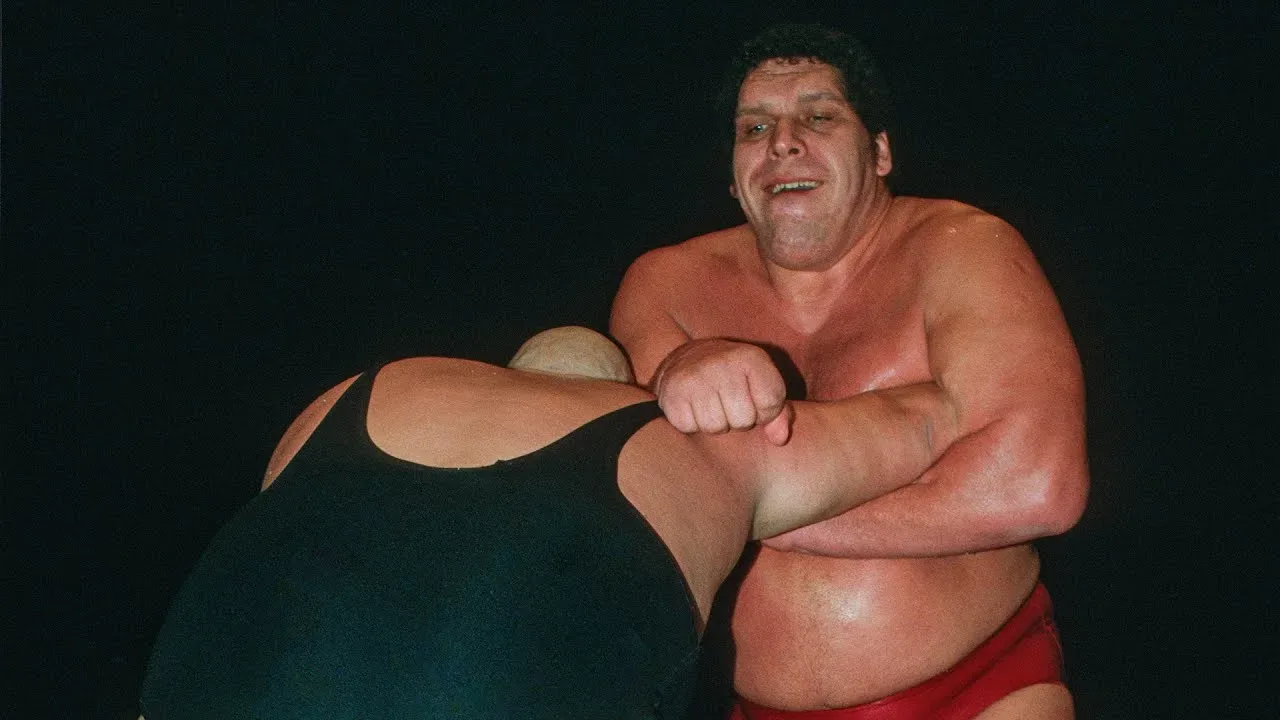
Jim Duggan has shared another vivid story from his many years wrestling some of the biggest attractions in WWE history, recalling a match in which Andre the Giant left him bleeding with what amounted to a single shot from his thumb.
Duggan’s career made him a natural opponent for larger-than-life villains. Armed with his trademark 2x4 and the crowd-rallying “Hoooo!” chant, Duggan was often positioned as the defiant everyman babyface against physically overwhelming opponents. That role put him across the ring from a remarkable collection of giants, including Andre, Yokozuna, Umaga and Big Show.
In a recent interview, Duggan reflected on that recurring assignment and explained that, when a major giant was on the roster, he was frequently the man called upon to confront them. As Duggan put it, “If there was a giant in our business, Yokozuna, Umaga, The Big Show, Andre the Giant, it was ‘Duggan, get your 2x4’; I had to wrestle every giant there was.”
A Small Moment With a Big Consequence
The Andre encounter Duggan described began with the sort of visual that made the Giant such a singular presence in professional wrestling. Duggan said he charged in and found himself with his chin at Andre’s stomach, looking upward while trying to convey that he was not intimidated by the enormous opponent in front of him.
For more background on this topic, read Ethan Page Draws a Line on AI Use in Wrestling Art and Promotion.
“I ran down; I had my chin on Andre’s belly, I’m looking up at him like, ‘I’m not afraid of you,’” Duggan recalled.
Then came the moment that changed the match. As Andre reached to grab him, Duggan said the Giant’s thumb caught him in the mouth. The contact opened Duggan’s lip, and the blood was immediate and highly visible. “His thumb hit my lip, and my lip fell down, and blood came pouring down my chest,” Duggan said.
In an era when the sight of blood could add instant intensity to a televised wrestling confrontation, the unexpected injury dramatically enhanced the scene. Duggan remembered that it created a genuine sense of surprise among those watching, because there was no obvious conventional strike that explained why he had suddenly been busted open.
“It actually worked out great,” Duggan said. “Everyone was like, ‘Where did the blood come from?’ He beat me up with his thumb.”
The Andre the Giant Challenge
Andre the Giant was not simply a large wrestler; he was presented as an almost unbelievable spectacle. The scale of his body, the aura built around his international reputation and the way promoters framed his appearances made virtually every interaction feel different from an ordinary match. For an opponent, selling Andre’s size was not merely part of the performance. It was unavoidable.
Duggan’s recollection captures that reality in a particularly direct way. A thumb connecting in the wrong place would be a minor moment with many opponents. With Andre, who was famously enormous and possessed massive hands, it became enough to visibly injure a fellow wrestler and alter the closing image of a television match.
The story also illustrates why wrestling against giant opponents required a distinct kind of babyface performance. The smaller wrestler had to project courage without making the size difference disappear. Duggan’s character was built for that tension. He was not presented as an unstoppable athletic marvel who could casually overpower anyone. Instead, his connection with audiences came from his willingness to stand up, keep fighting and reach for his 2x4 when the odds appeared stacked against him.
That framework made a giant like Andre an especially effective foil. Duggan could rush forward with confidence, only to be dwarfed by the visual reality of the matchup. When the physicality became as real as the cut Duggan described, it gave the audience an even sharper reason to invest in his resistance.
A Blood-Soaked Television Finish
Duggan said the WWF broadcast went off the air with him standing over Andre while blood covered him. It is an extraordinary picture: the beloved fan favorite surviving an encounter with one of wrestling’s most imposing stars, but doing so with the visible evidence of how punishing the confrontation had been.
“WWF went off the air with me standing over Andre the Giant, covered in blood,” Duggan recalled.
That ending is notable because it did not rely on a clean, uncomplicated triumph. The image of Duggan standing tall conveyed resolve, while the blood reinforced the damage he had endured. In wrestling storytelling, that combination can be more memorable than a routine celebration. The hero may have remained on his feet, but the audience could see the cost of the fight.
It also speaks to the unpredictable nature of the ring. Even in a profession where matches are structured around planned sequences and intended outcomes, accidental contact can happen quickly. Duggan did not characterize the moment as a deliberate attempt by Andre to cut him open. His account was specifically that Andre went to grab him and the Giant’s thumb struck his lip. The resulting blood, however, became part of the match’s final presentation.
Duggan’s Familiar Role Against Wrestling’s Giants
Duggan naming Yokozuna, Umaga, Big Show and Andre together underscores just how often he was associated with the giant-slayer role across different periods. Those wrestlers represented different generations, styles and presentations, but each brought the same fundamental challenge: how does a fan favorite make a fight feel credible against someone with a major size advantage?
Yokozuna was framed as an immovable force during his dominant WWE run. Umaga was portrayed as a savage and explosive threat. Big Show combined extraordinary size with enough mobility to work a wide range of match styles. Andre, meanwhile, remains one of the defining giant attractions in wrestling history. Duggan’s association with all of them reflects both his longevity and the clarity of his persona.
The 2x4 was central to that persona, but it was never only about the prop. It represented Duggan’s working-class, red-white-and-blue character and gave the fans a tangible symbol of resistance when he faced opponents meant to look unbeatable. Against giants, that visual became especially valuable. The crowd understood immediately that Duggan was entering a mismatch, and the 2x4 suggested he would find a way to fight anyway.
His story about Andre is therefore more than an anecdote about an accidental bloody lip. It is a snapshot of the role Duggan repeatedly played: the man who was asked to confront the monster, absorb the punishment and give the crowd someone to rally behind.
An Unforgettable Reminder of Andre’s Presence
Stories about Andre the Giant often focus on his unmatched physical scale and the surreal experiences of sharing space with him. Duggan’s memory adds a particularly blunt wrestling-ring version of that theme. Andre did not need a dramatic power move to leave a mark. One badly placed thumb was enough.
For Duggan, the incident ultimately served the match. The blood created a startling visual, made the encounter feel more violent and gave viewers a mystery they could not immediately explain. For fans looking back at the larger-than-life era of WWF television, it is also another reminder that Andre’s legend was built not only through his victories and famous rivalries, but through the sheer physical impact he could have in even the smallest exchange.
Duggan’s account preserves the humor of the moment as well. He remembers the confusion around where the blood had come from, then delivers the simple answer: Andre the Giant had, in effect, beaten him up with his thumb. It is a line that sounds unbelievable until the person involved is Andre.

Darryl Polo
Darryl Polo is a passionate wrestling fan covering WWE, AEW, TNA and beyond. He loves great rivalries, breakout stars and the moments that keep fans talking long after the bell. How we work.