
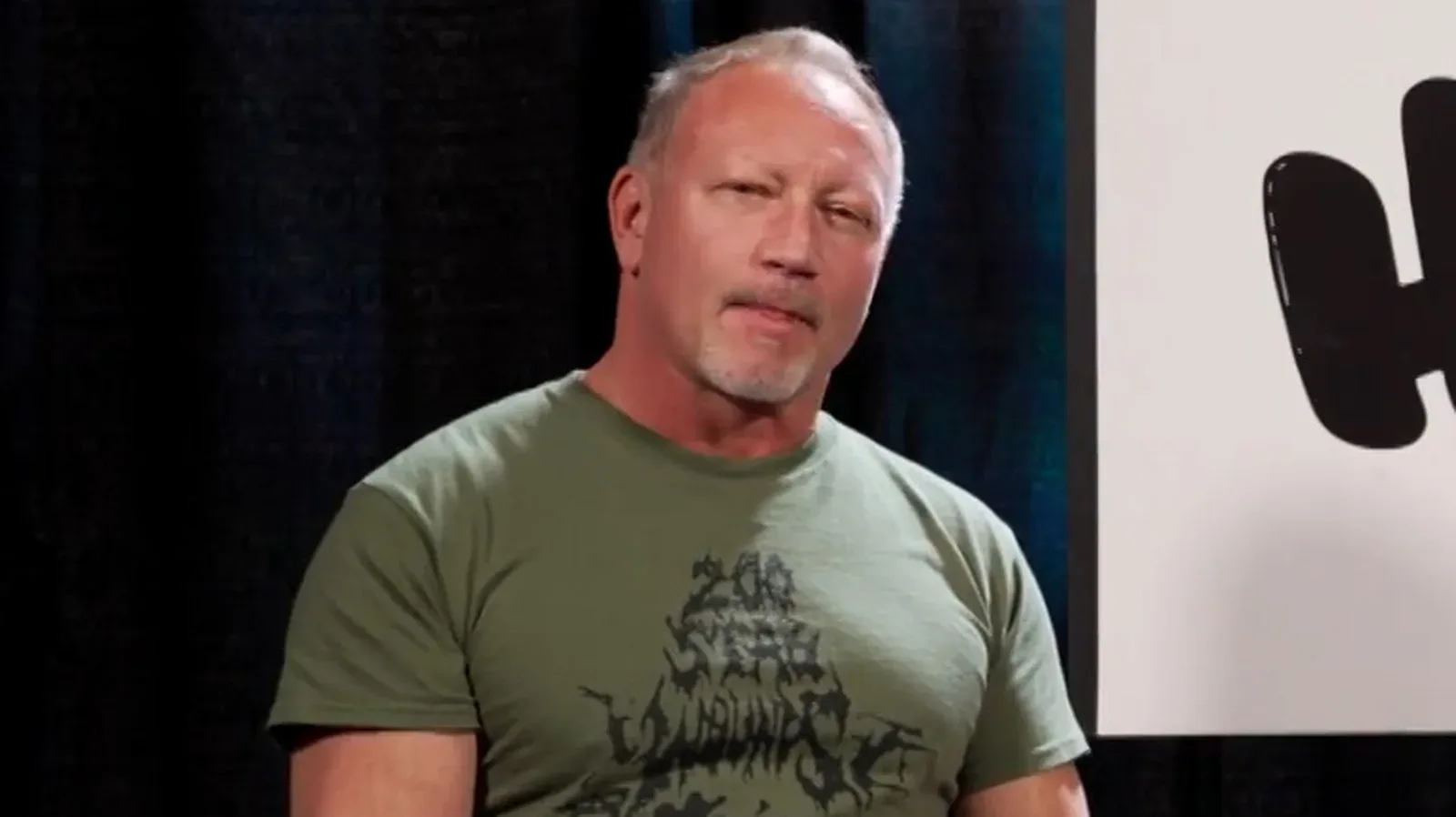
Jerry Lynn came close to taking a very different path during WWE’s Attitude Era boom.
The respected ECW veteran recalled that Jim Cornette had discussed bringing him into the then-WWF for a place in The Brood, the gothic stable that became one of the era’s most recognizable acts. The role ultimately went to Gangrel, who entered alongside Edge and Christian when the group debuted in late 1998.
Speaking on What Happened When, Lynn said Cornette had envisioned him as part of the group before WWE moved in another direction. “Jim was trying to bring me in — it’s funny — he was trying to bring me into WWF to be in The Brood before they brought in Gangrel, but I was too small,” Lynn said. “Which I understand. It was still a majority big man’s business, you know?”
The recollection adds another intriguing what-if to a period when WWF was aggressively searching for characters and performers who could stand out in an increasingly theatrical, highly competitive wrestling landscape. Lynn had already established himself as one of the most admired in-ring performers in ECW, but the presentation planned for The Brood demanded more than wrestling ability. It was a character-heavy act built around a distinctive visual identity, elaborate entrances, and a supernatural edge.
For more background on this topic, read Eric Bischoff Says Wrestling Needs Episodic Storytelling to Keep Fans Invested.
The Brood Became an Attitude Era Fixture
The Brood arrived in WWF in 1998 with Gangrel positioned as the central figure alongside Edge and Christian. Its members were portrayed with vampire-inspired imagery, dark lighting, dramatic music, and the entrance that became synonymous with the stable: a ring of fire on the stage and the trio rising through it.
While Edge and Christian would eventually grow into one of WWE’s defining tag teams of the next decade, The Brood gave both men an important early platform on national television. Gangrel’s presence and the faction’s unique atmosphere helped differentiate them from much of the roster at a time when WWF programming was filled with evolving alliances, unpredictable stories, and larger-than-life personas.
The stable’s run as an independent unit was relatively brief, but its impact has endured. The Brood later aligned with The Undertaker’s Ministry of Darkness in early 1999, putting Edge, Christian, and Gangrel into one of the promotion’s most prominent storylines. The larger faction was a major part of WWF television during that period and represented the company’s willingness to lean hard into darker character concepts.
Later in 1999, The Brood split apart. A short-lived version known as The New Brood paired Gangrel with Matt and Jeff Hardy, but that arrangement did not last long. Even so, the original trio’s look, entrance, and presentation remain closely linked to the Attitude Era, while Edge and Christian’s later successes ensured that the stable retained a lasting place in WWE history.
Why Lynn’s Size Was Part of the Conversation
Lynn’s comments reflect the reality of the business during that time. The late 1990s were not exclusively dominated by larger wrestlers, as performers with varied body types and styles were finding opportunities across WWF, WCW, and ECW. Still, size remained a major consideration, particularly when promotions were making casting decisions for featured character roles.
For a group such as The Brood, physical presentation mattered. The act was intended to project menace and mystery, and the performers had to fit a specific visual concept as much as they had to contribute between the ropes. Lynn’s acknowledgement that he understood the decision offers a clear-eyed look at how those choices were often made.
“What a mind for the business,” Lynn said of Cornette on What Happened When.
Lynn indicated that his history with Cornette was otherwise limited, but his praise for Cornette’s wrestling knowledge was emphatic. Cornette has held many roles in professional wrestling, including manager, commentator, promoter, trainer, and booker. His time in WWF placed him in position to offer input on talent and creative matters during a transformative period for the company.
The possibility of Lynn joining The Brood also underlines how fluid roster plans can be before a group reaches television. A name can be discussed, a role can be considered, and a direction can change before audiences ever see the finished product. In this instance, Gangrel became the performer associated with the part, and the resulting trio developed a presentation that fans still remember decades later.
Lynn’s ECW Reputation Was Already Secure
By the time this potential WWF opportunity was discussed, Lynn had already earned significant respect through his work in ECW. He became known for his technical skill, athletic approach, and ability to have high-level matches with a wide range of opponents. His career is especially associated with his series against Rob Van Dam, a rivalry that helped define an important stretch of ECW programming.
ECW offered a radically different environment from WWF. The promotion made room for a broad range of styles, from technical wrestling and high-flying action to brawling and hardcore matches. Lynn’s work fit naturally within that setting, and his consistency made him one of the company’s standout performers during the 1990s.
That background makes the Brood story especially interesting. Rather than entering WWF simply as an extension of his ECW identity, Lynn could have arrived in an entirely character-driven faction with a supernatural presentation. There is no indication that the idea progressed beyond Cornette’s effort to bring him in, and Lynn’s own explanation makes clear why he believes the plan did not happen. Still, it would have been a striking contrast to the reputation he built through his in-ring work.
A Brief WWE Run and a Long Career Beyond It
Lynn eventually did work for WWE in 2001, wrestling a few dozen matches before returning to the independent scene. That stint came after the period in which The Brood had already formed, aligned with the Ministry of Darkness, and gone its separate ways.
His broader career continued well beyond that WWE run. Lynn was part of the early years of TNA when the company operated under the NWA banner, and he also appeared in Ring of Honor as well as numerous independent promotions. Across those stops, his standing as a respected veteran performer remained intact.
Lynn retired from in-ring competition in 2013. His influence, however, did not end with his retirement. He later transitioned into a behind-the-scenes role and currently works for AEW as a coach and producer. That position allows him to bring decades of experience from ECW, WWE, TNA, ROH, and the independent circuit to a newer generation of wrestlers.
An Interesting Alternate Version of WWE History
Gangrel, Edge, and Christian are the names permanently attached to The Brood, and that legacy is not changing. The group’s identity was shaped by the performers who appeared on screen, particularly as Edge and Christian later became major stars and multiple-time tag team champions.
But Lynn’s story is a reminder that some of wrestling’s most enduring acts were not always assembled exactly as fans came to know them. Before the music, fire, and blood-themed imagery became staples of The Brood’s presentation, Cornette had apparently considered an accomplished ECW wrestler for the role that Gangrel ultimately filled.
For Lynn, the missed chance was not framed as bitterness. Instead, he offered a practical explanation rooted in the era’s preference for larger physiques and followed it by praising Cornette’s understanding of the business. The result is not a revision of The Brood’s history, but a revealing glimpse at one possible version of it: Jerry Lynn, an elite in-ring wrestler from ECW, potentially stepping into one of WWF’s most visually distinctive factions of the late 1990s.
In pictures

Darryl Polo
Darryl Polo is a passionate wrestling fan covering WWE, AEW, TNA and beyond. He loves great rivalries, breakout stars and the moments that keep fans talking long after the bell. How we work.