
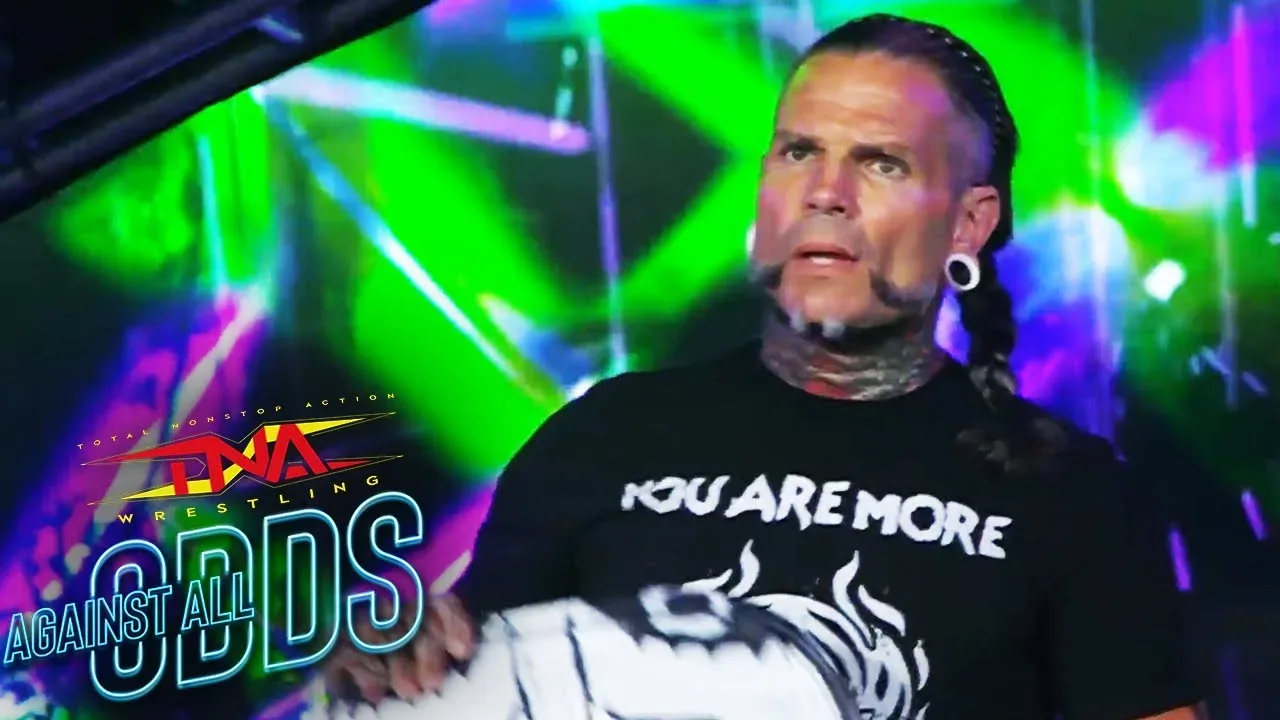
Jeff Hardy has offered a candid update on the neck issue that has raised concerns around his immediate future in TNA Wrestling, describing it as a persistent problem that has affected his confidence before matches and his ability to rest comfortably.
Hardy emphasized that he is not presently dealing with unbearable pain. Still, the possibility of the condition worsening has become a major consideration every time he prepares to wrestle. The veteran said he is trying to approach the situation carefully, while acknowledging that he believes time away from the ring may be necessary.
“I’m feeling alright. It’s just a nagging pain that will not go away,” Hardy said. “Pretty much before every match, I’m always scared and I freak myself out. I’m going, oh my God, this might be the match that it may become herniated. So dealing with that fear has been kind of rough. But I’m just trying to be safe.”
The comments provide further context to Matt Hardy’s statement at the end of October that Jeff could be headed for some time off because of a neck injury. Jeff’s update makes clear that the concern is not simply the discomfort he is experiencing on a day-to-day basis. It is also the uncertainty that comes with continuing to wrestle, especially in a career defined by a willingness to take major physical risks.
For more background on this topic, read Jeff Hardy Says His TNA ‘Death’ Angle Was His Idea, Confirms Canada Travel Issues Remain.
For Hardy, the psychological strain of wondering whether one moment could turn a manageable issue into a much more serious one has been difficult. That is an especially notable admission from a performer whose style has long included high-impact offense, dives, and spectacular finishing sequences that demand confidence as much as athletic ability.
A Cautious Approach Despite the Urge to Take Risks
Even as Hardy tries to protect himself, he admitted that turning down a chance to perform one of his signature high-risk moves is not easy. He specifically referenced a Swanton Bomb he performed at his most recent TNA pay-per-view, calling it a “pretty crazy Swanton.”
Hardy said opportunities such as that one remain difficult to resist because of the comfort he still feels when executing the move. The moment also carried a visual element tied to the return of the foam fingers, which Hardy wore before taking flight.
“So actually, it’s kind of hard for me to resist those opportunities because I feel so comfortable and confident when I do those, and we got those foam fingers back now,” Hardy said. “I was like, if I do this big Swanton, I gotta put those on my hands. Sure enough, I put them on my hands and arms wide open and nailed it.”
That balancing act is central to Hardy’s current situation. His confidence in performing familiar offense has not disappeared, and the desire to deliver memorable moments for the audience is still plainly there. At the same time, the neck problem has forced him to assess the potential consequences of every physical decision in a different way.
Hardy did not indicate that one specific spot or recent match caused the issue. Rather, he described a pain that has lingered and has not fully gone away. His concern is preventative: he does not want to continue until the condition becomes severe.
There is an important distinction in that assessment. Hardy is not saying he is presently unable to function or that he is in extreme pain. Instead, he is trying to avoid reaching that point. Given the physical nature of professional wrestling and the repeated stress placed on the neck through bumps, falls, travel, and training, his desire to step back before the issue escalates is understandable.
Painting and Sleep Have Made the Problem More Noticeable
Hardy also explained that the neck discomfort can become more pronounced outside the ring. In particular, he said that spending extended periods painting with his head down can trigger the problem. He further noted that it has affected his sleep.
“No, it’s not terrible,” Hardy said when asked whether he is currently hurting. “When I paint for a while and my head’s down for a long time, I can really feel it, and sleep has kind of not been that great because it does bug me at night. So it’s not a terrible pain, but I don’t want it to be a terrible pain. That’s what I’m afraid of, naturally.”
The details underline why Hardy is considering an extended pause even though he remains capable of wrestling. A problem that disrupts sleep and becomes noticeable during normal activities can be difficult to ignore, particularly when an in-ring schedule adds further physical demands. The issue appears to be less about a single acute moment and more about managing something persistent before it develops into a greater concern.
Hardy’s mention of painting is also fitting given the creative work that has remained a visible part of his identity beyond the ring. But it illustrates how a neck issue can affect everyday routines as well as performance. Keeping his head in one position for too long is enough to make him feel the pain, which speaks to the caution he is applying to the condition.
Hardy Says a Break Could Be Needed
When discussing the next step, Hardy was direct about what he feels may be best for him. He said he believes he needs time away from professional wrestling, potentially for a few months.
“But yeah, I just feel like I need a break from pro wrestling just for a few months,” Hardy said.
At this stage, Hardy did not provide a precise timetable for a return, nor did he state that a formal medical diagnosis or surgery is planned. His comments should therefore be viewed as a personal assessment of what he needs, rather than confirmation of a defined recovery schedule. The key point is that he is considering a meaningful period of rest in order to keep the current pain from becoming something more serious.
That decision would follow Matt Hardy’s earlier indication that his brother might be absent due to the neck problem. Jeff’s own words now add a clearer picture: the pain is manageable, but it is recurring; it is affecting sleep; and it has introduced fear into his pre-match mindset.
For any wrestler, competing while worrying about a potential injury can change the entire process of preparing for a match. For Jeff Hardy, whose offense has frequently relied on split-second timing and total commitment, that internal hesitation carries particular weight. He remains confident enough to take a Swanton when the moment calls for it, but he is also acknowledging that confidence alone is not a substitute for taking care of his health.
Current TNA Television Status
Hardy is currently off TNA television following a cinematic match in which he was “killed” by syX, the team of Samuel Shaw and Joseph Sawyer. The angle provides a storyline explanation for his absence while he evaluates the neck issue and the possibility of stepping away for several months.
There is no confirmed date for Hardy’s next appearance. His recent remarks suggest that fans should not assume an immediate return, especially if he follows through on the break he feels he needs. TNA now has a storyline mechanism for keeping him off programming, while Hardy can prioritize preventing a nagging condition from progressing.
The most encouraging part of Hardy’s update is that he does not describe the pain as terrible at present. However, his concern is rooted in protecting his future rather than waiting for the worst-case scenario. After a career built around remarkable resilience and fearless moments, Hardy is confronting the practical reality that a short-term pause may be the safest path forward.
For now, Hardy’s status remains one to watch. He still feels capable in the ring, still takes pride in delivering signature moments, and still has the instinct to give the audience something memorable. Yet he has also been clear that the persistent neck pain, interrupted sleep, and anxiety surrounding potential aggravation have made a temporary break from professional wrestling feel necessary.

Darryl Polo
Darryl Polo is a passionate wrestling fan covering WWE, AEW, TNA and beyond. He loves great rivalries, breakout stars and the moments that keep fans talking long after the bell. How we work.