
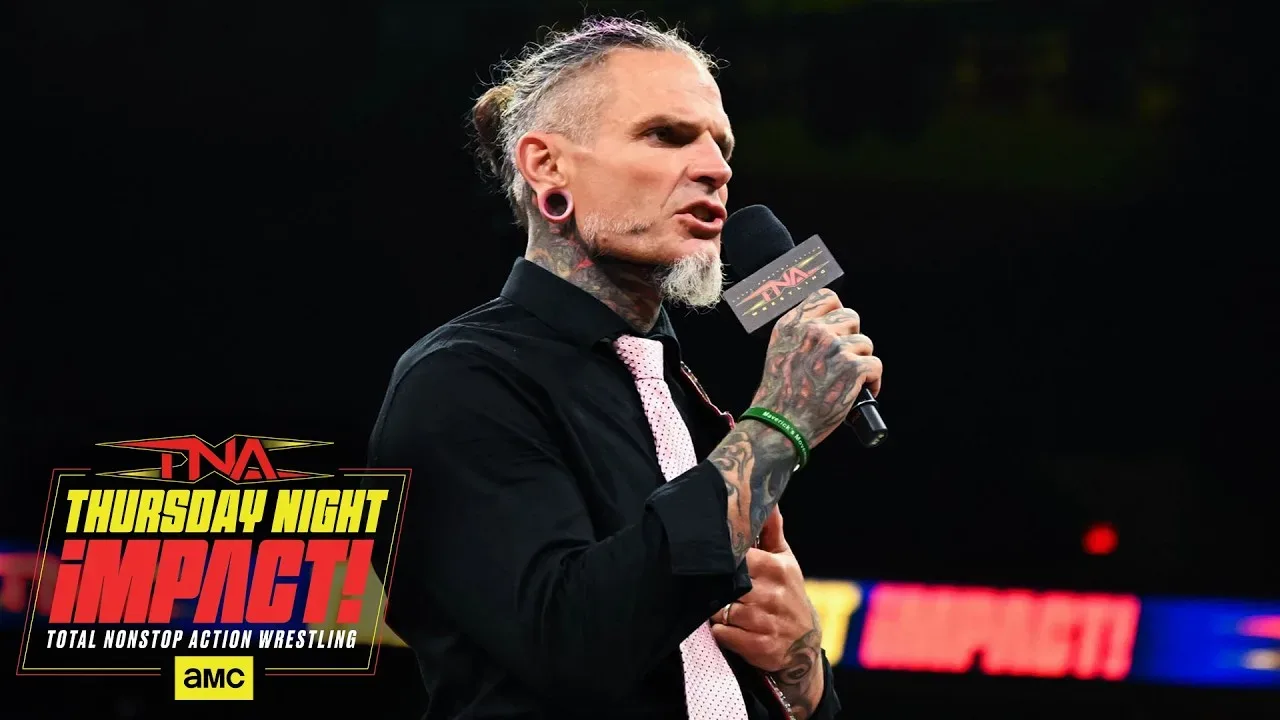
Jeff Hardy’s latest absence from TNA programming is not being presented as a routine injury angle, a simple backstage attack, or an unexplained disappearance. In storyline terms, Hardy says he has been sent to “the other side” after an especially grisly Slaughterhouse match visual involving a trash can, axes, Samuel Shaw, and Joseph Sawyer.
Hardy recently addressed the segment and his current on-screen status during an appearance on Insight with Chris Van Vliet. While the scene was designed to look brutal, Hardy made clear that he was enthusiastic about how it came together. He also revealed that the central idea behind the angle came from him.
“I’m on the other side. I’m just a hologram,” Hardy said. “Yeah, in the pro wrestling world, I’m on the other side out there in the stars. It was nasty.”
The angle marked the last time Hardy appeared on TNA programming. He was placed inside a trash can before Shaw and Sawyer chopped at the container with axes, creating an image intended to symbolically “kill” him off within the story. Hardy’s comments indicate that the presentation was not merely a shocking write-off devised around him, but a creative direction he personally wanted to pursue.
For more background on this topic, read Leon Slater Set To Defend TNA World Championship Against Nic Nemeth On November 19 iMPACT!.
For a performer whose career has often been tied to vivid imagery, unconventional characters, and high-risk spectacle, the sequence fit Hardy’s willingness to make a departure feel larger than a standard wrestling television exit. The former TNA and WWE champion described the process as an exercise in finding a unique way to stage the Slaughterhouse match concept.
Hardy Was Pleased With the Slaughterhouse Match Presentation
Hardy explained that the match required everyone involved to think creatively about what could be done within the concept. The eventual result blended a live wrestling-show environment with the kind of visual construction Hardy compared to making a movie.
“That was one of those things. This Slaughterhouse match idea they came up with, and it was like we had to be real creative to come up with what we were going to do in that match, and it all turned out pretty cool, I thought,” Hardy said.
He pointed specifically to the experience of seeing the footage after it had been edited. For Hardy, the final presentation added another layer to an angle that was already designed to be memorable in front of the audience.
“Especially when they get done with that, and then you edit it and you watch it back. It’s always so fun, making a little movie,” Hardy said. “But yeah, that was pretty nasty, man. That’s a hell of a way to take me out.”
Professional wrestling has long used cinematic ideas to heighten feuds and cover an absence, whether through staged attacks, buried-alive angles, explosions, supernatural transformations, or symbolic deaths. Hardy’s explanation puts this TNA moment firmly in that tradition, while also underlining the amount of planning that goes into making such a sequence appear chaotic and dangerous without revealing the mechanics behind it.
The importance of that planning is especially apparent in an angle involving axes and a confined prop such as a trash can. The intended reaction depends on the audience believing they have seen something extreme, but the participants must also coordinate a visual that works live and holds up once it is edited for television. Hardy’s satisfaction with the final version suggests the creative team achieved the reaction and image they were targeting.
The “Real Canadian Destroyer” Joke Had a Personal Context
Hardy also shared a joke made by his brother Matt Hardy about the segment. Matt dubbed the moment “the real Canadian Destroyer,” a line that played on the famous wrestling move name while referencing Jeff’s ongoing difficulty getting into Canada.
“Matt had a really witty name for that thing,” Hardy said. “He said, ‘This is the real Canadian Destroyer’ because I have issues getting into Canada, and actually, that was a good joke on Matt’s part.”
Jeff Hardy confirmed that the travel issue remains a reality for him. His inability to easily enter Canada has practical consequences whenever a promotion schedules television, live events, or major shows north of the border. TNA recently traveled to Calgary for Destination X, followed by television tapings in Edmonton on Wednesday and Thursday.
Hardy has had legal issues in the past related to DUIs. He did not offer a further explanation during this discussion regarding the present status or specific circumstances of his Canadian entry situation, but he directly acknowledged that the issue persists.
That made the timing of the storyline departure notable. With TNA holding a run of Canadian events, Hardy’s on-screen removal provided a storyline explanation for why he would not be part of the programming. The company did not simply leave his absence unaddressed; instead, it used an elaborate segment to make the situation part of the show’s narrative.
Hardy Says the Extreme Exit Was His Own Concept
Perhaps the most significant point from Hardy’s comments was his confirmation that the “death” angle was his idea. The scene was built to leave a lasting impression, and Hardy said he enjoyed seeing a concept from his imagination successfully become a finished wrestling segment.
“It just looked great watching it back, and I just loved it,” Hardy said. “That was my idea, and so it’s always cool when you dream up something in your imagination, and it comes out so good and so well in reality, and especially in front of a live audience.”
That creative ownership matters because it reframes the angle. Rather than being portrayed as someone being written out against his wishes, Hardy described himself as an active contributor to the decision and presentation. He embraced the dramatic nature of the segment and appeared proud of how the production translated an unusual concept into a televised payoff.
Hardy has built much of his identity around being different from the expected wrestling template. From his face paint and entrances to the experimental art, music, and character ideas associated with different stages of his career, he has consistently leaned toward presentation choices that are visually distinct. A trash-can-and-axes write-off is extreme even by wrestling standards, but it is also consistent with a performer who has never been reluctant to pursue unusual imagery.
His comments do not establish a timetable for an in-ring return, nor do they reveal how TNA may eventually revisit the story. What they do establish is that the current absence is being treated as a storyline death, at least for now.
“But yeah, as of right now, storyline-wise, I’m on the other side,” Hardy said.
What Hardy’s Comments Mean for TNA Programming
Within the boundaries of the TNA story, Hardy’s status is intentionally fantastical. The “hologram” description and references to being in the stars are not a literal retirement announcement or a medical update. They are Hardy’s way of explaining the severity of the fictional attack and the place it leaves his character after the Slaughterhouse match.
It also gives TNA flexibility. Wrestling companies frequently use dramatic write-offs to pause a character’s involvement while preserving the option of a future return. An angle that appears to conclusively remove someone can make a comeback more meaningful if and when the story calls for it. However, Hardy did not announce a return plan, and there is no stated date for his next TNA appearance.
For now, the focus remains on the image created by Shaw and Sawyer’s attack and on Hardy’s own positive reaction to the execution. He called it nasty, praised the way it looked after editing, appreciated Matt Hardy’s wordplay, and emphasized that the core idea originated with him.
TNA’s Canadian tour came and went with Hardy’s travel situation still unresolved, but the company had a storyline answer ready for his absence. In the fictional universe of the program, Jeff Hardy is gone to “the other side.” Outside that storyline, Hardy’s comments show that he remains engaged with the creative work that shaped one of TNA’s most striking recent angles.

Darryl Polo
Darryl Polo is a passionate wrestling fan covering WWE, AEW, TNA and beyond. He loves great rivalries, breakout stars and the moments that keep fans talking long after the bell. How we work.