
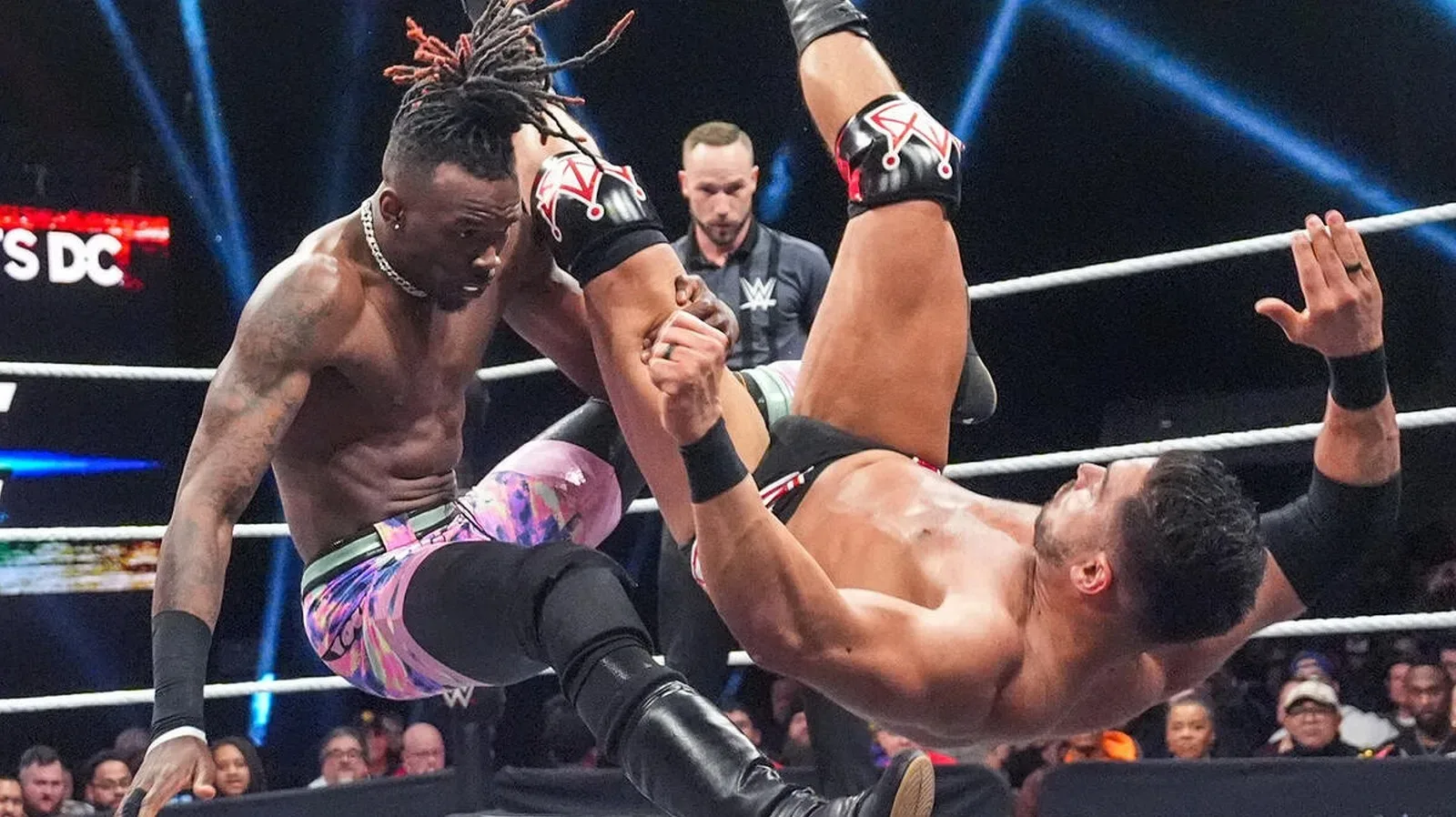
Je'Von Evans has already established himself as one of WWE's most naturally spectacular young in-ring athletes, but the rising star is not presenting himself as a finished product. Following another eye-catching showing in the Money in the Bank Briefcase Ladder Match, Evans discussed the areas he believes still require the most attention as he continues developing his career.
For Evans, the priorities extend beyond the explosive offense and athletic highlights that have drawn attention since his earliest appearances in NXT. He is placing particular emphasis on his promo work and on building a physique that can support his style over the long haul. Those goals reflect an understanding that becoming a durable, well-rounded WWE performer demands more than the ability to produce memorable moments between the ropes.
Evans is working to become more comfortable on the microphone
Speaking on The Rich Eisen Show, Evans was candid about the part of wrestling that did not initially come naturally to him: talking. He explained that he has been putting substantial effort into improving his mic skills and becoming more confident in the verbal side of his presentation.
“When it comes to, you know, my mic skills, like I've been trying to work hard on just talking, you feel me,” Evans said on The Rich Eisen Show.
For more background on this topic, read Kelly Kelly Explains Why She Turned Down Playboy Offer During WWE Run.
That focus makes sense given the unusual path Evans took into wrestling. He began competing on the independent scene at just 13 years old. While that early start gave him valuable experience and helped accelerate his development as an athlete, it also created a challenge when it came to speaking in front of audiences. Evans was a teenager working against adults, and he said he did not enjoy delivering promos because he was conscious of how unbelievable he might sound in that environment.
There is an important distinction in what Evans is describing. The issue was not a lack of personality or an absence of a recognizable voice. Rather, he was dealing with the difficulty of finding the right way to communicate as an extremely young wrestler sharing a ring with grown opponents. Promos require a performer to sell the stakes of a conflict, establish conviction and make viewers believe that the person speaking belongs at that level. For a teenager, that can be a demanding assignment even with considerable natural charisma.
WWE has changed his perspective on that part of the job. Evans said being signed by the company has pushed him to take promos more seriously and to focus on the details of making them work. His comments suggest that he now views speaking segments not as an obstacle separate from wrestling, but as another skill that can be improved through repetition, preparation and commitment.
“Being signed to WWE has made me understand and made me, like, lock in when it comes to promos,” Evans said.
Evans also emphasized that the process becomes more manageable when a performer breaks it down rather than treating it as something mysterious. That approach mirrors the way wrestlers sharpen every other part of their craft. Timing, footwork, conditioning and ring positioning all improve through dedicated practice. Evans sees promo work through a similar lens: study it, simplify it, keep working and become better over time.
Live opportunities are helping sharpen his voice
One of the most significant parts of Evans' development has been receiving chances to work on his speaking ability in a live WWE setting. There is a major difference between practicing a promo privately and delivering one in front of an arena audience, where reactions, timing and pressure can influence every word. Evans is grateful for those opportunities because they allow him to develop in the environment where the skill ultimately matters most.
He also revealed that he has recently been working with Paul Heyman. Heyman's history as an on-screen talker, manager and creative mind makes him a notable figure for any wrestler looking to improve their microphone work. For Evans, the collaboration appears especially useful because Heyman understands the cadence and style of speech that Evans brings to the screen.
“He understands that, like, I just talk so different,” Evans said of Heyman. “He worked with, you know, my unc', New Jack, so like he understands how I talk.”
The reference to New Jack speaks to the personal and cultural context Evans feels informs the way he communicates. Evans does not appear interested in simply adopting a generic wrestling-promo delivery. Instead, he is trying to refine his own voice while learning how to make it connect effectively with a broad WWE audience. That is a meaningful distinction for a developing performer. Strong promos are often most effective when they feel authentic to the wrestler delivering them, rather than sounding like a style imposed from outside.
Heyman's experience may help Evans translate that authenticity into a clearer television presence. The goal is not merely to talk more often. It is to make every appearance count, whether Evans is advancing an issue, responding to an opponent or giving viewers a better sense of who he is beyond his aerial ability. As Evans gains more comfort in those moments, the verbal side of his act could become a greater complement to the energy he already brings in the ring.
A long-term plan for his physique
The second major area Evans identified is his physical development. He said he is continually working to improve his physique, with longevity at the center of that effort. This is not simply a discussion about adding size for appearance's sake. Evans is considering the balance between muscle mass, explosiveness and the physical demands of his style.
“I feel like it'll just be better and just easier when it comes to, like, longevity,” Evans said.
Evans believes that adding more muscle could help him find a productive middle ground: maintaining the burst and athleticism that define his matches while avoiding unnecessary strain on his body. That is a particularly relevant concern for a wrestler whose offense and overall presentation rely heavily on speed, movement and high-impact physicality.
The best version of that plan is not necessarily the largest version of Evans. His comments indicate that he is looking for a sweet spot, one in which added strength supports his body rather than compromising the traits that have made him stand out. For an athlete with Evans' profile, preserving explosiveness is essential. The ability to move quickly and dynamically has been a central part of his appeal, including in the Money in the Bank ladder environment, where he again displayed his talents despite not winning the briefcase.
At the same time, a more developed frame can be valuable across the grind of a WWE career. Strength and conditioning are inseparable from a performer's ability to withstand training, travel, repeated matches and the inevitable physical demands of a schedule that can test even experienced veterans. Evans' comments show that he is thinking beyond immediate highlights and toward the sustainability of his career.
The path from standout athlete to complete WWE performer
Evans is already receiving attention because the physical gifts are difficult to miss. His in-ring ability has impressed audiences and veterans alike since his early NXT days, and his recent ladder-match performance offered another reminder of what he can do in a major-match setting. But his own assessment is centered on what comes next.
That mentality may be as encouraging as the athleticism itself. Evans is not suggesting that his current strengths are enough. He recognizes that WWE success is built from several connected elements: ring performance, confidence on the microphone, character, presence, conditioning and the ability to keep evolving as the competition changes. His work with Heyman and his commitment to physical development point toward an effort to improve those areas without losing the distinctive qualities that brought him attention in the first place.
There is no shortage of wrestlers who can produce an impressive sequence or thrive in a high-risk match. The performers who sustain momentum often learn how to give those moments added meaning through their words and through a presentation that holds up under the demands of a long career. Evans appears to be pursuing exactly that kind of growth.
For now, his focus is clear. He wants to become more comfortable and effective when speaking, he wants to use live WWE opportunities to accelerate that progress, and he wants to build a stronger body without sacrificing the explosiveness that makes his style special. If those pieces continue to come together, Evans' already notable upside could become even more difficult to ignore.
In pictures

Darryl Polo
Darryl Polo is a passionate wrestling fan covering WWE, AEW, TNA and beyond. He loves great rivalries, breakout stars and the moments that keep fans talking long after the bell. How we work.