
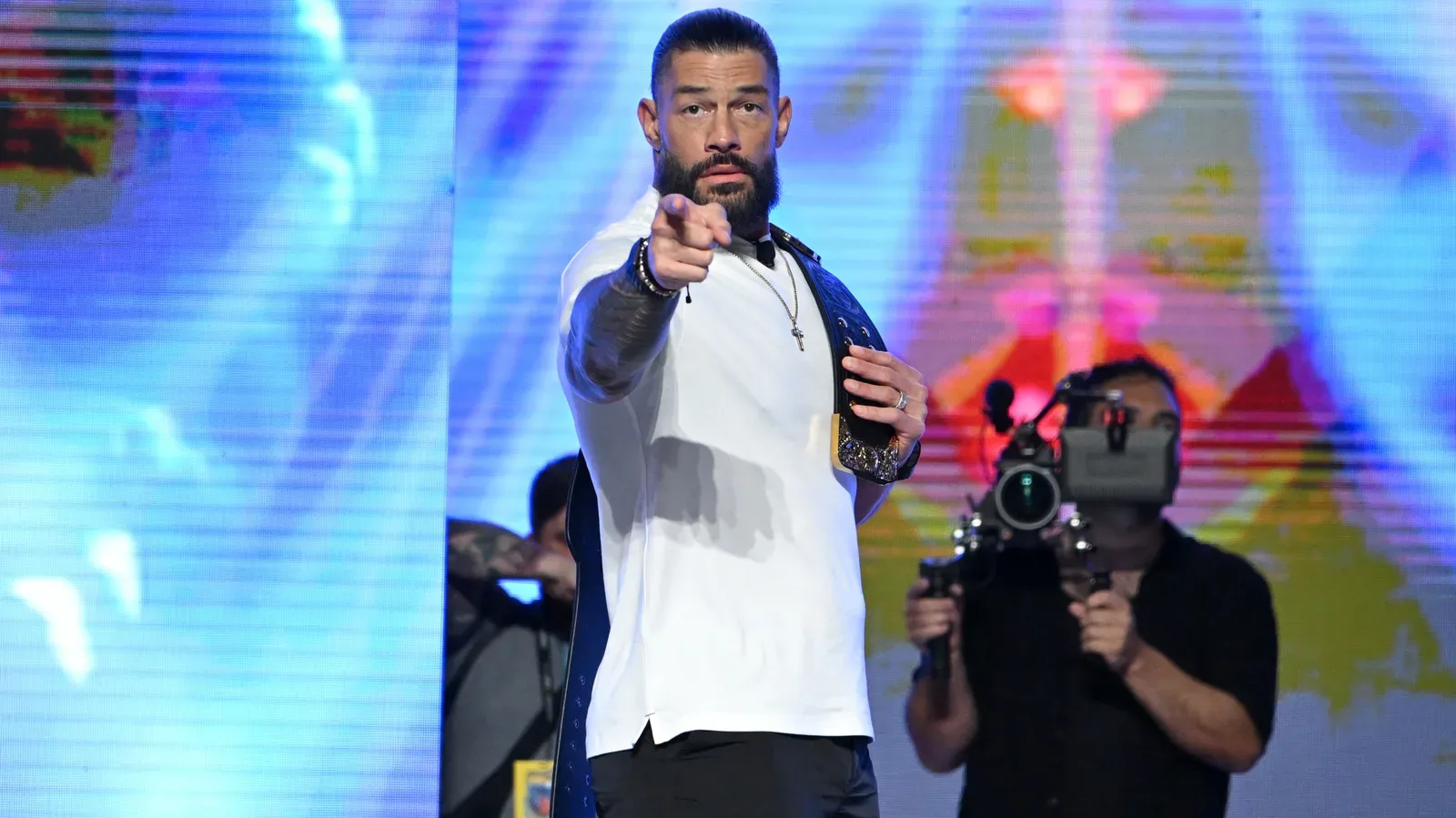
Jalen Brunson has offered a firm defense of Roman Reigns as debate continues around the WWE star’s standing among the greatest names in professional wrestling history.
Reigns has spent years as one of WWE’s most prominent and discussed performers, particularly through his run as the “Original Tribal Chief.” The character, the presentation surrounding it, and Reigns’ position at the center of major WWE stories have generated considerable praise. They have also produced criticism from some wrestling personalities who believe his legacy is being rated too highly in all-time discussions.
Brunson, who is both an NBA star and a longtime WWE fan, sees that criticism from a different perspective. In a recent interview, Brunson argued that being labeled overrated is evidence that Reigns has reached a level of cultural and wrestling relevance where people cannot stop talking about him.
“If he's being deemed overrated, he's doing something right,” Brunson said. “He's in people's heads. You're constantly thinking about him. He's doing something right. It is what it is at this point.”
For more background on this topic, read Jeff Hardy Explains Why the 450 Splash Disappeared From His Arsenal.
It is a concise assessment, but one that gets to the heart of why Reigns remains such a polarizing presence. WWE has never positioned him as a performer meant to blend into the background. Whether fans support him, reject him, appreciate his work, or debate his place among the industry’s historic icons, Reigns has consistently been a name that commands attention.
Brunson Has Shared WWE Television With Reigns
Brunson’s remarks carry added context because he has appeared alongside Reigns on WWE programming. The NBA player was part of Saturday Night’s Main Event in July, where his appearance seemingly aligned him with Reigns. That on-screen association was another example of WWE bringing major sports figures into its environment, while also demonstrating the crossover profile Reigns has developed.
For Brunson, Reigns is not simply a wrestler being evaluated through old match ratings or championship totals. He is a central attraction whose presence generates reaction. That is a standard that has long mattered in wrestling, an industry built on stars who can make audiences invest emotionally in their successes, failures, conflicts, and rivalries.
The “overrated” discussion has gained traction after Conrad Thompson offered a critical view of Reigns’ place in the sport’s greatest-ever conversation. Thompson acknowledged Reigns’ accomplishments, but argued that he should not be close to a professional wrestling Mount Rushmore. His central point was that Reigns has not delivered the sort of defining moments associated with legends such as Steve Austin and Ric Flair.
That is a difficult comparison for any modern wrestler. Austin and Flair are not simply major stars from their respective eras; they are foundational figures whose contributions have been examined for decades. Austin became synonymous with WWE’s boom period in the late 1990s, while Flair’s influence stretches across generations and promotions. Measuring Reigns against names of that scale guarantees a passionate response.
Roman Reigns Responded to the Criticism
Reigns did not let the criticism pass without comment. He pushed back on Thompson’s assessment and suggested that his name was being used to create additional interest and views for content. The response reflected Reigns’ long-established confidence, both in the presentation of his character and in his belief that his place at the top of WWE has been earned.
That reaction also illustrates why opinions about Reigns so often become larger discussions about wrestling itself. The argument is not limited to whether someone enjoyed a particular title reign, promo, or match. It expands into questions about drawing power, longevity, presentation, creative timing, championship success, memorable angles, and the changing way modern fans consume the business.
Reigns has been a fixture of that conversation for years because of the magnitude of his role. His “Tribal Chief” era transformed the way many viewers assessed him after earlier stages of his WWE career drew far more divided reactions. The evolution gave Reigns a persona with greater authority, patience, and control, allowing him to work in a style built around major-event stakes and carefully protected appearances.
Supporters point to the sustained impact of that work and the importance of the stories built around Reigns. Critics, meanwhile, may argue that success in a modern WWE environment is different from the kind of era-defining impact produced by prior legends. Neither position is likely to disappear, especially when the conversation invokes a Mount Rushmore concept that inherently leaves out more historic names than it includes.
Different Criticisms, Same Level of Attention
Eric Bischoff has also shared a more reserved view of Reigns’ current appeal. Bischoff has said that he respects Reigns as a wrestler, but has become bored with him because he does not see enough that feels new about the character. That criticism differs from a direct rejection of Reigns’ talent. Instead, it focuses on whether the presentation has continued to evolve enough to maintain interest over time.
That distinction matters. In professional wrestling, a performer can be widely respected for execution, star presence, and accomplishments while still facing questions about creative freshness. Long championship runs and dominant characters can create enormous value, but they can also lead to fatigue among viewers who want to see a significant change in direction.
Brunson’s point is that the criticism itself reinforces Reigns’ significance. A wrestler who has become irrelevant does not usually inspire extended arguments about whether he belongs among the elite. Strong reactions, including negative ones, are often part of being a top-level attraction. Reigns has remained at the center of those reactions because the audience and industry figures continue to judge his work against the highest possible standards.
WWE Hall of Famer Booker T has taken an even stronger position in Reigns’ favor. Booker has called the overrated label ridiculous and stated emphatically that Reigns is currently the best wrestler in the world. His view reflects the considerable respect Reigns retains among many who value his ability to command an arena, carry a major program, and perform as a centerpiece talent.
The Mount Rushmore Question Has No Simple Answer
The debate around Reigns is ultimately intensified by the language of all-time rankings. Calling a wrestler overrated is one thing. Placing that wrestler in a Mount Rushmore discussion is another, because it forces comparisons across entirely different eras of the industry.
Wrestling has changed dramatically across the careers of Flair, Austin, and Reigns. Television habits are different. The media landscape is different. The way talent interacts with fans is different. The business models, distribution platforms, promotional strategies, and expectations placed on main-event performers have all evolved. A wrestler’s impact can be measured through many lenses, but none of them can fully erase the context of the era in which that wrestler performed.
That does not mean all comparisons are meaningless. Reigns’ supporters can point to his prominence and the longevity of his top-level position. Those who question his all-time placement can point to the unique cultural scale associated with earlier icons. Both arguments rely on real standards, which is why the conversation remains unresolved.
Brunson’s defense does not attempt to settle the Mount Rushmore question. Instead, it argues that Reigns’ critics may be proving his relevance every time they return to the subject. Whether the discussion comes from fans, podcasters, Hall of Famers, or athletes from outside wrestling, Reigns remains one of the first names mentioned whenever the current WWE landscape is evaluated.
That is the reality behind Brunson’s comments. Reigns is not being discussed as a fringe name or a forgotten former champion. He is being debated because his work has been important enough to invite comparisons to the most celebrated stars the industry has ever produced. Some will consider that praise justified, while others will maintain that the comparison goes too far.
Either way, the “Original Tribal Chief” continues to occupy a place that few wrestlers reach: a position where every opinion about him becomes part of a broader debate over what greatness in WWE is supposed to mean.
In pictures

Darryl Polo
Darryl Polo is a passionate wrestling fan covering WWE, AEW, TNA and beyond. He loves great rivalries, breakout stars and the moments that keep fans talking long after the bell. How we work.