
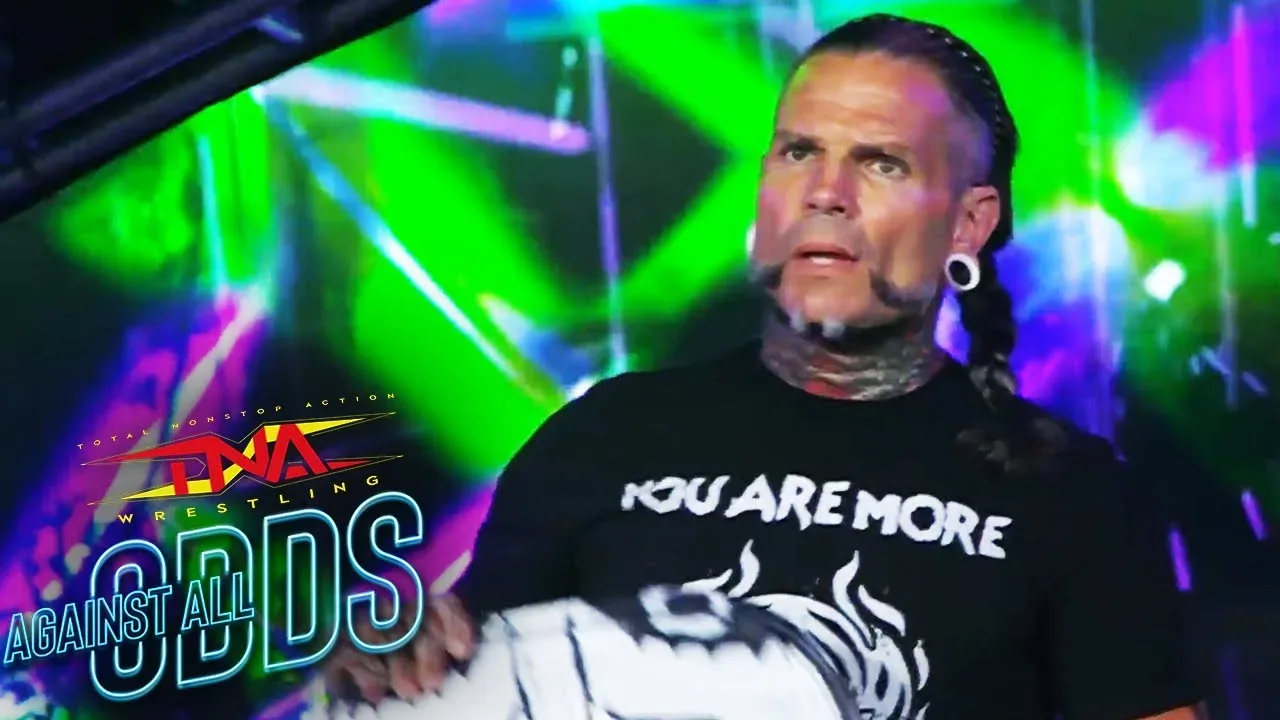
Jeff Hardy built his reputation on taking to the air, but one of the more difficult moves from his early repertoire ultimately became a risk he decided he did not need to take again.
During an appearance on The Stunner, Hardy discussed why fans stopped seeing him use the 450 splash. The former WWE standout recalled a frightening landing from the move during his early career, saying he nearly knocked himself out after over-rotating. While Hardy remains synonymous with spectacular offense and the Swanton Bomb, he made clear that the 450 was a different kind of challenge for him.
Hardy said the incident happened during his WWE run and believes it may have been in a match involving Too Cool. He was not fully certain of every detail surrounding the bout, but he was certain about the effect the move had on him and the decision it prompted.
“I’ve never been good at controlling myself with any kind of flips like that,” Hardy said. “I’m good with just one front flip, but when you talk about more than one flip, oh, man, it always could get wacky with me.”
For more background on this topic, read Jeff Jarrett Questions WWE’s Saudi Arabia Plans Ahead of WrestleMania 43.
The 450 splash requires a wrestler to complete a forward rotation and an additional half-turn before landing chest-first across an opponent. It is a move that leaves very little room for error, particularly when a wrestler is trying to control rotation, maintain body position and still land safely for both people involved. Hardy’s comments offer a straightforward explanation for why the move was not a lasting fixture in his arsenal: he did not feel he could consistently control the extra rotation.
A Scare That Changed His Approach
Hardy recalled either missing the move or connecting with it in a way that still went badly because of the rotation. In his telling, he came down hard enough that he nearly lost consciousness.
“I just over-rotated or something and it almost knocked me out,” Hardy said. “I think that was the last time I did the 450. Don’t even need it anymore.”
That final thought says plenty about Hardy’s evolution as a performer. Wrestlers frequently develop new moves, alter existing ones and remove techniques from their act as they gain experience. The decision is not always about whether a move gets a reaction. It can be about whether the physical payoff outweighs the danger, whether it fits the wrestler’s style and whether there is already a more reliable alternative available.
For Hardy, the alternative was obvious. The Swanton Bomb became one of the most identifiable finishing maneuvers in modern professional wrestling and a move inseparable from his individual presentation. The image of Hardy climbing high above the ring, spreading his arms and launching himself backward became a defining part of his career. Even though the Swanton is itself physically demanding, it is a motion Hardy has performed as a signature for years and one that he has made his own.
The 450 splash, by comparison, asked him to work outside the type of aerial movement he felt most comfortable executing. Hardy explained that a single front flip was within his control, while multiple rotations created the possibility that things could become unpredictable. His decision was therefore not an indictment of the 450 splash as a move, but an acknowledgment of his own limits with that particular motion.
High Risk Has Always Been Part of Hardy’s Identity
Hardy has long been regarded as one of professional wrestling’s most influential high fliers. Alongside his brother Matt Hardy, he helped make the tag team division a major attraction through an approach built around pace, imagination and a willingness to take dramatic risks. As a singles wrestler, Jeff carried that same energy into a persona that connected with audiences because it felt spontaneous, colorful and fearless.
That reputation can sometimes obscure the technical judgment involved in being an elite aerial performer. A wrestler may be willing to jump from a ladder, dive to the floor or launch from a turnbuckle, but that does not mean every acrobatic maneuver suits that wrestler’s body awareness or timing. Hardy’s explanation is a reminder that high-flying is not one single skill. Different flips, twists, landings and points of impact demand different forms of control.
The 450 splash has been used by many wrestlers over the years, but it carries a distinct visual and physical difficulty. The performer has to generate enough rotation to complete the motion without traveling too far, too short or too high. The landing must also protect the opponent while reducing the impact taken by the wrestler delivering the splash. A slight miscalculation can turn an impressive sequence into a painful one.
Hardy’s description of the move getting “wacky” for him when more than one rotation was involved captures that challenge in simple terms. The margin for error narrows considerably once a wrestler is no longer simply launching forward or backward. Hardy did not need to force the 450 into his act when he already had a recognizable style and a signature move that fans immediately associated with him.
The Value of Knowing What to Leave Behind
There is a tendency in wrestling to focus on the moves that performers add to their repertoires. A new finisher, a surprise dive or a rarely seen maneuver can generate excitement and create discussion. But an equally important part of a wrestler’s development is knowing when to stop doing something. Hardy’s story about the 450 splash illustrates the value of that calculation.
He did not present the decision as a dramatic reinvention or a complicated strategic change. Instead, he framed it as a practical response to a close call. He tried a difficult maneuver, realized that he had nearly hurt himself badly, and concluded that it was unnecessary. For a performer whose career has included so much memorable aerial offense, that is a notably candid assessment.
It also reinforces why signature moves matter. The Swanton Bomb did not merely replace the 450 splash as another item on a list. It became a symbol of Hardy’s approach to wrestling. Fans recognize the setup, anticipate the launch and understand the stakes of the moment. The move has a visual identity that fits Hardy’s character and body language, making it more valuable than an extra flourish that he did not feel he could reliably execute.
Hardy’s comments do not suggest that he was unwilling to challenge himself. His career speaks to the opposite. Rather, they show that innovation and self-preservation have to coexist, especially for wrestlers whose styles depend heavily on athletic risks. The most successful move is not necessarily the most complicated one. It is the one a performer can execute with confidence, use at the right moment and make meaningful to the audience.
Why the Story Resonates
For longtime fans, the revelation adds another layer to Hardy’s in-ring history. His career is filled with moments where he appeared willing to attempt nearly anything, which makes it easy to assume that every high-risk move was second nature to him. His explanation of the 450 splash challenges that assumption. Even a wrestler celebrated for fearless aerial offense can have a maneuver that does not feel natural.
That distinction is important. Hardy’s best-known work has never been defined solely by how many rotations he can complete. It has been defined by timing, emotion and the ability to make a big move feel like the culmination of a fight. The Swanton Bomb remains central to that identity because it is both spectacular and unmistakably his.
The 450 splash, meanwhile, stands as an early-career experiment that ended after one particularly dangerous scare. Hardy’s conclusion was blunt: after nearly knocking himself out, there was no reason to keep it. For one of wrestling’s most famous daredevils, that is as clear an answer as fans are likely to get.

Darryl Polo
Darryl Polo is a passionate wrestling fan covering WWE, AEW, TNA and beyond. He loves great rivalries, breakout stars and the moments that keep fans talking long after the bell. How we work.