
Begin with the document’s exact claim
The most useful first question is not whether two promotions are visible on the same card, but what the contemporaneous announcement or report actually says about their roles. An event announcement can identify presenters, name a show, list its location, describe its intended matchups, and state how it will be distributed. A results report can establish what was presented on a particular card and how participants or championships were identified there. Those are different kinds of records, so they warrant different conclusions. Reading the wording before supplying a larger label helps keep a guest appearance from becoming a claimed partnership in the reader’s mind.
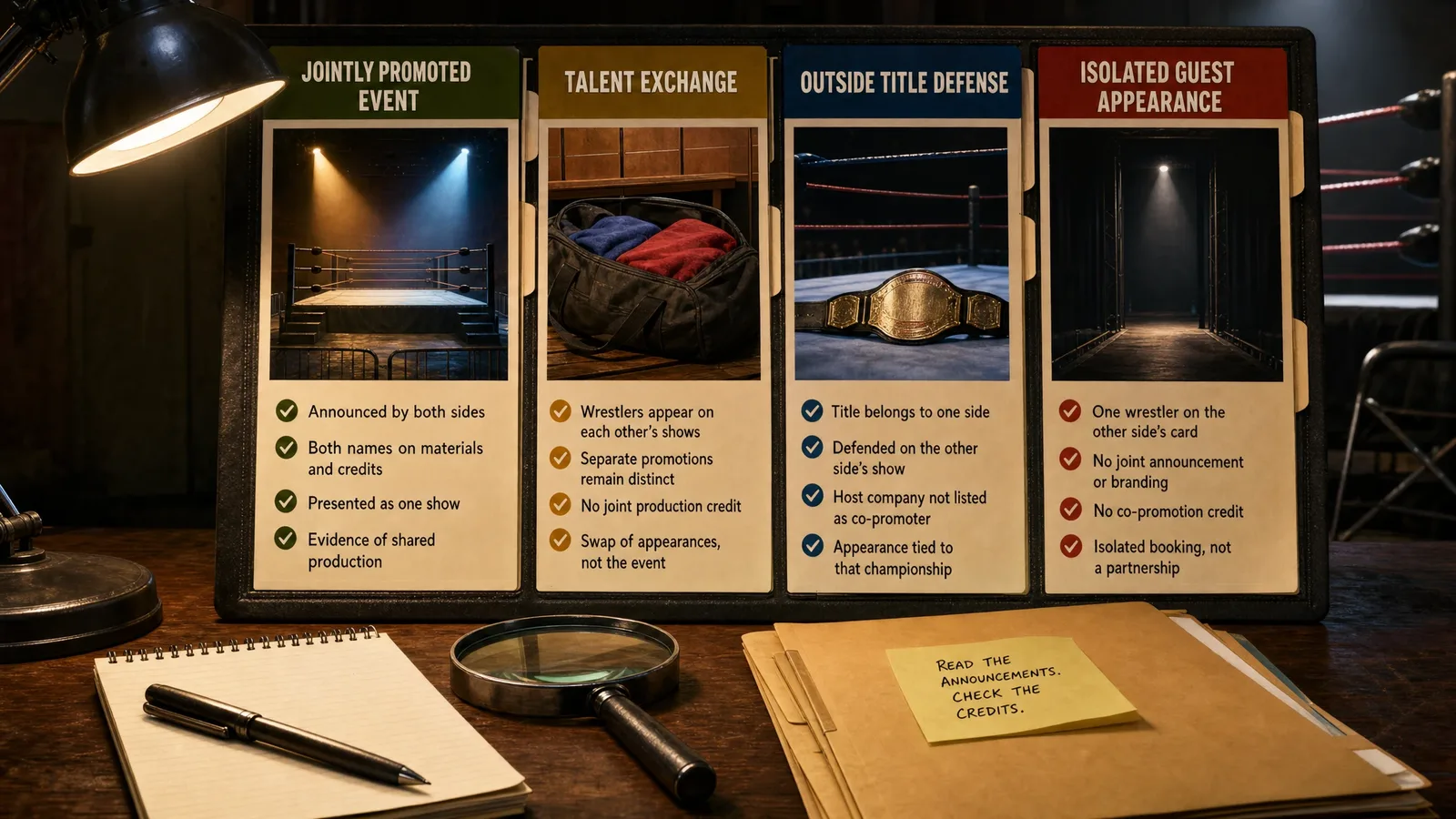
A practical way to assess the wording is to sort the evidence into four questions: Does the source call both companies presenters of the event? Does it document a championship from one promotion being defended on another promotion’s card? Does it expressly state a contractual arrangement involving a wrestler? Or does it simply identify a participant with another promotion while reporting one match? The available CMLL and AEW materials show why those questions cannot be collapsed into a single conclusion called an interpromotional partnership.
An explicit joint-event announcement is the clearest category
AEW’s announcement for Forbidden Door provides unusually direct language. Published before the event, it said that AEW and New Japan Pro-Wrestling would present their first joint pay-per-view special. The advertised name, AEW x NJPW: Forbidden Door, placed both promotions in the event branding, while the announcement set the show for the United Center in Chicago and described marquee matchups involving members of the AEW and NJPW rosters. This is not an inference drawn from a single visiting wrestler or one cross-promotional match: the presenting relationship for that named show appears in the announcement itself.
The same release offers several corroborating details a reader can look for in an event announcement. It included distribution information for the United States, Canada, international markets, and Japan. It also carried comments attributed to AEW’s Tony Khan and NJPW president Takami Ohbari. Distribution information and credited voices do not replace the central wording that both companies would present the show, but they make the public presentation more legible. Together, these details support describing Forbidden Door as a jointly presented event rather than merely an AEW card with NJPW guests or the reverse.
A joint show is still a claim about that show
Even clear joint-show language has a defined boundary. The Forbidden Door announcement establishes the public promotion of the named event and identifies both companies as presenters. It does not, on its own, publish the length of a business relationship, whether it was exclusive, who owned what, or what future events would involve. Those questions may matter to fans, but they are not answered simply because the event was jointly announced. The careful description is therefore specific: this was a documented joint pay-per-view special, not automatically proof of every broader arrangement a reader might imagine.
That boundary is useful because a big event label can encourage overreading. A source’s strongest available statement should set the wording used to describe it. Where both companies are named as presenters, “joint event” is supported. Where a source only shows an affiliated wrestler or an outside championship, narrower language is more accurate. This approach does not minimize a documented appearance or title match. It separates what the record positively establishes from contract duration, ownership terms, exclusivity, and future scope that the published material does not specify.
An outside title defense documents a match, not event ownership
CMLL’s April 3, 2026 results report from Arena México illustrates a different category. The report said that Místico, Mike Bailey, and Kevin Knight retained the AEW World Trios Championship against La Familia de Don Callis: Hechicero, El Clon, and Volador Jr. The page therefore documents an AEW-associated championship being defended on a CMLL-reported card at Arena México. That is substantial, concrete event evidence. It tells a reader that the championship match and its participants were part of that reported card.
What that title defense does not establish by itself is equally important. An outside championship on a host promotion’s card is evidence that the belt and its champions appeared on that specific card; it is not evidence that the host promotion owned the championship. Nor does the title match alone label the entire event as AEW x CMLL. CMLL’s report covered a multi-match program that also included a historical-world-champions eliminator, a Match Relámpago, women’s trios action, and other non-title matches. The most precise description keeps the focus on the documented AEW World Trios title defense.
A stated dual contract is more specific than a shared card
The April 3 CMLL report contains a separate detail that should not be blended into the title defense. It said Thunder Rosa sought to join CMLL as an Amazona and that the request was approved under a dual contract with AEW. Because the report expressly uses that contractual description, it supplies more specific evidence about that wrestler’s stated arrangement than a byline identifying someone with another company or a championship appearing on a card would provide. The contract reference concerns the reported arrangement for Thunder Rosa; it is not a substitute label for every other appearance on the show.
Specific does not mean complete. CMLL’s report does not publish the dual contract’s terms, duration, exclusivity, or wider implications. Readers can accurately say that the report described an approved dual contract with AEW. They cannot use that sentence alone to define the full business relationship between the promotions or to assign terms the report does not give. This distinction also clarifies why “talent exchange” should be used cautiously: the supplied reports provide an explicit dual-contract reference, but they do not publish an exchange agreement governing the entire card or a general continuing arrangement.
One identified visitor is not automatically an alliance
CMLL’s July 11, 2025 report provides the narrower guest-appearance model. It described a CMLL Arena México event, identified The Beast Mortos as an AEW wrestler, and reported that he defeated Esfinge in a singles match. Afterward, the report said that The Beast Mortos challenged Esfinge for the Mexican National Light Heavyweight Championship and that the challenge was accepted. These are meaningful details about one wrestler’s affiliation as stated in the report, participation in one match, and a subsequent challenge within the report’s account.
The rest of that July card is a reminder to retain the event’s own identity. The report also recorded Los Herederos’ first successful defense of the Mexican National Trios Championship and Yuki Mashiro’s Mexico debut in women’s trios action. Yet it did not describe the card as jointly promoted by CMLL and AEW, publish an exchange agreement, or say that The Beast Mortos’ appearance created a continuing alliance. A careful fan can recognize the AEW identification as relevant without treating it as a conclusion about the promotion of the whole event.
Read the whole card before naming the card
A title match or guest listing can be the most eye-catching item on a results page, but the surrounding report can alter how it should be described. On the April 3 CMLL card, the AEW World Trios Championship defense appeared alongside several other match types and segments. That context supports a match-level description: a CMLL-reported event included an AEW World Trios title defense. It does not require the stronger event-level description that both companies presented the entire card. The difference is small in wording and large in what the words claim.
Credits and labels deserve the same close reading. AEW’s Forbidden Door announcement names AEW and NJPW as presenters, uses both companies in the event title, and includes comments from credited figures from both sides. By contrast, the July CMLL report identifies The Beast Mortos as an AEW wrestler while describing a CMLL event. The first set of wording supports a joint-event description for the named pay-per-view; the second supports a wrestler-affiliation and match-participation description. Neither category should be stretched to answer questions the relevant source leaves unanswered.
A source-based checklist for fans
When encountering an interpromotional claim, start with the headline verbs and nouns. Look for language such as “present,” an event name combining promotions, or a direct description of a joint special. Then look at the credited voices and presentation details. In the Forbidden Door announcement, all of those elements were publicly available: AEW and NJPW were named as presenters, the title combined their names, distribution information was included, and comments were attributed to AEW and NJPW representatives. Those elements make a joint-show conclusion well supported for that event.
If the document is a results report instead, shift to match-level questions. Which championship was defended? Who was named as champion? Where did the report place the match? On April 3, CMLL reported the AEW World Trios Championship defense at Arena México and named both the champions and challengers. Those details support a precise statement about a title defense on that card. They do not transfer title ownership to CMLL or establish that all of the card’s matches were jointly promoted.
Finally, separate a wrestler’s identification from a declared business structure. The July 11 CMLL report’s description of The Beast Mortos as an AEW wrestler supports that stated affiliation and his appearance against Esfinge. The April 3 report’s reference to Thunder Rosa’s dual contract is more direct evidence about her reported arrangement, though it still omits its terms and duration. This comparison gives readers a useful evidence ladder: an affiliation label, an express individual arrangement, and a named joint event each establish different things.
The disciplined conclusion is often narrower than fan shorthand, but it is also clearer. Call Forbidden Door a jointly presented event because AEW’s announcement explicitly did so. Call the Arena México trios bout an AEW World Trios title defense on a CMLL-reported card because that is what CMLL documented. Call The Beast Mortos’ match a reported appearance by a wrestler identified as AEW-affiliated, not proof of a continuing CMLL-AEW alliance. In each case, the best label follows the source’s own level of specificity rather than asking one appearance to explain an entire relationship.
Explore more

Darryl Polo
Darryl Polo is a passionate wrestling fan covering WWE, AEW, TNA and beyond. He loves great rivalries, breakout stars and the moments that keep fans talking long after the bell. How we work.