
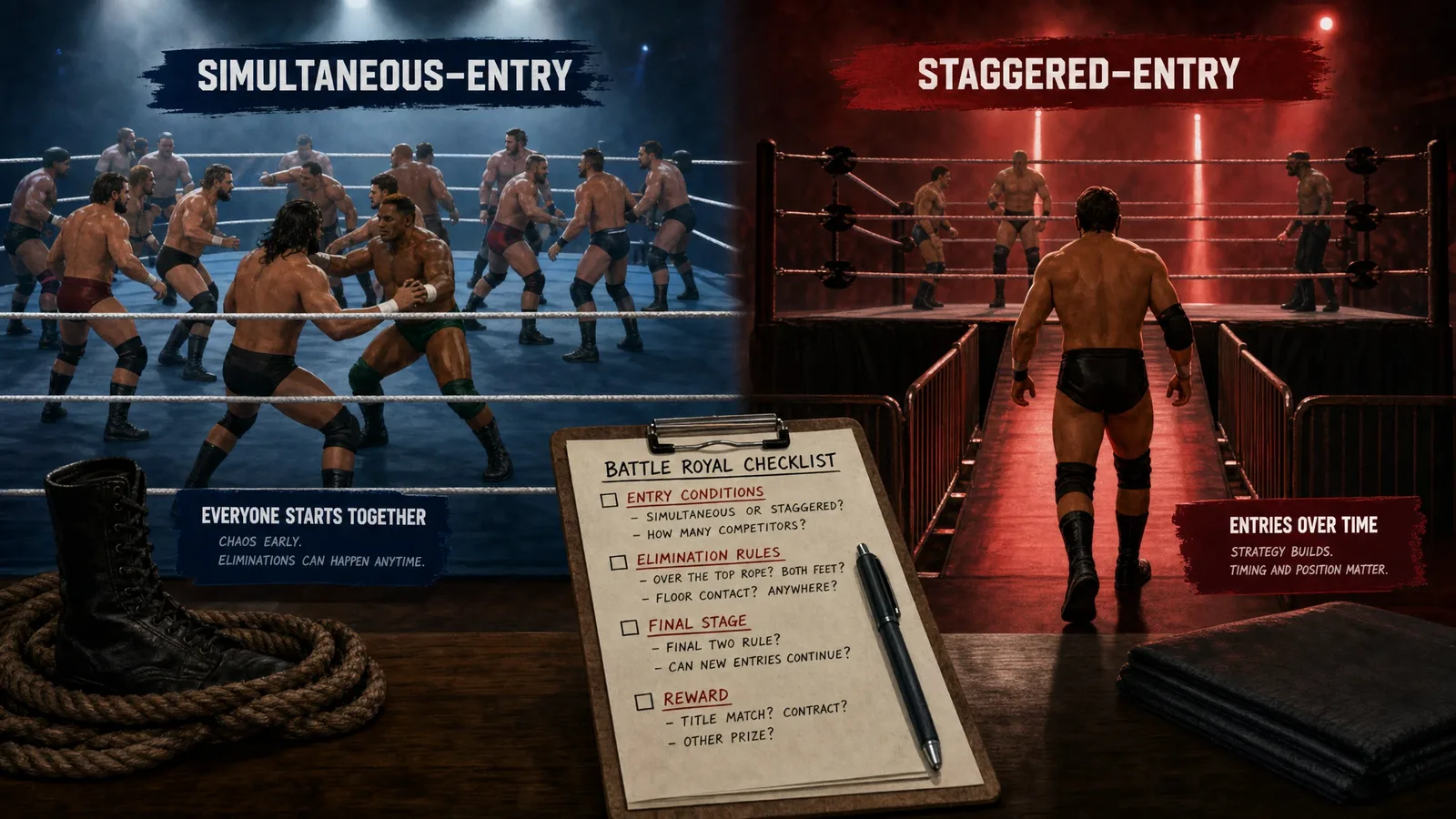
The label alone does not supply every rule
Battle royal is a broad match label, not a complete universal rulebook. The documented WWE and Impact examples differ in how wrestlers enter and in how the reported finish unfolds. That is why the name on a match graphic is only a starting point for viewers. To understand a particular contest, separate four questions: who is active at the start, how wrestlers are eliminated, what happens when the field is reduced, and what the winner receives. Those details identify the format more precisely than a familiar label can do on its own.
One immediate distinction is whether every participant is present from the beginning or whether the field builds through later entrances. WWE’s Andre the Giant Memorial Battle Royal example places every listed participant in the ring at the same time. WWE’s historical Royal Rumble description instead has participants arrive at two-minute intervals. These approaches can both involve many wrestlers, but they ask viewers to follow different counts. A simultaneous match begins with its full listed field active; a staggered match requires viewers to distinguish the announced total from the number currently in the ring.
The other major distinction concerns the finish. In WWE’s Andre example, the final man remaining is the winner. Impact’s reported 2022 Call Your Shot Gauntlet reached Steve Maclin and Bully Ray as its last two competitors, then reported Bully Ray defeating Maclin with the Bully Bomb to win the match and its prize. The comparison does not establish one shared closing rule for all battle royals. It does show why a viewer should keep watching for the announced or reported terms of the final stage rather than assume that the last two always resolve a match in the same way.
Simultaneous entry: WWE's Andre example
WWE’s Andre the Giant Memorial Battle Royal provides a documented simultaneous-entry example. Every listed participant begins inside the ring at the same time. The opening phase is therefore a full-field contest immediately, rather than a match that gradually fills through later arrivals. For viewers, the announced field and the active field match at the start. There is no entry countdown to track before the roster becomes complete; the attention can stay on the stated elimination condition and on which wrestlers remain as that condition removes competitors from the contest.
The elimination test in this WWE example is specific: a competitor is eliminated after being thrown over the top rope and having both feet touch the floor. The winner is the final man remaining. It helps to treat those as separate pieces of information. The first states what removes an individual from the match. The second states when the contest has a winner. Together, they describe an elimination-based path from the full opening field to one remaining wrestler. They do not, however, make the same floor-contact wording an automatic rule for other matches carrying the battle royal label.
WWE introduced the annual Andre the Giant Memorial Battle Royal at WrestleMania 30 in honor of Andre the Giant. That history identifies the event’s commemorative framing, while the published example supplies the match details viewers can track: all listed participants start in the ring, elimination follows the top-rope and both-feet-on-the-floor condition, and the final man remaining wins. A viewer can recognize both levels at once. The match name provides its identity, but the entry and elimination wording explains how that specific contest proceeds.
Staggered entry: tracking an active field
WWE’s historical description distinguishes a traditional over-the-top-rope battle royal from the Royal Rumble chiefly through entry timing. In the Royal Rumble structure it describes, participants arrive at two-minute intervals rather than all entering together. That timing makes the number of wrestlers presently active an important part of following the match. A viewer should not read the announced total as though every listed participant is already competing. Instead, it is useful to note both the overall field and the changing in-ring field as entrants arrive over the course of the contest.
WWE’s historical account gives several participant totals for the Royal Rumble context. It dates the first Royal Rumble to January 24, 1988, in Hamilton, Ontario, and says that match had 20 participants. The same account says WWE later used 30 as the preferred field size in that context, while some editions expanded to 40. Those figures are historical details, not a definition of staggered entry. A large announced field may describe scale, but the relevant format question remains whether everyone begins together or participants are introduced over time.
The two-minute interval is a feature of WWE’s historical Royal Rumble example, not evidence that every staggered-entry battle royal uses the same interval. WWE’s account describes the entry countdown as repeatedly raising the question of who enters next. That makes the timing visible to viewers in this particular structure. The practical lesson is narrow: when a match has later arrivals, listen for its own announced entry procedure. A countdown format elsewhere may have its own field size, timing and elimination language, none of which should be supplied from the Royal Rumble description by assumption.
Impact's 2022 Call Your Shot example
Impact’s Call Your Shot Gauntlet at Bound For Glory 2022 was reported as a 20-person countdown battle royal. Eric Young and Joe Hendry began the match, showing that the entire announced field was not in the ring at its opening. The report also describes later participants as coming and going. Those reported details make it a useful staggered-entry comparison alongside WWE’s Royal Rumble history. Both examples involve a field that changes as participants arrive, but the report of the 2022 Impact match should be read on its own terms rather than treated as proof that every countdown battle royal follows identical rules.
The reported 20-person total answers one question about the 2022 Call Your Shot match: the size of its announced field. Eric Young and Joe Hendry beginning the contest answers a different question: who was active at the outset. Later participants coming and going answers another: the field did not remain fixed from the start. Keeping those observations separate gives viewers a clearer account of the reported sequence. It also leaves the right space for a promotion’s match announcement or commentary to specify any further elimination conditions or closing procedures for the individual contest.
A match name can be useful shorthand, but it should not replace the details that are actually announced for the contest. WWE says the Royal Rumble name was selected after numerous possible names were considered instead of simply calling the match a battle royal. Its historical description then identifies two-minute intervals as part of that format. The 2022 Impact report calls Call Your Shot a countdown battle royal and records its 20-person field, two-person opening and later arrivals. The names point toward recognizable presentations; the documented entry sequence is what tells viewers how these examples began.
Read the final two as a fresh checkpoint
The end of a battle royal deserves as much attention as its opening. WWE’s Andre example states that the final man remaining wins, so the elimination process continues until one competitor is left. The reported 2022 Call Your Shot sequence differs in what is known at the end: Steve Maclin and Bully Ray were identified as the last two competitors after the countdown-battle-royal portion narrowed the field. The report then records a match-winning result between them. For a viewer, last two is therefore a checkpoint worth recognizing, not a phrase that supplies the same conclusion in every format.
At Bound For Glory 2022, the report says Bully Ray defeated Steve Maclin with the Bully Bomb to win the Call Your Shot Gauntlet. That is the supported reported sequence: Maclin and Bully Ray were the final two, and Bully Ray’s Bully Bomb victory settled the match. It establishes that the prize was not reported as being awarded simply upon the field reaching two people. It does not establish a universal final-two rule, a standard rule for every Call Your Shot match, or a general rule for other battle royals. Each of those questions requires the rules announced for the particular event.
This is a useful viewing question near any battle royal finish: does the stated format award victory to the last remaining wrestler, or does the presentation identify another deciding step once the field is down to two? WWE’s Andre example supplies the first documented outcome. The 2022 Call Your Shot report supplies a separate recorded sequence in which Bully Ray and Steve Maclin were the final two and Bully Ray defeated Maclin. Comparing those examples is not a claim that every promotion uses one of only two systems. It is a reminder to verify the end condition instead of assuming it from the opening chaos.
Rewards can differ as well
The winner’s reward is another item worth tracking. The documented WWE example is a commemorative battle-royal victory connected to the Andre the Giant Memorial Battle Royal. In Impact’s 2022 Call Your Shot Gauntlet, the prize was a championship opportunity usable against any Impact championship at a time of the winner’s choosing. These are distinct stated stakes. A viewer who knows only that a match is a battle royal still does not know what winning earns. Checking the reward completes the picture created by the entry pattern, elimination test and final-stage conditions.
The three documented reference points can be compared without flattening them into one generic format. WWE’s Andre example begins with all listed participants, uses the stated top-rope and both-feet-on-the-floor elimination condition, and awards victory to the final man remaining. WWE’s Royal Rumble history describes staggered arrivals at two-minute intervals. Impact’s reported 2022 Call Your Shot match had a 20-person announced field, opened with Eric Young and Joe Hendry, included later arrivals, and ended with Bully Ray defeating Steve Maclin after they became the final two. The common label does not erase those differences.
A four-question viewing checklist
First, ask who starts: is the entire listed field in the ring, or do only some participants begin while others arrive later? Second, ask how elimination is defined. WWE’s Andre example specifies a top-rope exit and both feet touching the floor, but another match’s conditions should be heard from that match’s own announcement. Third, ask what happens at the end: does the last remaining wrestler win immediately, or is another final-stage result reported or announced? Fourth, ask what the winner receives. Those questions turn battle royal from a broad label into a set of conditions viewers can follow clearly.
Explore more

Darryl Polo
Darryl Polo is a passionate wrestling fan covering WWE, AEW, TNA and beyond. He loves great rivalries, breakout stars and the moments that keep fans talking long after the bell. How we work.