
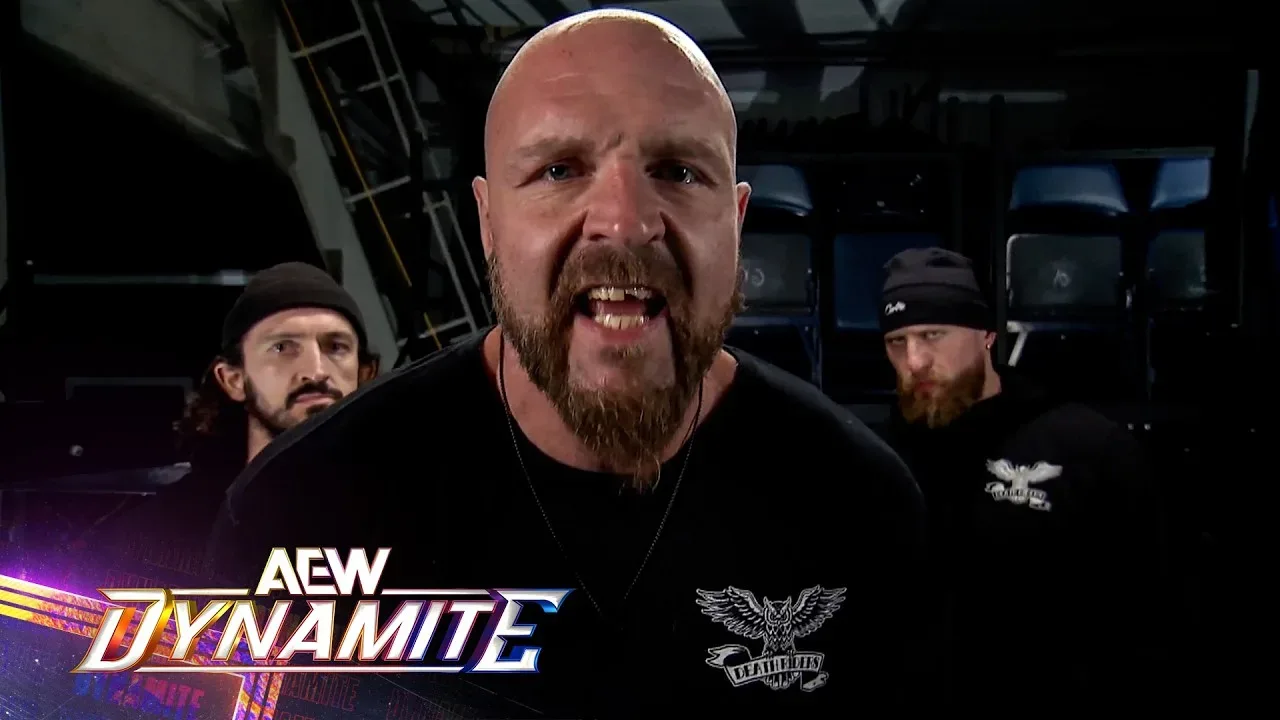
Gabe Kidd has opened up about the difficult emotions surrounding AEW’s tribute show for PAC, explaining how a private moment with Jon Moxley after the night’s main-event tag team match reinforced the bond within the Death Riders.
The wrestling world has continued to mourn the loss of Benjamin Satterley, known internationally as PAC, following his death at the end of September. For Kidd, the loss carried particular weight. Kidd had history with PAC through the Death Riders and spoke about the challenge of processing grief while still being expected to perform in front of a live audience at a show built around honoring PAC’s legacy.
During a conversation with Chris Jericho, Kidd said part of the experience was complicated by the reality that PAC would periodically return to England and be absent from events. That rhythm made the initial feeling of loss difficult to fully comprehend, even as the tribute show made the situation impossible to avoid.
“It’s still so fresh and there would be periods of time where he would go back to England and he just wouldn’t be at the show,” Kidd said. “So it almost still feels like that now and it didn’t, especially at the tribute show, it didn’t — I’m holding in this emotion all day because I know if Ben could see us, if he was there and could communicate with us, he’d be like, ‘Don’t mope around all day, you’ve got a job to do.’”
For more background on this topic, read AEW Used “Toy Bricks” Terminology During Blood & Guts Rather Than LEGO Name.
Kidd’s comments reflected a central tension that performers often face during times of grief: the need to work through deeply personal feelings while also carrying the responsibility of a live event. In Kidd’s view, PAC would have wanted the group to approach the evening with purpose rather than allow sadness to prevent them from giving the audience everything they had.
He connected that mindset directly to the identity of the Death Riders. Kidd described their philosophy as one rooted in effort, gratitude, and honoring the people who make sacrifices to attend wrestling events. For performers, the show is a job, but it is also an opportunity that should not be treated casually.
“That’s the backbone of the Death Riders,” Kidd said. “Regardless of the situation, we’re at work, we have to put on a show. There are people that have saved up for years for this, to come and watch this. It’s the effort. That’s the whole thing about the Death Riders, this is a gift, this is a blessing. Don’t take it lightly.”
That approach meant Kidd spent much of the tribute show attempting to keep his emotions under control. The main event gave him a task to focus on, but once the match had ended, the feelings he had been holding back came out. Kidd said he dropped to his knees, overwhelmed by the moment, before realizing Moxley was there beside him.
The embrace became one of the most meaningful moments of the night for Kidd. While he chose not to reveal the private exchange he had with Moxley, Kidd made clear that the words Moxley shared stayed with him because they were sincere and grounded.
“I’m holding in all this emotion and then we do the match and it just comes out,” Kidd said. “I just dropped to my knees and I feel someone wrap their arms around me. I look up, it’s Mox. I’m not going to share what we said to each other because that’s between me and him, but he said something to me that’s just real.”
Kidd’s emphasis on authenticity has been a defining part of how he presents himself in wrestling. He explained that he has always tried to approach the profession honestly, without attempting to become a version of himself that does not feel genuine. In an emotional setting such as PAC’s tribute show, that principle took on even greater significance.
“That’s always been my approach to wrestling, is just be real,” Kidd continued. “Be who you are. Don’t change yourself and try and act like someone else.”
The emotion intensified as those involved watched video footage and the purpose behind the day, the match, and the tribute was fully felt. Kidd said the realization of why they had all gathered led him to break down. He framed the Death Riders not simply as a wrestling unit but as a family, one whose connection had been strengthened by loss.
That distinction matters in an industry where alliances and groups can often be presented as temporary arrangements shaped by storylines, rivalries, and changing circumstances. Kidd was clear that the relationships formed around PAC go beyond those conventional wrestling dynamics. The sense of family, he said, existed before the tragedy, but has become even more profound since it.
“We’re watching the video and the realization hits of why we’ve had this whole day and this match, just broke down because the Death Riders are family and before this were, but now more than ever,” Kidd said. “That’s a bond that’s never going to be broken. If it ever gets suggested, nobody’s going to do it because there are things that are more than wrestling.”
For Kidd, continuing to perform is now intertwined with honoring PAC’s example. He said PAC himself would have given his full effort and reported for work despite personal hardship. Kidd pointed to the way PAC handled the death of Andy as an example of how much he valued showing up and continuing forward, even while grieving someone close to him.
“Especially now,” Kidd said. “We have to keep going for him because if it was anyone else, he would’ve done the exact same thing. He would’ve put 100% effort in and he would’ve showed up to work. He did when Andy passed away, cause he was so hurt by that man. That was his guy.”
The tribute show therefore represented more than a ceremonial farewell. For the people closest to PAC, it was an occasion to confront a loss that remains raw while also doing the work they believe he would have expected of them. Kidd’s experience illustrated both sides of that process: the discipline required to make it through the match and the unavoidable release that followed when there was no longer a need to hold everything inside.
Moxley’s response also underlined the personal support surrounding Kidd at that moment. The exact conversation remains private, as Kidd believes it should, but the meaning of the exchange was evident in how he described it. Rather than turning the moment into a public account of every word, Kidd focused on the impact of Moxley being present and offering something genuine when it was needed.
In an environment built on physical competition and intense characters, the tribute night showed another side of the people involved. Kidd’s account centered on grief, respect, and a commitment to continuing forward together. The Death Riders’ shared loss has not erased the pain of PAC’s absence, but Kidd believes it has made the group’s connection permanent in a way that transcends wrestling.
Elsewhere in the discussion, Kidd revealed that Aussie Open had originally been scheduled to participate in the 2023 G1 Climax. However, his reflections on PAC and the AEW tribute show carried the greatest emotional weight, offering a direct perspective on a night when the responsibility to perform and the reality of loss met in front of a wrestling audience.

Darryl Polo
Darryl Polo is a passionate wrestling fan covering WWE, AEW, TNA and beyond. He loves great rivalries, breakout stars and the moments that keep fans talking long after the bell. How we work.