
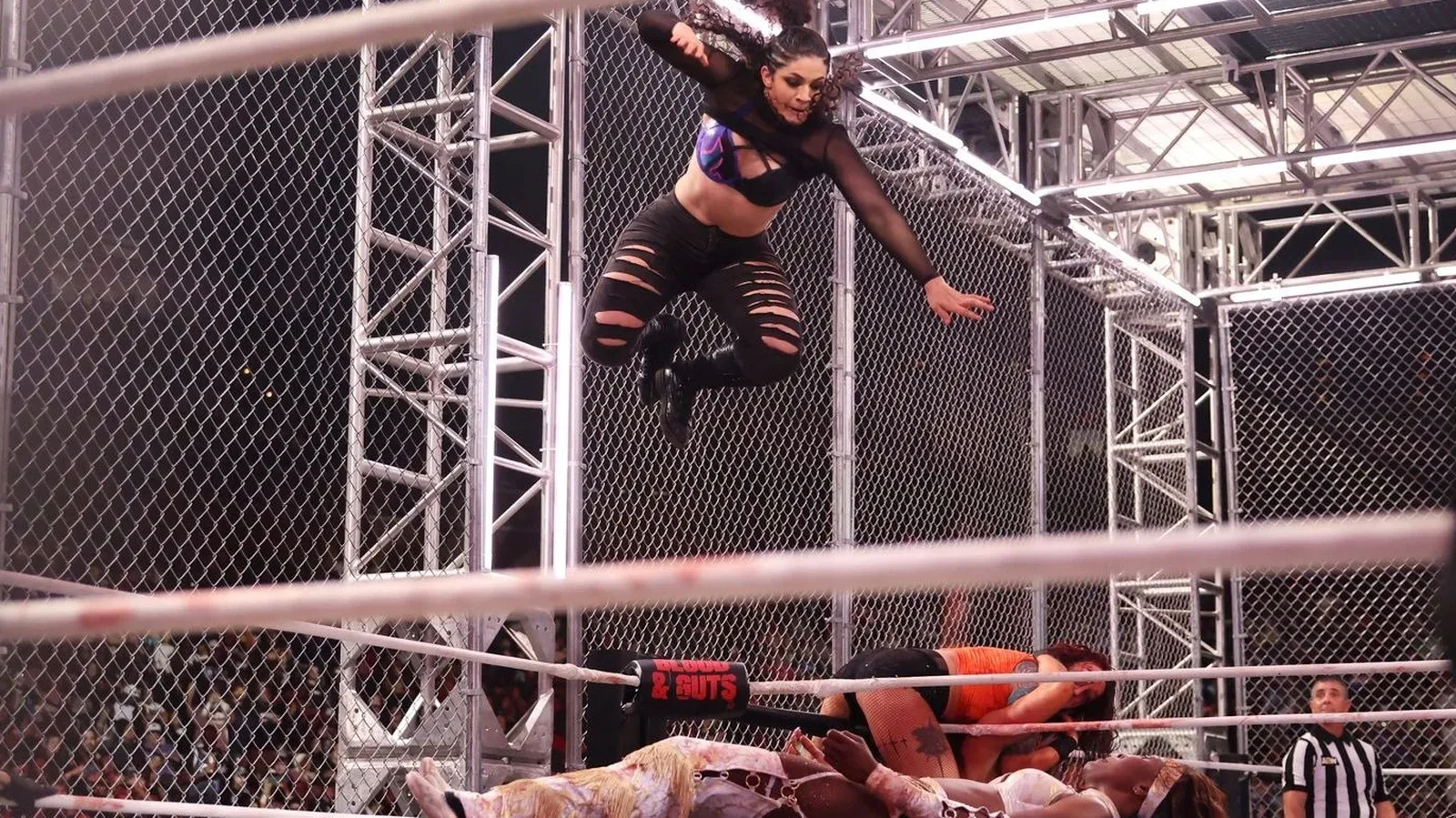
AEW’s annual Dynamite: Blood & Guts episode opened with the women’s Blood & Guts match for the second straight year, and one small point of terminology stood out amid the customary weapons and chaos inside the cage.
Willow Nightingale entered the caged rings wearing a backpack containing toy bricks and broken glass. During the presentation, the bricks were described as “toy bricks” rather than by the LEGO brand name. While that distinction can sound minor in ordinary conversation, it was apparently deliberate enough that the wording had to be corrected whenever the branded term was used.
Speaking on Wrestling Observer Radio, Bryan Alvarez said AEW had been instructed to use the generic phrase.
“They made it very clear that they have to call them toy bricks. Every time somebody accidentally said the word LEGOs, they had to correct it to toy bricks. So toy bricks got involved here.”
For more background on this topic, read Chris Jericho Details How He Prepared to Play Gorgeous George in ‘The Greatest’.
The report did not establish a specific reason AEW could not use the LEGO name on the broadcast. There was no indication that the company had publicly detailed the direction, whether it stemmed from a direct request, a legal review, a standards concern, or a general internal policy concerning trademarks. What was clear from the discussion was that “toy bricks” was the approved language for the segment.
A Deliberate Choice of Broadcast Language
The distinction matters because LEGO has become a common shorthand for interlocking plastic bricks. Fans and commentators may use the name casually, even when referring to similar products or generic versions of the item. On a nationally distributed wrestling program, however, a well-known trademark can carry different considerations than it does in everyday speech.
AEW’s commentary avoided treating the name as a generic term and instead described the objects by what they were: toy bricks. That kept the focus on the visual and physical role they were expected to play in the Blood & Guts match without attaching the sequence to a particular company’s branding.
It also avoided potential confusion over the specific items Nightingale had brought to the ring. The report identified the contents as toy bricks and broken glass, not confirmed branded LEGO products. Referring to them as LEGO bricks on air could create an implication about the product itself that AEW evidently did not want to make.
Blood & Guts has long been framed as one of AEW’s most violent specialty match settings, built around two rings, a steel cage, teams, escalating weapon use, and a surrender-based finish. Within that environment, props can quickly become a major part of the narrative. Nightingale’s backpack immediately established that she was bringing a particularly painful-looking option into the cage, while the broadcast’s terminology ensured the prop was described in generic terms.
Why Trademark Language Can Be Sensitive
Trademark issues do not always require a promotion to avoid every mention of a product name. Broadcasters, athletes, and fans regularly refer to companies, products, and brands in news coverage and conversation. Still, wrestling programming presents a unique blend of live entertainment, promotion, advertising, physical performance, and sometimes violent imagery.
That combination can make a generic description the simpler choice. A named product could be seen as connected to a stunt or weapon spot, even if no formal connection exists. In this case, the central visual was not a harmless toy demonstration. The bricks were part of a Blood & Guts match, a setting designed to present danger and physical punishment.
LEGO maintains a Fair Play Policy addressing issues including protection of its trademark, counterfeit products using LEGO branding, and how internet users should refer to its products. The policy does not specifically establish a television rule that would explain AEW’s wording during Blood & Guts. As a result, any direct link between the policy and AEW’s decision remains unconfirmed.
Still, the policy illustrates why a company might choose caution with a globally recognized brand name. By saying “toy bricks,” AEW could identify the weapon without making the LEGO name part of a violent match presentation. The approach is straightforward, accurate to the objects’ general purpose, and less likely to raise questions about whether the brand was being used in connection with the segment.
Willow Nightingale’s Entrance Set the Tone
Nightingale’s entrance provided a memorable visual before the match’s action unfolded. A backpack is an ordinary item, but in the context of Blood & Guts it became a delivery system for weapons. The reveal of toy bricks and broken glass immediately signaled that the opening contest would embrace the match concept’s reputation for brutality.
The fact that the women’s match opened the event for the second consecutive year also gave the moment added importance. Starting a themed edition of Dynamite means setting the pace for the entire night, and Nightingale’s preparation helped establish the atmosphere from the outset. The choice of weapons fit a format where wrestlers look for increasingly inventive ways to gain an advantage within the cage.
For viewers, the language may have been more noticeable precisely because the correction was repeated. “Toy bricks” is more formal and less conversational than the term many people would instinctively use. But repetition made the instruction apparent: AEW’s broadcast team was not to turn the brand name into shorthand for the weapon.
That does not change the basic idea behind the spot. The intended reaction comes from the familiarity of stepping on a small plastic brick and the discomfort associated with it. The generic wording still communicates that idea immediately. It simply does so without identifying a manufacturer.
Live Wrestling Requires Quick Adjustments
Live wrestling television demands constant attention to production details that viewers may never notice. Commentary has to react to entrances, storyline developments, unexpected crowd responses, match action, production cues, and safety-related circumstances in real time. When a particular term is restricted or discouraged, it can be easy for an announcer to default to the more familiar word and then have to correct course.
Alvarez’s description suggests that this was exactly what happened during the Blood & Guts broadcast. The important point was not merely that AEW chose “toy bricks” once in a prepared line. The terminology was reportedly reinforced whenever “LEGOs” was said accidentally.
That type of correction is not unusual in a broader television sense. Sports and entertainment broadcasts often employ preferred terminology for sponsors, partners, legal reasons, medical language, event branding, and product descriptions. Wrestling adds another layer because its live nature leaves little room to revise dialogue before it reaches the audience.
In this instance, the adjustment did not alter the match’s stakes or its central story. It was a production-language decision attached to one of the props Nightingale carried into the cage. Yet it is the kind of detail that can become notable because wrestling fans are highly attentive to commentary choices, especially during major themed episodes.
No Confirmed Explanation Beyond the Reported Direction
There remains no confirmed public explanation for why AEW needed to avoid the LEGO name during the segment. The available information supports the conclusion that the phrase “toy bricks” was required on the broadcast; it does not confirm a direct complaint, legal action, licensing matter, or any other specific circumstance involving LEGO.
That uncertainty is important. It would be inaccurate to present the change as proof of a dispute or as evidence that LEGO itself demanded the wording. The report did not provide that detail. The most reasonable reading is simply that AEW elected, or was required internally, to use a generic description rather than a trademarked one.
For the Blood & Guts opener, that meant Nightingale’s backpack contained toy bricks and broken glass. The visual remained the same, the danger associated with the match remained the same, and the commentary had a clear directive about how to describe one particular weapon.
It is a small example of how a live wrestling show balances spectacle with the practical realities of television production. In a match built around cages, teams, weapons, and extreme physicality, even a handful of plastic bricks can bring legal and branding considerations into the conversation. AEW’s answer, at least on this night, was to keep the description simple: toy bricks.
In pictures

Darryl Polo
Darryl Polo is a passionate wrestling fan covering WWE, AEW, TNA and beyond. He loves great rivalries, breakout stars and the moments that keep fans talking long after the bell. How we work.