
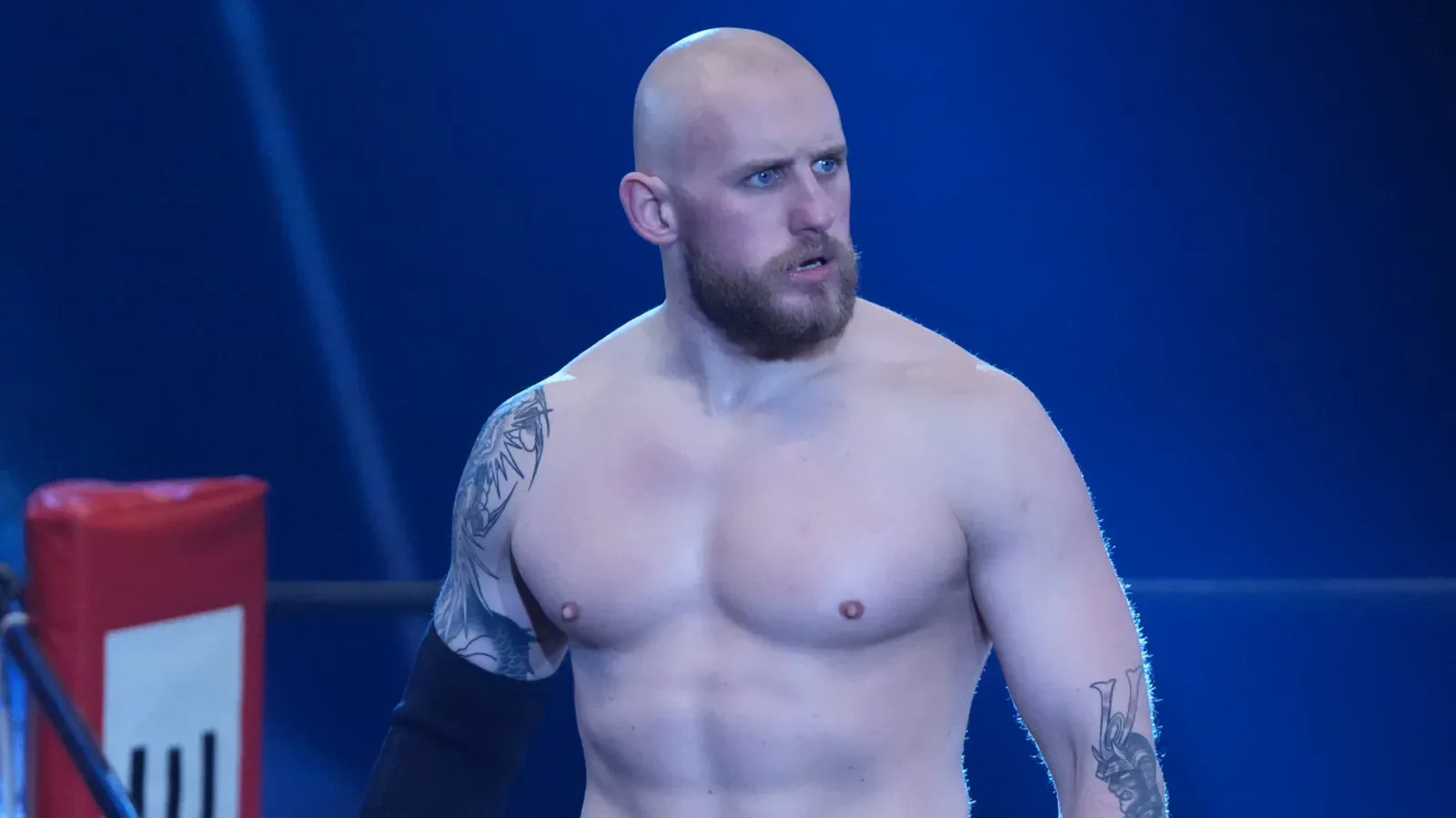
Gabe Kidd has built much of his in-ring identity around volatility, intensity, and a willingness to push opponents into uncomfortable territory. The “Mad Man” label has become central to his presentation across AEW and New Japan Pro-Wrestling, but Kidd has made clear that the name also carries deeply personal meaning.
Speaking on Talk Is Jericho with Chris Jericho, Kidd revisited a painful chapter from 2022 in which he experienced a serious mental health crisis after his time training and wrestling in Japan. Kidd described the period as one that nearly derailed both his life and his career, while also explaining how support from his family and New Japan figures helped him begin concentrating on getting well.
“I didn't realize it at the time, but when I was in the COVID-[19] hotel in Japan, I'd lost my mind,” Kidd said. “But then, they sent me home, and I got to see my family and friends again. And I'm like, ‘okay, I've had the reset that I need. I can go back and keep working.’”
Rather than being the reset he believed it would be, returning home preceded what Kidd described as an episode of psychosis. He said he did not understand what was happening to him at the time, and that his perception of those closest to him had been severely affected.
For more background on this topic, read NJPW Confirms Tokon Shop Global Will Remain Open After New Japan of America Closure.
“But then, I entered this episode of psychosis that I don't even know what I'm in. And it was a whole thing. Like, my mom had to call the police on me, bless her...I'm thinking she's the enemy. I felt everyone was the enemy...because when you're in mania, your emotions are so heightened.”
Kidd said police took him to a hospital, where he remained for two-and-a-half weeks. His comments offered a candid look at a period that had previously sat behind the larger-than-life persona wrestling audiences now associate with him. In an industry where toughness is often celebrated and performers frequently work through physical and personal hardship, Kidd’s account underscored the importance of recognizing when professional ambition must give way to recovery.
During that time, Kidd said wrestling remained heavily on his mind. He recalled calling then-NJPW President and CEO Takami Ohbari and Hiroshi Tanahashi every day while he was receiving help. His goal, he explained, was to return to New Japan and pursue a major opportunity against Kazuchika Okada, who was the IWGP Heavyweight Champion at the time.
The response from Ohbari and Tanahashi was not to rush him back into the ring or entertain a championship challenge immediately. Kidd said both men urged him to put his health first before considering an offer of that magnitude. Their message was a practical one: the match and the career goals could wait, but his wellbeing could not.
That distinction is important in understanding Kidd’s eventual path. He had clear ambitions in New Japan and evidently wanted to prove he belonged at the top of the company’s hierarchy. A match against Okada for the IWGP Heavyweight Championship would have represented one of the biggest opportunities available to any wrestler in the promotion. Yet the conversations Kidd described showed that the people he contacted were focused on what was necessary for him beyond the immediate competitive picture.
A different route after returning
Kidd ultimately did return to wrestling, but he said New Japan management had plans for him that did not align with the title opportunity he had envisioned during his recovery. That difference in direction contributed to his eventual departure from NJPW as a full-time performer and his official move to AEW in early March.
His relationship with New Japan has not ended. Kidd continues to make appearances for the promotion, though he said those appearances are now “more so” for him than for the company. The phrasing suggests a changed perspective from the one he carried in 2022, when the drive to get back and chase an immediate main-event prize was at the forefront of his thinking.
That more selective arrangement has not diminished Kidd’s standing in Japan. He is a two-time IWGP Global Heavyweight Champion, a distinction that places him among the key international-level names connected to NJPW in recent years. The championship itself has become a significant platform for wrestlers operating between New Japan’s global identity and its relationships with other promotions, and Kidd’s reigns have reinforced his position as one of the more prominent British wrestlers working on that stage.
At the same time, AEW has become the primary setting for the latest phase of his career. Kidd is part of The Death Riders, a group that has put him in a major spotlight and amplified the hard-edged qualities that have long defined his work. His presentation can be confrontational and unpredictable, but Kidd’s new comments add a meaningful layer of context to the distinction between a wrestling character and the real-life experiences that helped shape it.
There is no suggestion in Kidd’s account that difficult mental health experiences should be romanticized or folded into a wrestling storyline. Instead, he described an ordeal in direct terms: he was frightened, confused, in conflict with people who were attempting to help him, and in need of professional care. His willingness to speak openly about that period could resonate with viewers who have faced comparable struggles or watched loved ones go through a crisis.
Full Gear challenge ahead
Kidd now turns his attention to one of the most chaotic match environments AEW offers. He is set to compete in his first Anarchy in the Arena match at Full Gear this Saturday in Phoenix, Arizona, where The Death Riders will face The Cut.
Anarchy in the Arena is not a conventional wrestling match, and that makes it a particularly notable first for Kidd. The bout is built around disorder, multiple competitors, and a lack of the usual structure that governs standard tag-team or singles contests. For a wrestler whose reputation has been built on aggression and a willingness to embrace mayhem, the setting appears well suited to his on-screen strengths.
Still, the significance of the match is larger than a stylistic fit. Kidd enters Full Gear with a career that has already included major changes in geography, promotion, role, and personal outlook. His rise has not followed a straight line from New Japan’s dojo system to AEW television. It has involved a genuine interruption, time away, recovery, a return to competition, championship success, and a redefinition of what his connection to New Japan means.
Professional wrestling often encourages audiences to view careers through simple benchmarks: title wins, main events, rivalries, faction affiliations, and high-profile matches. Kidd has achieved several of those markers already. But his discussion makes clear that the most consequential victory in his story may have come away from the ring, when he accepted help and began working toward stability after a frightening episode.
That does not lessen the competitive hunger Kidd described. If anything, his recollection of repeatedly calling Ohbari and Tanahashi about a match with Okada demonstrates how strongly he wanted to reclaim his place and prove himself. What changed was the understanding that returning before he was ready would not have served him or his career.
As Kidd prepares for Full Gear, he does so as an established name in both AEW and NJPW rather than a wrestler merely trying to force his way back into the conversation. He remains connected to New Japan, holds significant championship credentials, and has a prominent role alongside The Death Riders in AEW. His account of 2022 also ensures that “Mad Man” is more than a catchphrase. It is a reminder of a difficult time he survived, and of the recovery that allowed his career to continue moving forward.
In pictures

Darryl Polo
Darryl Polo is a passionate wrestling fan covering WWE, AEW, TNA and beyond. He loves great rivalries, breakout stars and the moments that keep fans talking long after the bell. How we work.