
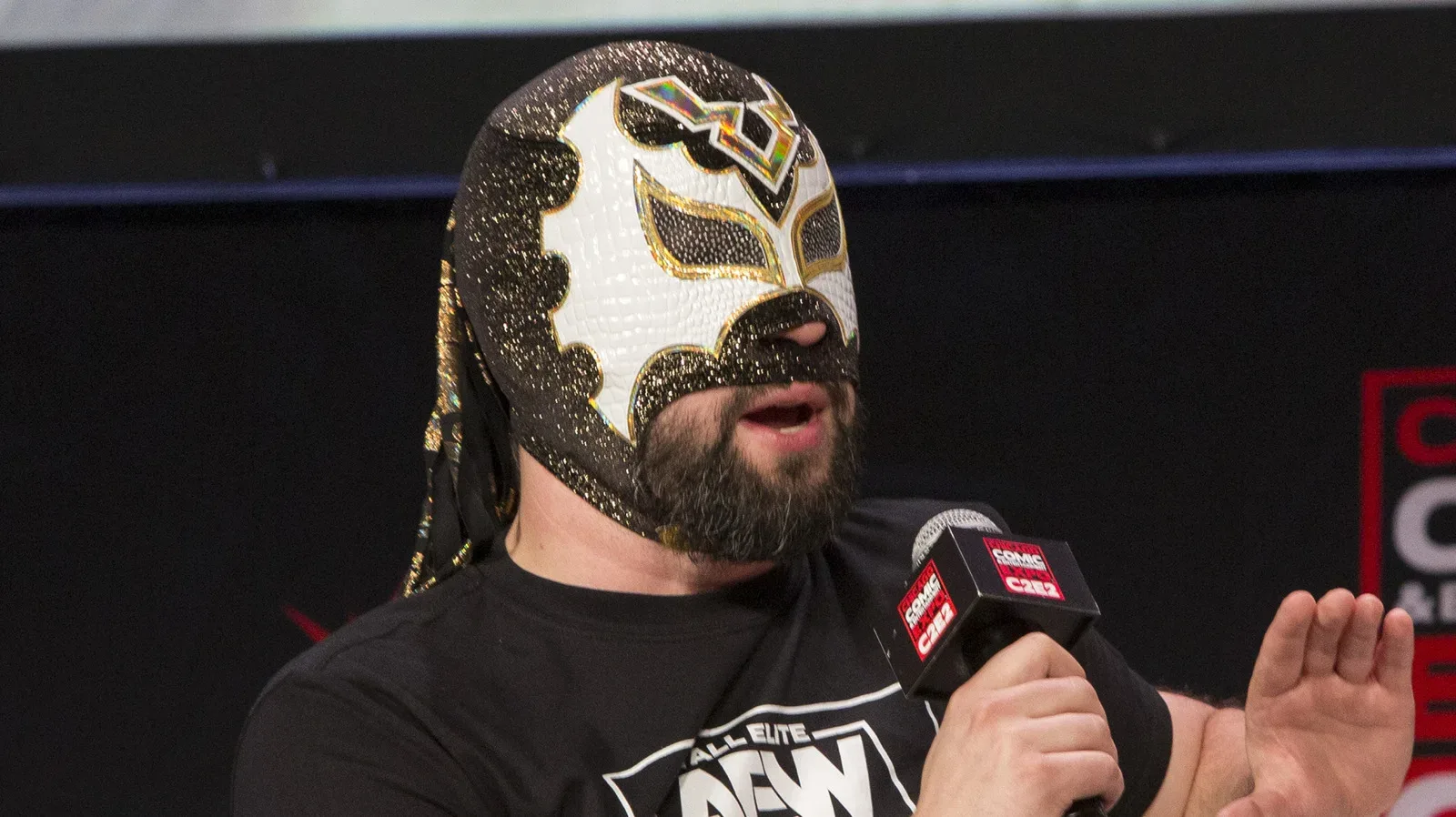
Excalibur has been a defining voice of All Elite Wrestling since the company’s earliest days, serving as the fast-paced play-by-play presence who can explain unfamiliar holds, provide historical context and keep up with the speed of AEW’s often chaotic matches. Yet before he and Jim Ross became a familiar pairing at the commentary desk, there was an important early test of whether their styles and personalities would fit together.
Speaking with Ballast Point Brewing Company, Excalibur recalled taking part in a chemistry test with Ross during the build to AEW’s first event, Double or Nothing. The exercise came before the pair had called a show together, at a time when AEW was still assembling the broadcast team that would help establish its identity.
For Excalibur, the session included a moment that captured the uncertainty surrounding the presentation of an announcer known for wearing a mask. Seeing cameras set up for the test, he put on his mask before sitting behind the microphones. Ross, a WWE Hall of Famer with decades of national television experience, responded with a pointed question.
“Before we even called a show together, they brought us in for a chemistry test,” Excalibur said. “We all sit down behind the microphones, but I see there’s cameras there, so I put on the mask. And JR looks at me and says ‘You know, this isn’t about you, right?’ And I’m like ‘Sir, please, I know. Just give me a chance.’”
For more background on this topic, read Excalibur Calls Kenny Omega vs. Will Ospreay at All In the Best Match He Has Ever Called.
The exchange came at a pivotal stage for both AEW and Excalibur. The promotion had high-profile figures attached to its launch, a roster built around established names and rising independent wrestling talent, and an immediate need to create a television sound that felt distinct. Ross brought unmatched mainstream experience and a major-event voice recognized by generations of fans. Excalibur brought extensive familiarity with many of the wrestlers and styles that would form the foundation of AEW’s in-ring product.
That contrast made the chemistry test especially significant. A commentary team is not simply a collection of knowledgeable voices. It must communicate the importance of the match, identify the emotional stakes, introduce competitors to viewers and react naturally in real time. In AEW’s case, that challenge was heightened by the company’s intent to feature a broad range of wrestling, from traditional singles contests to lucha libre-influenced action, tag team wrestling, hardcore stipulations and international talent.
A Partnership That Became Part of AEW’s Identity
Ross and Excalibur went on to work together throughout AEW’s formative period, including the company’s early pay-per-views and weekly television programming. Their booth often placed Ross in the role of veteran broadcaster and emotional guide, while Excalibur supplied immediate technical detail, wrestler backgrounds and the names of moves that might otherwise be unfamiliar to a wider audience.
Their time together has included interruptions, as Ross has taken prolonged absences connected to health issues. Still, the relationship developed well beyond that initial meeting. Ross has described Excalibur as “a great friend” and “a great asset to me,” praise that reflects the mutual trust required in a live broadcast environment.
That trust is particularly valuable in professional wrestling commentary because there is little room for hesitation. Announcers need to respond to action as it unfolds while also following story developments, timing commercial breaks, working alongside multiple partners and adapting if a match does not proceed exactly as expected. On an AEW broadcast, the desk can be asked to sell a championship bout, clarify an ongoing rivalry, welcome a surprise appearance or provide context for a performer making a major first impression.
Excalibur’s consistency has made him a central figure in handling that workload. From the launch of AEW onward, he has frequently served as the connective thread between different programs and formats. His role has not been limited to calling moves; it has involved translating the importance of what viewers are seeing and helping establish a sense that every wrestler’s background matters.
Why the Wrestlers Come First
Excalibur said his guiding principle is to avoid making the broadcast about the announcers themselves. In his view, the commentators are there to narrate the performance rather than compete with it for attention. That philosophy speaks directly to the question Ross raised during their chemistry test: whether the mask, or any other aspect of the announcer’s presentation, might distract from the actual purpose of the show.
“The thing that I like to do most is keep the focus on the action in the ring,” Excalibur said. “Because really, it’s not about me. I’m just the voice, the narrator that’s describing the action. The meat and potatoes of it is what’s going on in the ring.”
That approach has shaped how Excalibur is heard on AEW programming. He often delivers dense information quickly, particularly when a match involves wrestlers with deep histories outside AEW or a style that benefits from explanation. The objective is not merely to label a maneuver. It is to help the audience understand why the move matters, what it says about the wrestler using it and how it could alter the contest.
In a promotion that has regularly presented wrestlers from different backgrounds and countries, that kind of context can be essential. A viewer may be seeing a competitor for the first time, while longtime followers may already understand the significance of a submission, a finishing sequence or a rivalry that began elsewhere. Effective play-by-play has to serve both groups at once.
Excalibur also emphasized that the respect he brings to the commentary position is rooted in his view of what performers put at stake in the ring. Wrestling is built around physical exertion and risk, and the announcer’s task includes recognizing that reality without allowing the commentary to overwhelm the story being told by the wrestlers.
“And the effort being given by these guys and girls who are, quite frankly, they’re risking their lives in some cases,” Excalibur said. “Their future, future health, future prospects, future ability to interact with their kids, things like that. Me being respectful of that is paramount to me. It’s the most important thing to be respectful of the effort being put forth by these people.”
The Importance of Commentary in AEW’s Presentation
AEW’s commentary has evolved since Double or Nothing, with numerous voices contributing across Dynamite, Collision, Rampage, pay-per-views and other programming. The combinations at the desk have changed, and the company’s roster and programming footprint have expanded. Through those changes, Excalibur has remained one of the promotion’s most recognizable broadcast presences.
That longevity is notable because announcing in AEW requires more than a traditional sports-broadcast cadence. The company’s shows can shift rapidly from serious championship drama to fast-moving multi-person matches, then into personal confrontations that advance the next major event. The broadcast team must make those transitions feel coherent. A call that is too detached can drain urgency from the action, while a call that is too focused on the announcer can pull viewers away from the performers.
Excalibur’s recollection of his first interaction with Ross shows that this balance was being considered before AEW even presented its first show. Ross’ question may have been blunt, but it addressed a fundamental concern for any broadcast: the wrestlers and their stories must remain the priority. Excalibur’s response, and the career that followed, indicates that he understood the assignment from the beginning.
The mask remains a recognizable part of Excalibur’s public identity, but his explanation makes clear that he does not see it as the centerpiece of his work. The centerpiece is the match, the wrestlers taking part and the stakes they are trying to communicate. That perspective has helped him develop from a commentator associated with AEW’s launch into one of the voices most closely tied to the company’s overall presentation.
For AEW, the early chemistry test with Ross was a small but consequential part of building the broadcast foundation around Double or Nothing. Years later, it stands as a revealing story about the formation of a partnership, the pressure of launching a new national wrestling promotion and the professional mindset Excalibur continues to bring to the desk.
In pictures

Darryl Polo
Darryl Polo is a passionate wrestling fan covering WWE, AEW, TNA and beyond. He loves great rivalries, breakout stars and the moments that keep fans talking long after the bell. How we work.