
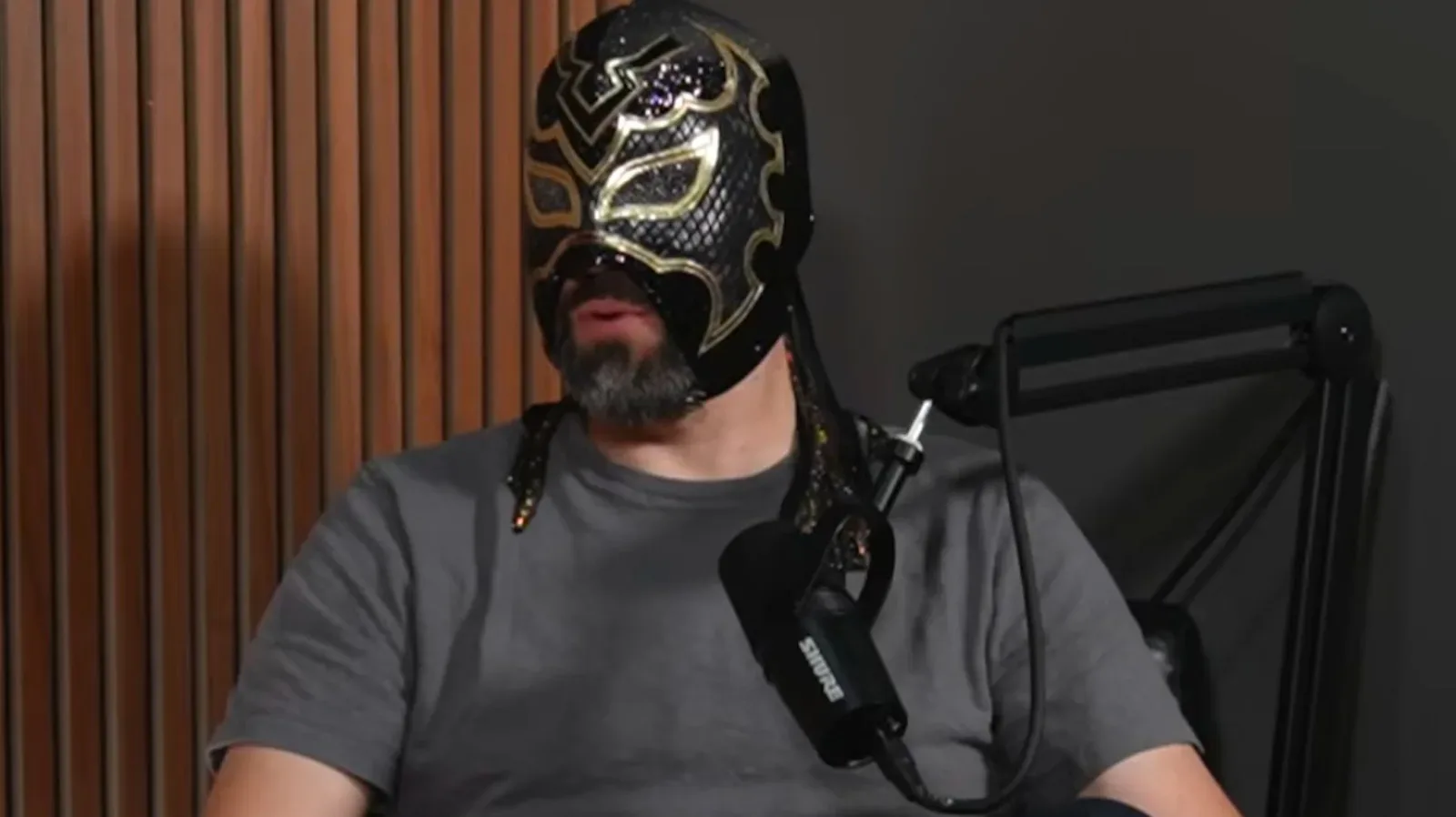
Excalibur has put Kenny Omega vs. Will Ospreay at AEW All In in a category of its own.
The longtime commentator, whose voice has become one of the defining sounds of All Elite Wrestling broadcasts, named the Omega-Ospreay meeting at Wembley Stadium as the best professional wrestling match he has ever called. Excalibur went even further during an appearance with Ballast Point Brewing Company, saying it may be the greatest professional wrestling match he has ever seen.
That is a significant assessment from a broadcaster with a deep connection to modern independent wrestling and a major role in AEW’s presentation since the company’s earliest events. Before becoming a familiar voice on AEW Dynamite and pay-per-view broadcasts, Excalibur was closely associated with Pro Wrestling Guerrilla as its commentator. He also competed in the ring from 2000 through 2007. Across those experiences, he has been near high-level matches in multiple eras of wrestling, making his praise for Omega and Ospreay especially notable.
For Excalibur, the match was not simply defined by moves, athleticism or the outcome. The setting, the audience reaction and the willingness of the announce team to let the moment breathe all helped create a presentation he considers unmatched.
For more background on this topic, read Kris Statlander Steps In for Marina Shafir to Team With Jon Moxley at Warrior Wrestling.
Wembley Stadium set the stage
All In at Wembley Stadium offered an environment very different from an ordinary weekly wrestling television show. The scale of the building, the enormous crowd and the emotional significance of Ospreay wrestling in front of a massive audience in his home country created an atmosphere that did not need to be forced by the commentators.
Excalibur recalled that the broadcast booth was quiet through the first portion of Ospreay’s entrance, including his video package and walk to the ring. Rather than speaking over the crowd, the team allowed viewers to take in the full reaction inside Wembley.
“Then he comes out to Wembley Stadium to 50,000 of his countrymen who are just screaming their heads off,” Excalibur said to Ballast Point Brewing Company. “They are cheering. They are singing along with his song. The fireworks are going off. What could we say as broadcasters that carried more weight than what was happening in that stadium at that moment?”
The comment captures an important part of professional wrestling commentary: knowing when not to talk. A great wrestling call can provide context, identify a turning point or add urgency to a dramatic finish. But a broadcaster can also elevate a moment by recognizing that the live crowd, music and visual spectacle are already telling the story.
In Ospreay’s case, Wembley itself became part of that story. The cheers and singing did more than welcome a wrestler to the ring. They established the emotional stakes before the match began. Ospreay was arriving for one of the biggest stages of his career, and the audience response made clear how much the occasion meant to the people in attendance.
Excalibur’s recollection also illustrates the difference between silence and inactivity on commentary. The booth’s choice to hold back was still a deliberate storytelling decision. By allowing the audience to dominate the soundscape, the broadcast preserved the magnitude of Ospreay’s entrance rather than attempting to compete with it.
From spectacle to a fight over who was the best
Once Omega and Ospreay were in the ring and the match began, Excalibur said the commentary approach changed. The announcers began laying out the history between the two competitors and supplying viewers with the statistical and competitive context surrounding the contest.
That transition was crucial. Entrances can establish emotion, but the match needs a central question that gives every near fall, counter and momentum swing added meaning. Excalibur viewed Omega vs. Ospreay as a direct battle to determine the superior wrestler.
“But now it’s a battle for the best and who is the top dog,” Excalibur said.
That framing suits two performers whose reputations have been built around elite matches and a willingness to pursue the highest possible standard in the ring. Omega and Ospreay brought established expectations with them, but the scale of All In made those expectations even larger. The broadcast team’s job was to make the rivalry understandable without drowning out the action or the reactions coming from Wembley.
Excalibur’s words suggest that the match succeeded because all of its pieces were aligned. There was the pre-match presentation, the scale of the stadium, the crowd’s emotional investment, the history between Omega and Ospreay, and the in-ring performance itself. None of those elements had to carry the entire burden alone. Instead, each one supported the others.
That is often what separates a widely praised match from a match that becomes a lasting reference point. Wrestling audiences can appreciate a spectacular sequence or a hard-fought main event in isolation. The bouts remembered for years, however, usually feel like complete events. They have an atmosphere before the bell, a clear narrative after it rings and a crowd that recognizes the importance of what it is watching.
Excalibur’s strongest possible endorsement
Excalibur did not leave much room for ambiguity when describing his final opinion of the encounter.
“It was the best professional wrestling match that I have ever called as a broadcaster and maybe the best professional wrestling match that I’ve ever seen,” Excalibur declared.
For someone who has spent years calling fast-paced, technically detailed wrestling, that is a sweeping statement. Excalibur’s commentary is regularly associated with his ability to identify moves, explain transitions and add historical knowledge in real time. His well-known “Un-BEE-LEEV-able” call has become a familiar exclamation on AEW programming, particularly when a match reaches a moment of extraordinary risk or skill.
Still, his reflection on Omega vs. Ospreay emphasizes that announcing is not solely about identifying every maneuver. The best call is sometimes an explanation. At other times, it is a timely emotional reaction. And in a setting like Wembley Stadium, it can be the decision to say nothing while tens of thousands of people provide the soundtrack.
The ability to balance those approaches matters in a match of this stature. Commentary must account for viewers who know every chapter of a rivalry, while also giving casual viewers enough information to understand why the wrestlers’ exchanges matter. It must respect the performers’ physical storytelling while helping frame the broader stakes. And it must do all of that without interrupting the emotional connection between the wrestlers and the audience.
Omega vs. Ospreay gave the AEW broadcast team an unusually large canvas on which to work. Ospreay’s entrance demonstrated the power of the live environment. The match then gave the commentators an opportunity to define the contest as a struggle for supremacy. Excalibur’s assessment makes clear that, in his view, the final product met the enormous standard created by those opening moments.
A match and a broadcast moment built for a massive audience
There is also a broader takeaway in Excalibur’s comments about how AEW presented All In. A stadium wrestling show is not merely a larger version of an arena show. The production choices must adapt to the building, the crowd size and the sense of occasion. What works in a smaller venue may not carry the same effect in a stadium filled with fans who are singing, cheering and reacting as one.
Ospreay’s walk to the ring was a moment where the venue dictated the broadcast. Omega and Ospreay’s match was where the booth could then add its perspective, weaving in the rivalry and the question of who could rightfully claim to be the better wrestler. The result, at least through Excalibur’s eyes, was the finest match-call of his career.
That opinion will naturally invite debate among wrestling fans, particularly because both Omega and Ospreay have been involved in numerous acclaimed matches. But Excalibur was not offering a casual ranking. He was reflecting on a moment he experienced from a uniquely demanding seat: live at the desk, responsible for helping guide a global audience through one of AEW’s biggest matches in one of wrestling’s grandest settings.
In the end, Excalibur’s memory of the match begins with restraint. The crowd spoke first. Then the commentators told the competitive story. By the time Omega and Ospreay had finished their battle at All In, Excalibur believed he had called the best professional wrestling match of his broadcasting career.
In pictures

Darryl Polo
Darryl Polo is a passionate wrestling fan covering WWE, AEW, TNA and beyond. He loves great rivalries, breakout stars and the moments that keep fans talking long after the bell. How we work.