
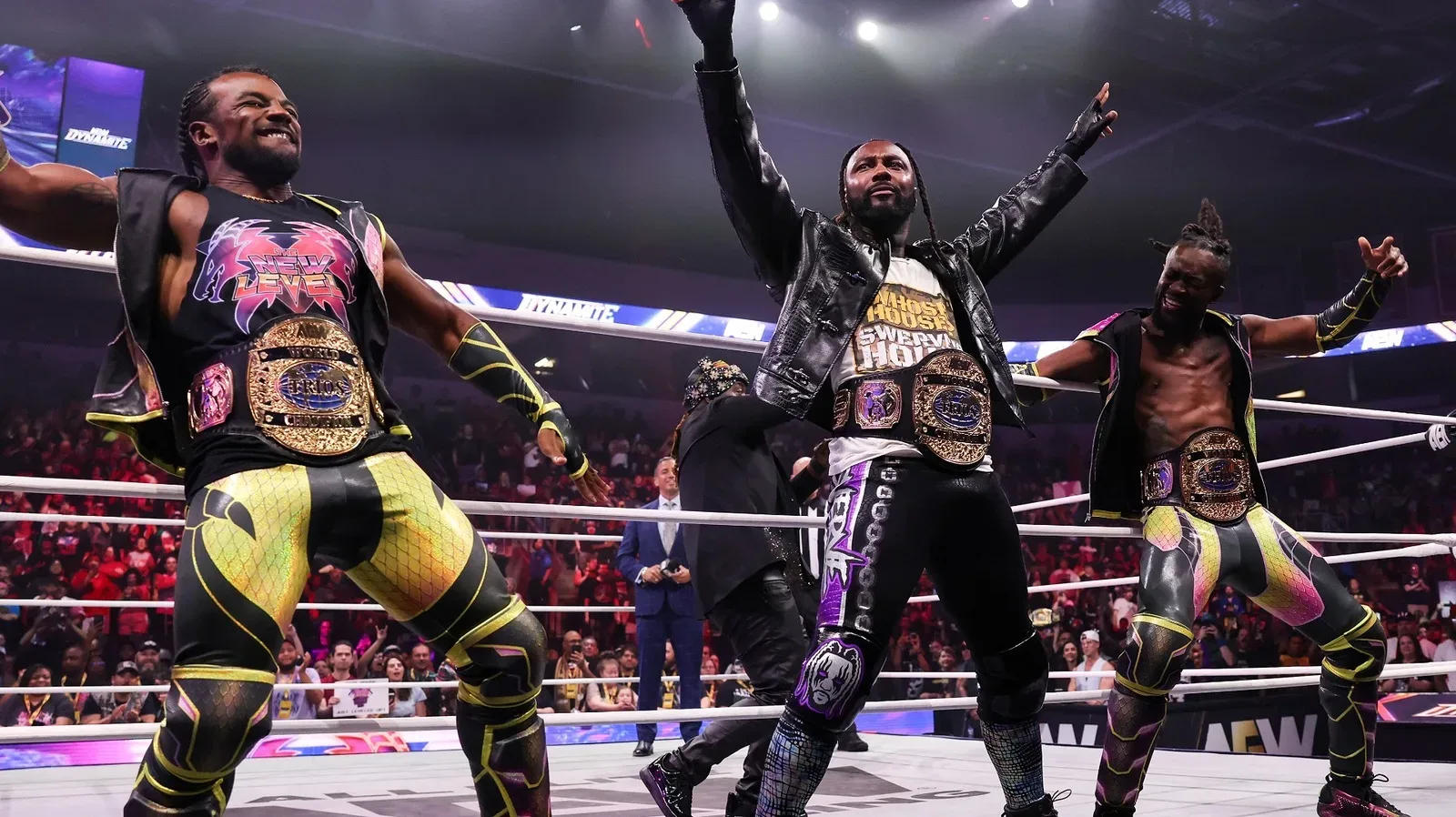
Eric Bischoff believes AEW may have taken a short-term shortcut with the presentation of Austin Creed and Kofi following their arrival at All In: London.
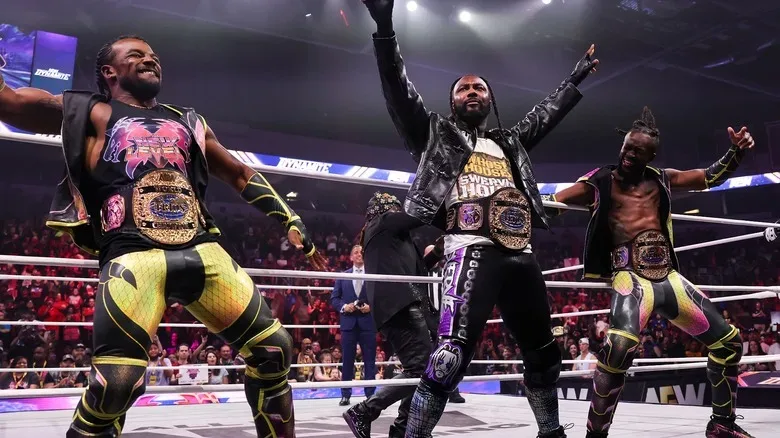
Creed and Kofi made their AEW debuts at last month’s All In event, aligning themselves with Swerve Strickland and helping him capture the AEW World Trios Championships. Their introduction immediately positioned them as major players within the company, with the trio entering the championship picture rather than spending weeks or months establishing a foothold on television.
While the pairing with Strickland represented a significant fresh chapter for both men, much of Creed and Kofi’s presentation has remained deliberately recognizable. The duo is being known as New Level, a name that closely echoes the New Day identity associated with their WWE run. Their on-screen energy and established chemistry have also carried over into AEW, giving viewers an immediate frame of reference for the act.
Speaking on 83 Weeks, Bischoff said he understands why AEW would want to capitalize on the familiarity and goodwill attached to the performers’ past. Still, he argued that a more distinct reinvention would be the stronger long-term creative route.
For more background on this topic, read Frankie Kazarian Reflects On Friendship And AEW Locker Room Memories With Andy Williams.
“They’re trying to draft off of the equity that the former New Day had in WWE, which I understand it; I’m not criticizing that. I completely understand that from a business perspective. I prefer not to do that,” Bischoff said.
Bischoff’s point was not that Creed and Kofi should disregard the accomplishments that made them valuable names. The former New Day became one of the most recognizable tag-team acts of its era, and their shared history is naturally a major part of the appeal when they appear together. Their chemistry is already established, their personalities are familiar to a broad wrestling audience, and the connection makes their AEW debut easier for viewers to process.
Instead, Bischoff’s concern centered on whether a presentation that is too closely tied to a previous act can limit a performer’s potential to create something new. In his view, an act built around a variation of an existing identity risks feeling derivative, even if the talent involved remains popular and effective.
“So given a choice? If I think I have the option of creating something really new, and unique, and powerful, or effective at least? I would opt to do that before I would take the easy way out, the cheap way out, and try to come up with something that’s a derivative,” Bischoff said.
The criticism arrives at an interesting point for AEW’s new trio. Creed and Kofi did not enter the company in a vacuum; they immediately joined forces with one of AEW’s most prominent stars in Strickland and won the World Trios Championships. That type of debut supplies momentum, credibility, and a defined role from the start. It also means that the group’s presentation will be examined closely, particularly as AEW decides how much of its identity will be rooted in the duo’s prior success and how much will be built around their new environment.
There is a practical case for keeping familiar elements intact. Wrestling is driven by recognizable characters, visual cues, catchphrases, entrance styles, alliances, and histories. When established wrestlers arrive in a new promotion, immediate familiarity can make the transition feel important. It gives longtime fans something to connect with on night one while allowing newer viewers to understand why a debut is meaningful.
New Level also differs from simply attempting to recreate a former group in the same setting. Creed and Kofi are now operating in AEW, in a new alliance with Strickland, competing for AEW championships and working within a different roster landscape. The name may invite comparisons, but their direction as World Trios Champions could still develop into something clearly separate as their stories progress.
Bischoff, however, argued that the cleaner and potentially more valuable choice would be to leave the past behind more fully. He compared an overly familiar presentation to something that continues to linger after it should have ended.
“I would rather try something completely different. ... It’s like a hangover that won’t go away,” Bischoff said. “I think breaking clean from a previous character and establishing a new character ... is a smarter long-term approach than hanging on to the past.”
That view speaks to a longstanding question in professional wrestling: when a performer leaves a major promotion, should the next chapter preserve the traits that made them famous, or should it present a dramatic reset? There is no single formula. Some wrestlers thrive by retaining a recognizable core and adjusting it to a new setting. Others find their greatest success after transforming their personas, look, style, or motivations enough that the next run feels like a new act rather than a continuation.
For Creed and Kofi, the debate is especially notable because their history together is inseparable from their appeal. They were not simply teammates; they were part of a highly identifiable act with a specific tone, name, and audience relationship. A total departure from that history might have risked removing some of the qualities fans most wanted to see when the two appeared together again. At the same time, the closeness of New Level to their previous branding makes it understandable why Bischoff sees an opportunity for AEW to establish a more independent identity.
Bischoff acknowledged that his argument is informed by his own experience in WCW. He noted that similar creative choices happened during his time overseeing the promotion, and he framed his present-day preference through the lens of wrestlers who did not succeed under his watch. That admission adds important context to his criticism: rather than presenting himself as someone who always avoided familiar or derivative concepts, he recognized that he has seen the drawbacks firsthand.
WCW’s history included many cases in which performers entered with established reputations, previous personas, or associations that followed them from elsewhere. In some situations, that name recognition was useful. In others, the challenge of separating a wrestler from what audiences already knew proved more difficult. Bischoff’s comments suggest that he now places greater value on a decisive creative break when talent has the ability to make one.
Whether that principle applies to New Level will ultimately depend less on the one-word difference in the name and more on what happens next. If Creed and Kofi are given fresh motivations, a unique dynamic with Strickland, meaningful rivalries, and a voice distinct from their prior work, their AEW run can become its own chapter regardless of the inevitable comparisons. Conversely, if their presentation remains reliant on reminders of their former act without adding new layers, Bischoff’s concern may continue to resonate with viewers looking for a clearer evolution.
The World Trios Championships provide an immediate platform for that evolution. Championship reigns create opportunities for a group to define its priorities and establish the type of unit it wants to be. Strickland brings his own established presence to the alliance, and the contrast or chemistry between him and New Level could become central to differentiating the trio from anything Creed and Kofi did before arriving in AEW.
For now, their debut has accomplished one significant objective: it has generated attention. Creed and Kofi’s entrance at All In: London was a consequential moment, and their alliance with Strickland immediately changed the trios title landscape. Bischoff sees the act’s familiar branding as a creative limitation that AEW would be wise to move beyond. AEW, meanwhile, has an opportunity to use that familiarity as a starting point rather than a final destination.
New Level’s next steps as AEW World Trios Champions will determine whether the group becomes primarily a recognizable echo of the past or develops the new, independent character Bischoff believes would offer the greater long-term reward.
In pictures
Darryl Polo
Darryl Polo is a passionate wrestling fan covering WWE, AEW, TNA and beyond. He loves great rivalries, breakout stars and the moments that keep fans talking long after the bell. How we work.