
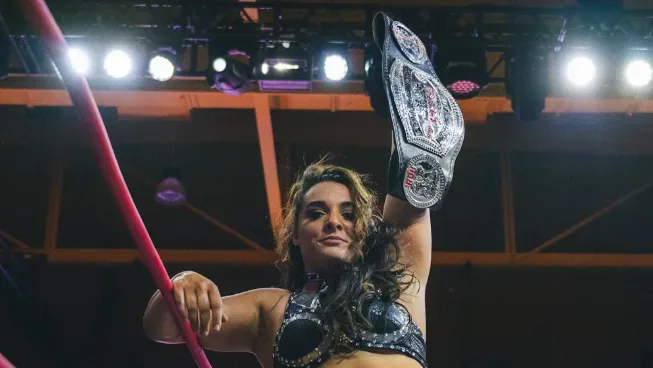
Deonna Purrazzo has opened up about the most difficult consequence of her recent Ring of Honor injury absence, identifying the interruption to her momentum—not simply the time away from the ring—as the part that weighed on her most heavily.
Purrazzo was injured during an ROH taping in a match with Steph De Lander. The injury came on a floor spot and forced Purrazzo to step away from in-ring competition until she was medically cleared. Once cleared, Purrazzo returned to face De Lander again at Death Before Dishonor, resuming a rivalry that had been directly affected by the setback.
While discussing the period away from the ring, Purrazzo explained that she believed she had reached an especially productive stretch in her ROH and AEW run before the injury occurred. In her view, her performances were clicking, and the audience response was beginning to reflect the work she had put in.
“Getting injured in July was most difficult but I felt like for the first time in my time in ROH/AEW, I was firing on all cylinders. I was doing my best work and the fans were recognizing that. Having that momentum suddenly taken away from me was probably the hardest part.”
For more background on this topic, read Deonna Purrazzo Reflects On ROH Legacy And Meaning Of Women’s Pure Championship Reign.
The timing of an injury can often be as significant as the injury itself, particularly for a wrestler working across a packed schedule and attempting to establish a consistent position on television, at tapings, and on major events. For Purrazzo, the absence arrived when she felt she was gaining traction with fans and producing some of her strongest work since joining the ROH/AEW landscape.
That is a frustrating position for any performer. Momentum in wrestling is not solely defined by wins and championships. It also involves regular visibility, character progression, audience reaction, rivalry development, and the ability to build on what happened the previous week. An unplanned medical absence can pause all of those elements at once, even when a wrestler has been doing everything possible to move forward.
Purrazzo’s Technical Style Shapes Her Return Mindset
Purrazzo also addressed the nature of the spot that led to her injury and indicated that the experience will reinforce the approach she has long taken to her in-ring style. Known primarily as a technical wrestler, Purrazzo has built much of her reputation around grappling, submissions, positioning, and precision rather than a high-risk aerial offense.
She made clear that she does not see herself as a wrestler who regularly chases dangerous moments for their own sake. Looking ahead, Purrazzo said she intends to remain as grounded as possible.
“Being a technical wrestler, I am not much of a high flier or risk taker anyway. So, I think moving forward I will continue to keep my feet planted on the ground as much as possible!”
The statement fits the identity Purrazzo has cultivated throughout her career. Her best-known strengths are rooted in a controlled, methodical brand of wrestling, where transitions and holds carry as much importance as spectacle. That does not mean technical wrestlers are immune to injuries—every style carries physical risk—but it does underline why Purrazzo sees a return to the fundamentals of her game as the right path following a floor-related injury.
There is also an important distinction in Purrazzo’s comments. She is not presenting a dramatic overhaul of her work or suggesting that she will stop competing with intensity. Instead, she is emphasizing the characteristics that already define her: a preference for mat-based wrestling and an approach that does not depend on taking frequent high-risk risks. For a wrestler whose presentation is built around skill and strategic control, that is a natural response to a difficult interruption.
A Return Against Steph De Lander
Purrazzo’s medical clearance allowed her to return to the ring at Death Before Dishonor, where she again shared the ring with Steph De Lander. That rematch gave the story surrounding the injury a degree of in-ring continuation. The opponent connected to the original incident was also part of Purrazzo’s first major return setting after the layoff.
In professional wrestling, a return match can serve several purposes at once. It is a test of readiness, a chance to reestablish a wrestler’s rhythm before a live audience, and an opportunity to remind viewers of the issues that were left unresolved by an absence. Purrazzo’s return against De Lander carried those elements because their previous encounter had been interrupted by the injury.
The fact that Purrazzo was medically cleared and able to compete at Death Before Dishonor is the central positive development following the setback. Still, her comments show that being cleared did not erase the disappointment she felt over losing the momentum she had built. Physical recovery and professional frustration are separate parts of the process, and Purrazzo’s reflection focused most strongly on the latter.
Her perspective also speaks to the pressure wrestlers place on themselves during a period when they believe they are delivering at a high level. When performances are connecting and fans are responding, every missed appearance can feel magnified. A wrestler may be focused on healing, but they are also watching stories continue, cards change, and opportunities move forward without them.
ROH Women’s Pure Championship Adds to the Stakes
Purrazzo’s comments come while she is also associated with the ROH Women’s Pure Championship picture. Elsewhere in the same discussion, she addressed her reign with the title, adding another layer to the importance of maintaining consistency whenever possible.
The Women’s Pure Championship represents a particularly suitable platform for Purrazzo’s style. Pure wrestling places an added focus on rules, technical execution, and strategy, all areas that align with the qualities she highlighted when discussing her preference to keep her feet on the ground. Purrazzo has long been identified with a polished technical approach, and the championship environment places that aspect of her wrestling at the forefront.
That alignment makes the lost momentum she described even more understandable. A title reign is not only about holding a championship; it is about sustaining the performances and rivalries that give the reign meaning. Time away through injury can complicate that rhythm, especially when a wrestler feels they had just begun to hit a new level of confidence and recognition.
Purrazzo did not minimize the challenge of being sidelined, but her remarks also conveyed a clear sense of direction. She has returned to competition, has revisited the De Lander rivalry, and remains committed to the technical foundation of her work. Rather than framing the injury as a reason to abandon that identity, she sees it as a reminder to lean further into it.
Momentum Remains a Central Focus
For Purrazzo, the objective now is straightforward: rebuild the momentum that was interrupted. That will come through the same areas she believes were working before the injury—strong performances, a clear in-ring identity, and a connection with fans who had begun to recognize the level she felt she was reaching.
Her assessment is also a candid reminder that injuries affect more than a wrestler’s calendar. They can halt confidence, derail the natural progression of a storyline, and take away the chance to capitalize on a period of positive audience response. Those losses are harder to measure than time missed, but they can be just as consequential to a performer.
Purrazzo has now had the opportunity to return after being medically cleared, and her comments suggest she is approaching the next stage of her ROH and AEW work with an even sharper awareness of what she wants to preserve. She does not intend to become a high flyer or reshape herself into a risk-taking performer. Instead, she plans to continue relying on the technical style that has made her one of the most recognizable specialists in women’s wrestling.
With the injury absence behind her, Purrazzo’s focus is on regaining the consistency that was taken from her at an inopportune moment. Her return at Death Before Dishonor was an important step. The larger goal will be restoring the momentum she felt before the injury and continuing to make the most of her place in ROH’s women’s division.

Darryl Polo
Darryl Polo is a passionate wrestling fan covering WWE, AEW, TNA and beyond. He loves great rivalries, breakout stars and the moments that keep fans talking long after the bell. How we work.