
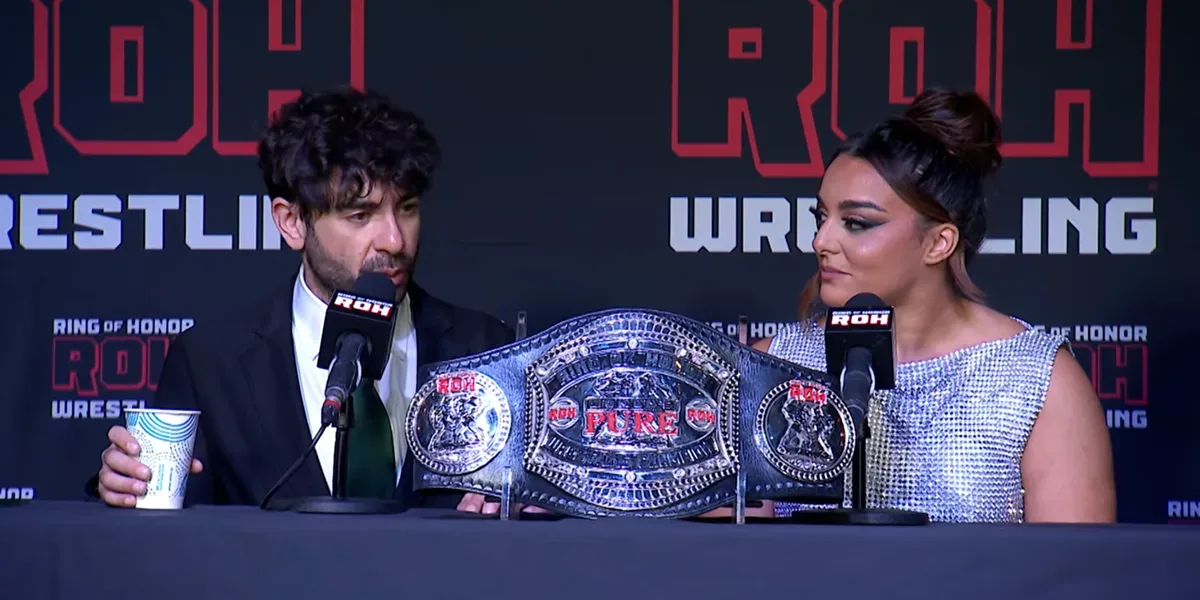
Deonna Purrazzo believes women’s wrestling has made major strides in its most visible spaces, but she wants the industry to make the same commitment to women in the offices and production areas that shape what fans ultimately see on television.
Purrazzo, whose career has included prominent runs in TNA/IMPACT, Ring of Honor and AEW, pointed to the increasing normality of women competing in stipulation matches and closing major events as a defining sign of progress. At the same time, she stressed that the business still has room to grow in positions of influence, specifically naming creative, talent relations, agenting and producing as areas where she would like to see more women represented.
Her comments arrive at a time when women across several major wrestling promotions have increasingly been positioned in headline matches, featured in longer-form championship programs and included in match concepts that were once almost exclusively associated with men’s divisions. Purrazzo’s view is that those opportunities have not been handed out as empty gestures. Rather, she sees them as the result of performers repeatedly showing they can deliver when presented with meaningful stories, time and stakes.
Purrazzo sees a major change in women’s main-event opportunities
The former multi-time world champion identified the expanded use of women in stipulation bouts and main events as the development she is proudest to have witnessed. For Purrazzo, it represents a stark shift from an earlier period in which women were frequently not given the storytelling foundation or television investment needed to make a top-of-the-card position feel earned.
For more background on this topic, read Kevin Knight Wants NJPW Return to Showcase His Growth Since Young Lion Days.
“I’m most proud of how normal it has become to see women in stipulation matches and main-eventing television and pay-per-views,” Purrazzo said. “Twenty years ago, women often weren’t given the time, investment or storylines necessary to warrant those opportunities. Now, we’ve proven over and over again that when the work warrants the spotlight, women can deliver in it.”
That distinction is central to Purrazzo’s argument. She did not frame main events or special match stipulations as opportunities that should be provided simply to satisfy a demographic benchmark. Instead, she said women should receive those platforms when their work, character development and programs have built the appropriate momentum.
“I’ve always believed women shouldn’t be given the spotlight simply because we’re women,” Purrazzo said. “We should be given it because the work we’ve done warrants it.”
Purrazzo added that the current landscape has supplied considerable evidence that women’s wrestling can capture audience interest when it is treated as a meaningful part of a promotion’s overall presentation. In her assessment, the repeated success of women in high-profile situations supports the case for equal access to opportunities rather than separate standards.
“What we’re seeing now is evidence that women’s wrestling draws fans’ attention and deserves the same opportunities as the men because, every time we’re given one, we continue to deliver,” Purrazzo said.
A career that has crossed multiple major women’s divisions
Purrazzo’s own body of work gives her a broad perspective on the evolution she described. During her time in TNA/IMPACT, she main-evented three pay-per-views and became the company’s first-ever Iron Woman. Those milestones came during a period in which Purrazzo established herself as one of the company’s defining in-ring champions and one of the division’s most technically distinctive performers.
She also recalled main-eventing AEW Dynamite while she was under contract with TNA, defending the ROH Women’s World Championship. The appearance stood as an example of the increasingly interconnected nature of the wrestling industry, while also putting a women’s title defense in the closing position of AEW’s flagship weekly program.
Purrazzo further cited being part of the first televised women’s Texas Bullrope match in AEW. The match was another notable example of women taking part in a stipulation traditionally framed as a brutal, high-intensity attraction. The inclusion of women in that setting aligns with the broader change Purrazzo highlighted: major promotions are increasingly allowing women’s rivalries to use the same kinds of match environments that have historically been reserved for men’s programs.
She also pointed to the first women’s Blood & Guts match taking place last year, as well as Athena’s string of ROH pay-per-view main events. Both examples reinforce Purrazzo’s larger point that high-stakes women’s matches are no longer isolated novelties. They are becoming part of the expected range of possibilities for major cards and television events.
The next priority is representation behind the camera
While Purrazzo celebrated what has changed on-screen, she was equally clear that the work is unfinished. Her focus now turns to the departments that determine stories, guide performers, develop matches and help make decisions about a roster’s direction.
“Wrestling can still feel like a boys’ club, especially when it comes to positions of influence and decision-making,” Purrazzo said.
She specifically called for more women to hold jobs in creative, talent relations, agenting and producing. Those positions can carry substantial influence over the development of wrestlers and divisions. Creative personnel help shape narratives and character direction. Talent relations roles can be important to communication between performers and management. Producers and agents help structure matches, offer feedback and support talent as they prepare for television and pay-per-view events.
Purrazzo’s point is not limited to the women’s divisions. Having women in these roles would mean greater representation in the rooms where the full product is developed, including decisions that affect the presentation of the entire roster. It also offers experienced performers an avenue to continue contributing to wrestling in influential capacities beyond their active in-ring careers.
“I’d like to see more women in creative, more women in talent relations, and more women working as agents and producers,” Purrazzo said. “We’ve proven that women belong in every position in front of the camera. Now, I’d like to see that same progress reflected in the people helping shape what happens behind it.”
Why the backstage conversation matters
The increased visibility of women’s wrestling has made the conversation about backstage representation especially significant. A promotion can put women in main events and marquee matches, but the long-term consistency of that effort can depend on who is participating in the planning process. Purrazzo’s comments suggest that true progress should be measured not only by who receives television time, but also by who has a voice in creating the conditions for that television time to matter.
A stronger presence of women in creative and production roles could also bring more perspectives into a business where personal experience often informs storytelling. That does not mean women’s wrestling requires a separate creative structure, nor did Purrazzo present it that way. Instead, her call is for women to be part of the wider professional ecosystem that develops all aspects of wrestling programming.
The issue carries particular relevance for performers who have navigated different locker rooms and promotions. Purrazzo has competed under a variety of systems and has worked in companies with distinct approaches to championships, weekly television, pay-per-view events and roster development. Her experience allows her to point to tangible on-screen gains while also recognizing where institutional change has not kept pace.
TNA remains the most formative stop of Purrazzo’s career
Elsewhere, Purrazzo identified her time in TNA Wrestling as the period that shaped her the most as a performer. That assessment is consistent with the central role she occupied during her TNA/IMPACT tenure, where she accumulated major accomplishments and was given several opportunities to perform at the highest level of the card.
Her history in TNA/IMPACT also informs her comments about deserving opportunity through performance. The company gave Purrazzo a platform in championship programs and pay-per-view main events, and she views those moments as part of the larger proof that women can excel when promotions invest in their stories.
Purrazzo’s message ultimately recognizes two realities at once. Women’s wrestling has already moved well beyond an era in which a major stipulation match or a television main event was treated as an exception. Yet, she believes the industry should not stop at celebrating those milestones. The next measure of advancement, in her view, is whether women gain more seats in the creative, talent relations and production roles that influence wrestling long before the cameras start rolling.

Darryl Polo
Darryl Polo is a passionate wrestling fan covering WWE, AEW, TNA and beyond. He loves great rivalries, breakout stars and the moments that keep fans talking long after the bell. How we work.