
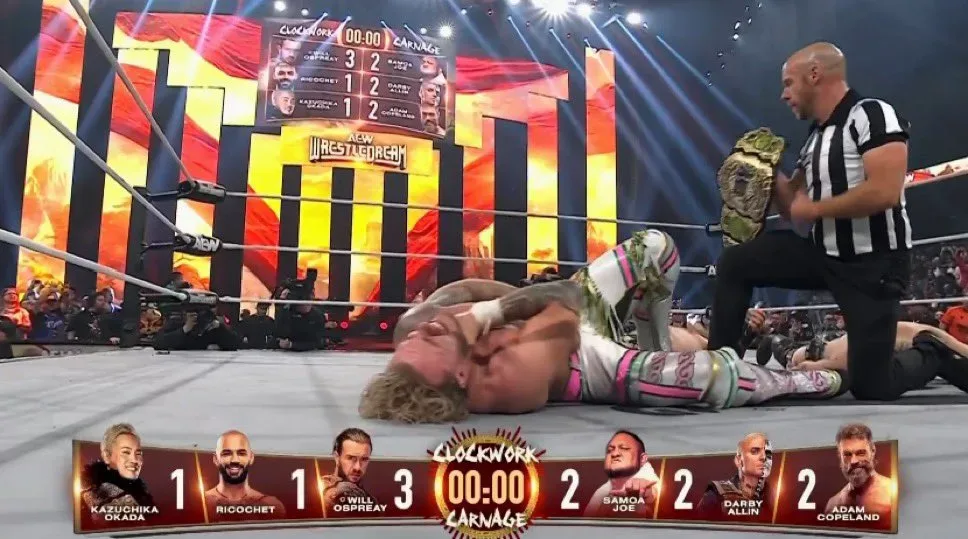
Will Ospreay has reflected on the creative gamble behind Clockwork Carnage following his successful AEW World Title defense at AEW WrestleDream.
Ospreay entered the event as champion and retained the title in the Clockwork Carnage match, a stipulation he had personally conceived. In comments shared after the show, Ospreay expressed gratitude to the audience, AEW, and company president Tony Khan for embracing an idea designed to offer something different from the promotion’s usual championship-match presentation.
The AEW World Champion described the reaction to the bout as meaningful and framed the experience as a personal point of pride. For Ospreay, the significance of WrestleDream went beyond leaving with the championship still in his possession. It was also about seeing an original concept reach a major stage and receive support from both the company and viewers.
View the referenced post on X
“Thank you all for watching #AEWWrestleDream & being part of Clockwork Carnage. The fact a company like @AEW & @TonyKhan put faith in trying something that’s not been done before. Grateful for all the reviews for it proud of myself for daring to try something new. All love guys”
For more background on this topic, read Exodus Pro Heat Of The Moment Results: EC3, Joshua Bishop and Team Cleveland Win Cleveland Cup.
Ospreay Takes Pride In A New Idea
Professional wrestling has long been driven by reinvention. New match concepts, unusual stipulations, and distinctive event structures can become central to a performer’s identity when they connect with an audience. At the same time, attempting something untested carries an obvious risk: a new idea has to work in real time, in front of a live crowd, while also serving the larger stakes of the match.
Ospreay’s message made clear that he understood that risk and welcomed it. Rather than simply viewing Clockwork Carnage as another title-defense stipulation, he presented it as a chance to challenge himself creatively. His reference to “daring to try something new” was especially notable because the concept was attached to the AEW World Championship, the company’s top prize.
That is a significant platform for any experimental match format. A world-title defense carries expectations regarding competition, drama, and consequence. By placing Clockwork Carnage in that setting, AEW gave Ospreay’s idea a prominent showcase at one of its major events. Ospreay, in turn, was entrusted with leading the match as champion and with demonstrating why the concept belonged on that level.
The result, from Ospreay’s perspective, was a success. He retained the AEW World Title and subsequently thanked fans for the feedback they had offered on the match. His remarks did not attempt to overstate the moment or lay out what might come next for the stipulation. Instead, they centered on appreciation for the people who watched and for the opportunity to put an original idea into practice.
AEW’s Willingness To Experiment
Ospreay specifically credited AEW and Tony Khan for placing faith in an approach that had not been done before. That acknowledgment speaks to the collaborative side of major-event wrestling presentation. Even when a wrestler supplies the initial concept, bringing a new match to television or pay-per-view requires the promotion’s confidence in the idea, as well as a willingness to make room for it within a championship program.
AEW has frequently positioned itself as a promotion open to variety in its match presentation. Its events have featured traditional singles contests, multi-person bouts, specialty matches, tournament encounters, and stipulation-driven rivalries. Clockwork Carnage added another concept to that broader environment, with Ospreay emphasizing that the defining feature was its novelty.
There is an important distinction between a wrestler simply being placed in an unusual stipulation and a wrestler actively advocating for a fresh format. Ospreay’s comments establish that he was the person behind the Clockwork Carnage idea. That gives the WrestleDream match an added layer in the context of his title reign: it was not only a defense of the championship, but also a direct expression of the champion’s willingness to bring his own creative instincts into a high-pressure setting.
For a performer with Ospreay’s reputation, innovation is a natural part of the discussion. He has built much of his standing through an athletic, fast-paced style and a readiness to pursue ambitious matches. Clockwork Carnage represented an extension of that mindset, though it was an expansion beyond the physical demands normally associated with his work. The focus was on constructing and presenting a distinct match experience rather than relying exclusively on the familiar rhythms of a title bout.
A Successful Defense At WrestleDream
Ultimately, the clearest outcome from AEW WrestleDream is that Ospreay remains AEW World Champion. Retaining the title ensured that the Clockwork Carnage experiment did not interrupt his reign. Instead, the match became part of the champion’s ongoing record, linking a successful defense with an effort to broaden what an AEW World Title match could look like.
Championship reigns are often remembered through a combination of opponents, results, major-event moments, and signature match types. Ospreay now has a WrestleDream defense associated with an original concept that he brought forward himself. Whether Clockwork Carnage returns in the future is not something Ospreay addressed, and there is no indication yet that it is intended to become a recurring fixture. Still, the match has already established a place in the story of this particular title defense.
His post-show comments also underscore the value he placed on the audience response. Ospreay thanked supporters for “being part of” Clockwork Carnage and said he was grateful for the reviews it received. That wording suggests he viewed the match as a shared event rather than solely a personal achievement. A new stipulation only fully comes alive once an audience sees it, reacts to it, and begins to form an opinion about it.
In wrestling, fan response can shape the future of nearly any presentation choice. A successful one-off can become a memorable special attraction; another concept may remain tied to the circumstances that made it work the first time. Ospreay did not make any promises about repeat appearances or future revisions to Clockwork Carnage. His immediate focus was on recognizing the support the idea received at WrestleDream.
Creative Risk And Championship Responsibility
Ospreay’s reflection carries a wider message about the balance between creative risk and championship responsibility. Being a world champion places a wrestler under intense scrutiny. Each defense is evaluated not only as a match, but as a representation of the title and the company. Choosing to introduce a new stipulation in that position can invite more attention than a conventional contest would receive.
That attention did not deter Ospreay. His comments make clear that he considers the willingness to attempt something unfamiliar worth celebrating. In an industry that often draws strength from tradition, there is also a lasting need for performers and promotions willing to explore new possibilities. Ospreay’s pride was rooted in that willingness to step outside of established expectations.
AEW WrestleDream therefore gave Ospreay two reasons to look back on the night positively. He left as AEW World Champion, preserving his standing at the top of the promotion. And he saw Clockwork Carnage, an idea of his own, receive the company backing necessary to become a reality on a major show.
For now, Ospreay’s message is one of appreciation rather than prediction. He thanked AEW, Tony Khan, and the fans who watched, while acknowledging the reviews and discussion generated by the match. Most of all, he made clear that he is proud of taking the chance. At WrestleDream, Will Ospreay did not merely defend the AEW World Title; he used the occasion to test a new idea under the brightest possible spotlight and emerged still holding the championship.

Darryl Polo
Darryl Polo is a passionate wrestling fan covering WWE, AEW, TNA and beyond. He loves great rivalries, breakout stars and the moments that keep fans talking long after the bell. How we work.