
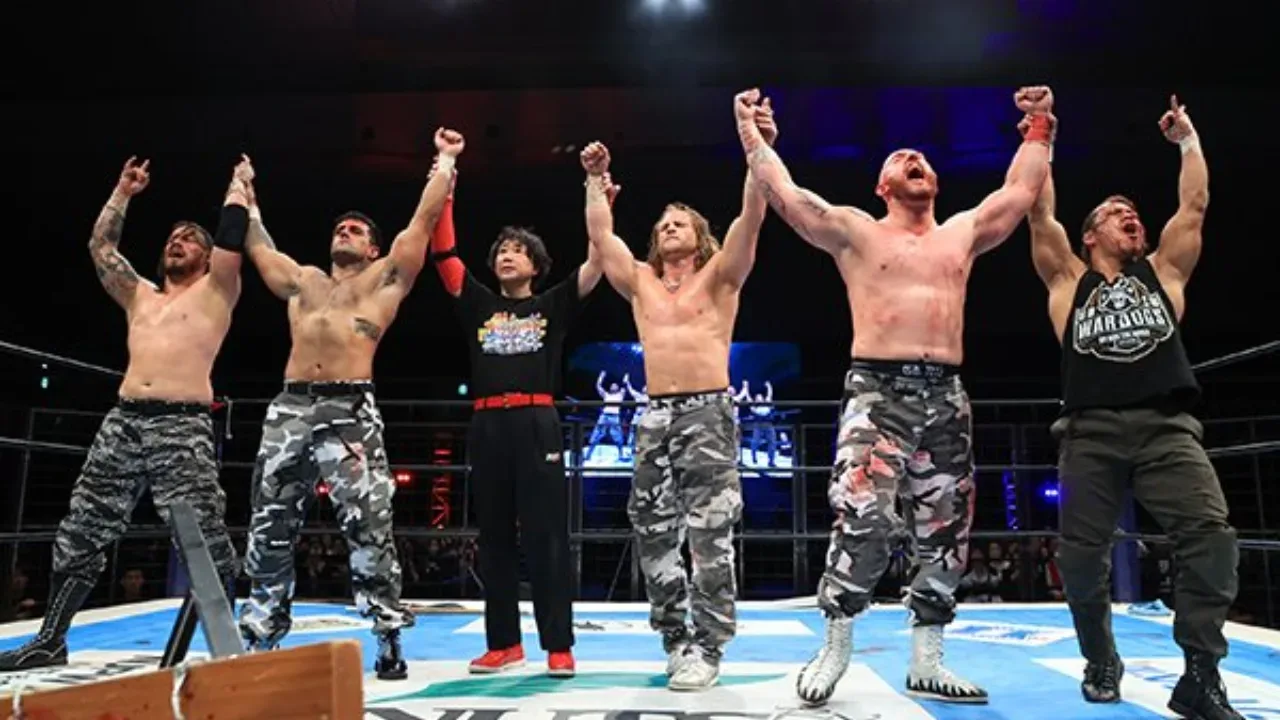
David Finlay has detailed the creative turning point that led to the formation of the War Dogs, explaining that the group emerged after New Japan Pro-Wrestling declined his initial desire to bring BULLET CLUB to an end.
Finlay became the leader of BULLET CLUB before spearheading the version of the unit that became known as BULLET CLUB War Dogs. That offshoot developed a distinct identity around Finlay and several wrestlers connected to the L.A. Dojo system, including Gabe Kidd, Clark Connors, Alex Coughlin and Drilla Moloney. While the group’s presentation evolved over time, Finlay says its beginnings came from a straightforward disagreement over the future of one of NJPW’s most recognizable faction names.
Speaking on Talk Is Jericho, Finlay said he wanted to close the book on BULLET CLUB soon after assuming its leadership role. NJPW, however, did not approve that direction because of the value attached to the brand. The eventual answer was not a full replacement, but a new branch operating beneath the BULLET CLUB banner.
“I became the BULLET CLUB leader and then I immediately wanted to kill it but they were like, ‘No! It makes money.’ So the compromise was we’d form BULLET CLUB War Dogs which is where The Dogs come from. So it was me and a bunch of the L.A. Dojo guys that weren’t getting used. So I was the leader and then it was Gabe Kidd, Alex Coughlin, who had to retire for medical reasons, Clark Connors and Drilla Moloney. We were like the core of that group and then as time went on, it expanded as groups do. Those are my boys and it’s cool that me, Gabe and Clark can kind of tweak the act but transplant the act into another company. There’s this sense of pride that comes with that.”
For more background on this topic, read Gedo Set For Rare In-Ring Appearance At wXw’s November 7 Hamburg Event.
Finlay’s comments put the War Dogs’ origin in a different light. Rather than beginning as an attempt to simply add another layer to BULLET CLUB, the concept was born out of his desire to move on from the name entirely. NJPW’s decision preserved BULLET CLUB, while the War Dogs designation gave Finlay and his group room to establish their own tone and chemistry inside an existing framework.
A compromise that created a separate identity
Faction names in professional wrestling can carry years of history, audience recognition and commercial importance. Finlay’s description of the discussion makes clear that NJPW did not want to discard BULLET CLUB outright. The compromise allowed the promotion to retain that established identity while also giving Finlay an opportunity to lead something more specifically shaped around the wrestlers he envisioned at its center.
That distinction matters because Finlay did not describe the War Dogs as a randomly assembled collection of members. He identified a core group: himself, Kidd, Coughlin, Connors and Moloney. The common thread was the L.A. Dojo connection, as Finlay said the group was built with talent that had not been getting used.
For Finlay, the War Dogs were therefore a vehicle to put those performers into a more prominent collective role. The act could expand as factions often do, but the original identity came from that core. His recollection emphasizes that the group’s early direction was tied to relationships and shared background as much as it was to a label attached to BULLET CLUB.
Coughlin’s place in Finlay’s account is also notable. Finlay specifically mentioned that Coughlin had to retire for medical reasons, placing him among the wrestlers he regards as part of the group’s foundational lineup. Though the group changed over time, Finlay’s comments reinforce the importance of those original members to the War Dogs’ creation.
From NJPW’s War Dogs to The Dogs in AEW
The War Dogs name and BULLET CLUB affiliation no longer exist as factions in NJPW. But Finlay, Kidd and Connors now represent The Dogs under the AEW banner, giving the central surviving members of that original group an opportunity to continue the act in a new environment.
Finlay framed that transition as more than carrying a name from one company to another. He said he, Kidd and Connors can “tweak the act” while transplanting it into AEW. The wording suggests an effort to preserve the elements that made the group meaningful to its key members while adapting to a different promotion and a different stage of their careers.
The shift also separates the current group from the circumstances of its formation. In NJPW, War Dogs began as a compromise attached to BULLET CLUB after Finlay’s proposal to end the larger faction was rejected. In AEW, The Dogs stand as their own act, without BULLET CLUB or War Dogs existing as active NJPW factions.
That makes the present version especially personal for Finlay, Kidd and Connors. The group is rooted in an idea that was shaped by institutional limits, then built through the contributions of performers from the L.A. Dojo orbit. Now, three of its central figures have the chance to reinterpret that identity in AEW.
Finlay’s pride in the group’s evolution
Finlay’s remarks were not centered on frustration over the original creative decision. Instead, he focused on pride in the outcome. Even though he initially wanted BULLET CLUB finished, the compromise eventually produced a group he clearly considers important to his career and to the careers of the wrestlers around him.
His description of Kidd, Connors, Coughlin and Moloney as the core carries a sense of ownership and loyalty. Finlay did not portray the group as an interchangeable faction concept. He described it as something built alongside “my boys,” with the shared history of its members remaining central even as the act changed and moved between promotions.
That perspective helps explain why maintaining some version of the group in AEW carries significance. Finlay is not presenting The Dogs solely as a continuation of a branding exercise. In his account, it is a continuation of a bond forged among wrestlers who were brought together under a specific set of circumstances and then developed a collective presence over time.
It also underscores how quickly creative plans can change in wrestling. Finlay’s original goal was to end BULLET CLUB after becoming its leader. NJPW’s response redirected that plan. Yet the alternative produced BULLET CLUB War Dogs, and that unit’s legacy is now being carried forward by Finlay, Kidd and Connors as The Dogs.
The lasting impact of an unintended beginning
There is an irony in Finlay’s story: a group that became so personally meaningful to him began because his preferred idea was not approved. The rejection of a BULLET CLUB ending did not stop him from searching for a new direction. It resulted in a compromise that created space for a more defined unit built around people he trusted.
Finlay’s account also places the L.A. Dojo-linked foundation at the heart of the War Dogs’ history. While the group expanded beyond its earliest lineup, he pointed back to the original cluster of Finlay, Kidd, Coughlin, Connors and Moloney as the wrestlers who established the act’s core identity.
With BULLET CLUB and War Dogs no longer existing as NJPW factions, the story has entered another phase. The Dogs’ presence in AEW gives Finlay, Kidd and Connors a chance to retain that connection while changing the presentation for a new setting. For Finlay, the ability to do that appears to be a source of considerable satisfaction.
What began as a compromise over BULLET CLUB’s future became a foundation for a group that has outlasted its original NJPW structure. Finlay’s comments make clear that, for the wrestlers still carrying it forward, The Dogs represent more than the result of a rejected pitch. They represent a shared history, a core group of allies and an identity they are continuing to shape together.

Darryl Polo
Darryl Polo is a passionate wrestling fan covering WWE, AEW, TNA and beyond. He loves great rivalries, breakout stars and the moments that keep fans talking long after the bell. How we work.